Spanish AR, ER, IR Regular Verbs – Activities Pack
- Grades
- Grades 7–10, High School, Middle School
- File type
- Preparation
- Print ready


- Subject
- Foreign Languages, Spanish
- Topic
- regular verbs, Spanish verbs practice
- Resource types
- Activities
- Preparation
- Print ready
About this resource
What's inside this resource
Spanish: AR ER IR Regular Verbs Activities
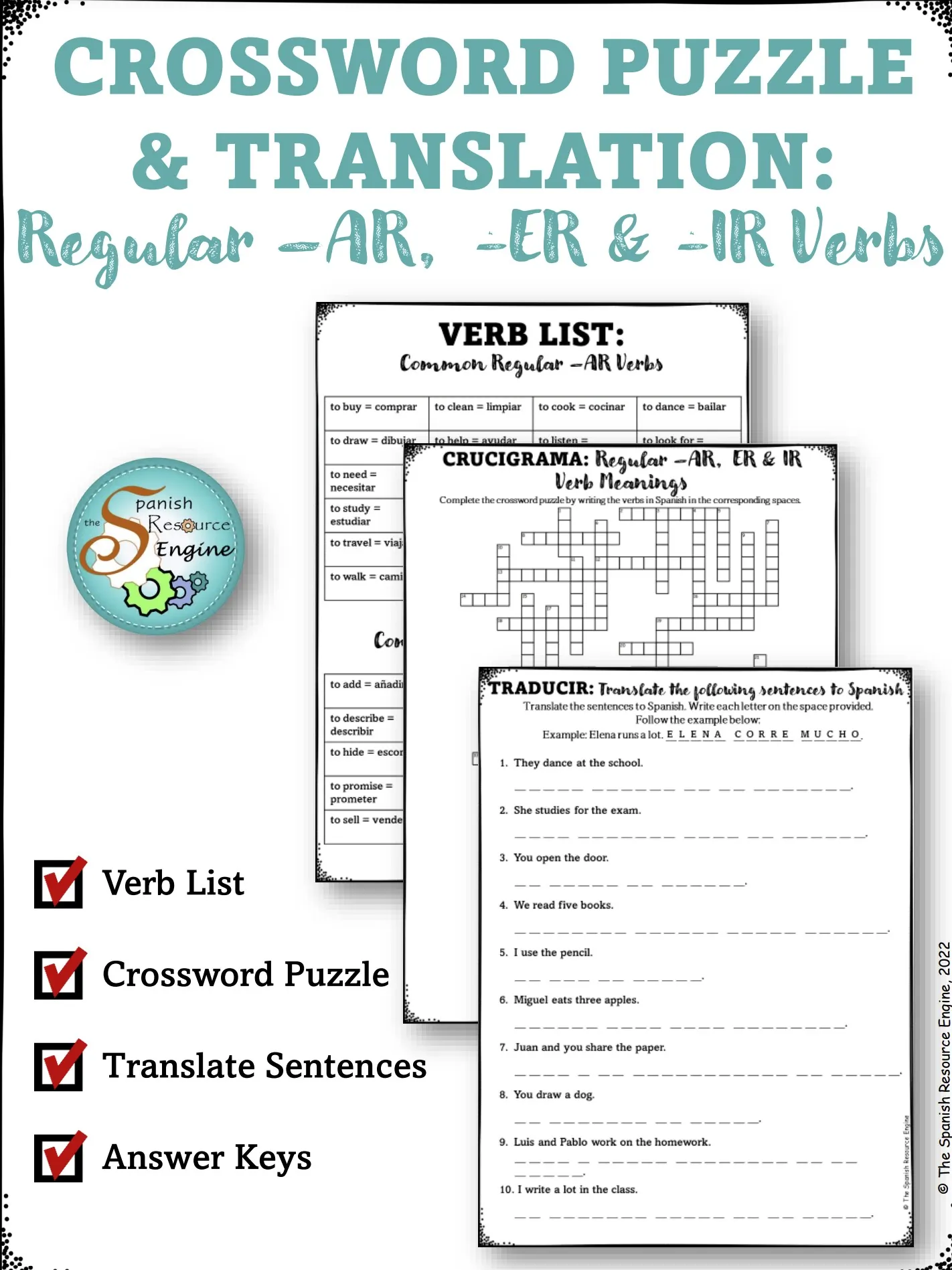
Introducing a Spanish teaching resource tailored specifically for educators who want to enhance their students' understanding of regular AR, ER, and IR verbs. This tool is perfect for both traditional classroom teachers and homeschooling parents.
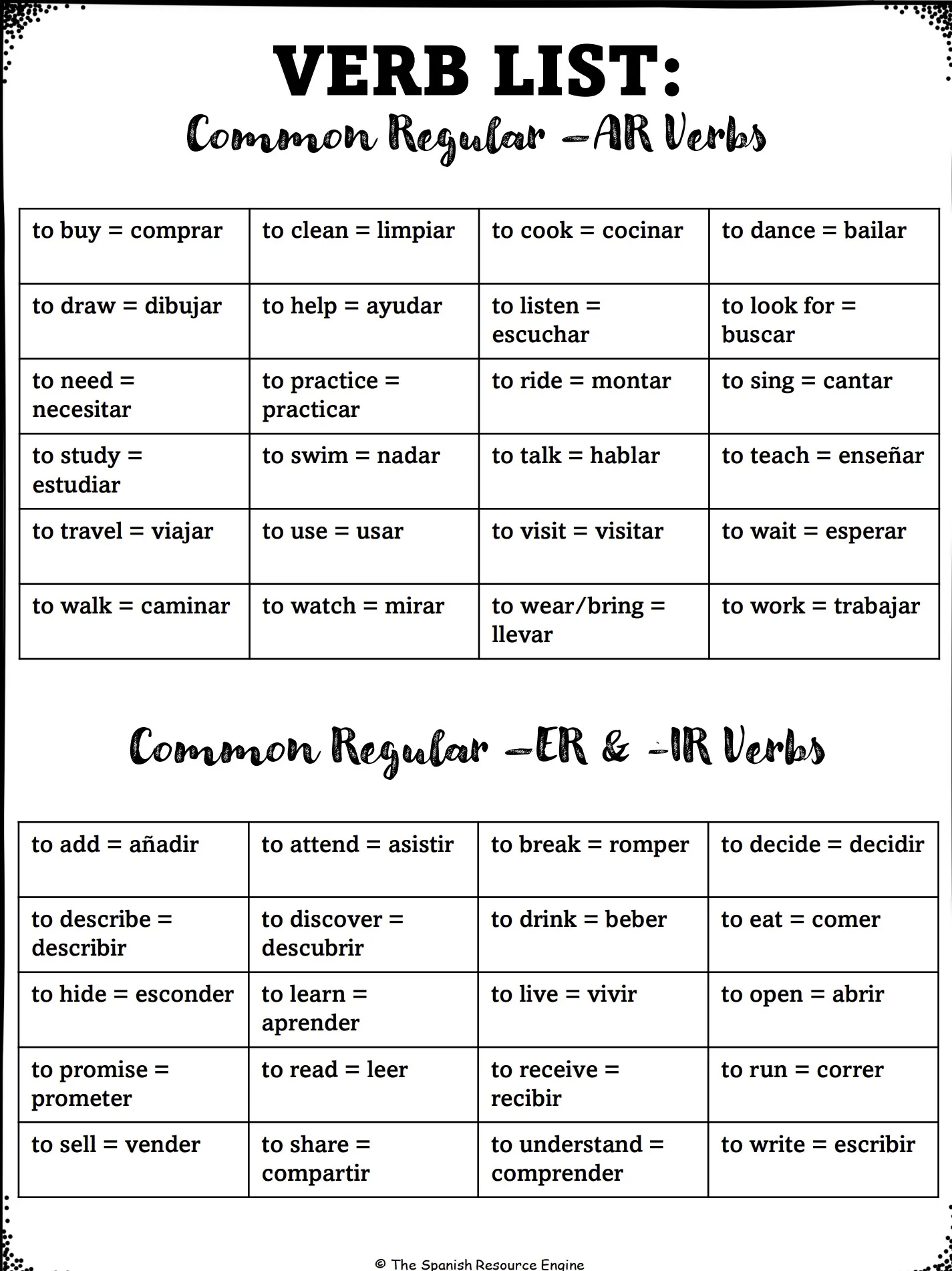
Within this resource, you'll find 7 well-organized pages which include a handpicked set of AR, ER, and IR verbs. Each verb is paired with its English translation, making it easy for students to grasp their meanings and applications. The presentation is clear and simple, aligning perfectly with a grade 7-8 reading level, ensuring that the content is both accessible and challenging for students in that age group.
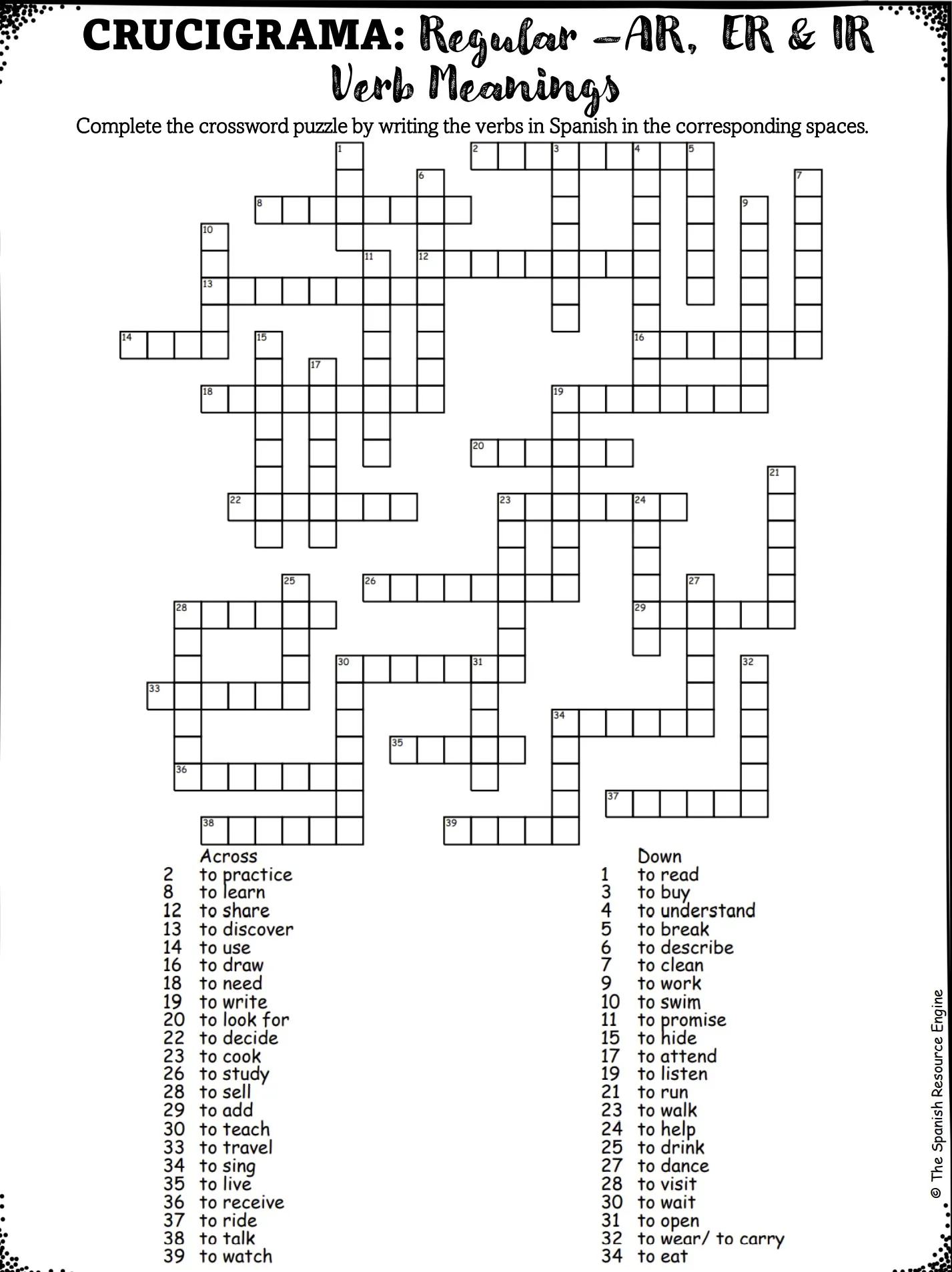
But that's not all. To cement understanding and promote practice, two engaging activities have been incorporated. There's a crossword puzzle that'll challenge students to recall and use the verbs they've just learned. Following this, there's also a translation activity which allows learners to apply their newfound knowledge in a practical context. These exercises not only test comprehension but also make the learning process more interactive and enjoyable.
For educators' convenience, answer keys for both the crossword and translation activity are provided. This means that checking or going over answers with the class becomes a seamless process.
In essence, this resource offers a comprehensive approach to teaching regular AR, ER, and IR verbs in Spanish. It's not just about rote memorization – it's about understanding, application, and genuine linguistic development. Whether you're introducing these verbs for the first time or looking for a fresh way to review them, this tool promises to be a valuable addition to your teaching materials.
Related resources
More resources teachers may find useful
24 related resources were found using this product's title, contributor, categories and tags.



In the classroom
Teaching tips & learning objectives

Learning objectives
Give the Spanish infinitive for common regular verbs from their English meanings (to dance = bailar, to read = leer, to share = compartir)
Separate regular -AR verbs from regular -ER and -IR verbs using the grouped verb list
Form present-tense endings for a range of subjects — ellos bailan, ella estudia, tú abres, nosotros leemos, yo uso

Teaching tips
Give out the verb-list page first and keep it visible: both the crucigrama and the translation exercise draw on the same 44 verbs.
Because the crossword prompts are English meanings and the answers are Spanish infinitives, it works as a vocabulary check before conjugation is formally introduced.
Walk through the printed model — Elena runs a lot / ELENA CORRE MUCHO — before students start, since each blank holds exactly one letter and the number of blanks signals the length of the Spanish sentence.

Skills covered
Spanish verb vocabulary recall — students supply infinitives such as comprar, dibujar, esconder and escribir from the English meanings on the reference list.
Present-tense conjugation of regular verbs — the translation sentences require forms including bailan, estudia, abres, leemos, come and comparten.
Crossword problem solving — students fit Spanish verbs into the numbered crucigrama spaces that correspond to each English meaning.
Good to know
Questions teachers ask about this resource
Are the crossword prompts written in English or in Spanish?
The prompts are English meanings and the solutions are written in Spanish — the printed direction reads "Complete the crossword puzzle by writing the verbs in Spanish in the corresponding spaces."
Do the translation sentences stay with one subject pronoun, or do they vary?
They vary deliberately. The ten sentences run through ellos, ella, tú, nosotros and yo plus compound subjects such as "Juan and you" and "Luis and Pablo", so a different present-tense ending is needed almost every time.
How are students meant to write out each translation?
One letter per blank. Every English sentence is followed by a row of short underscores matching the letters of the Spanish sentence, and the worked example Elena runs a lot / ELENA CORRE MUCHO shows the convention including the final period.

No reviews yet
Downloaded this resource? Tell other teachers how it went.
Resource details
Concepts & topics
Core concepts
 Core concepts
Regular -AR verbs
Regular -ER and -IR verbs
Present-tense conjugation
Spanish-English translation
Verb vocabulary
 Topics
Explore more
Categories this resource belongs to
Explore related searches
More to explore
You may also like