Volume and Surface Area Worksheet - Doghouse Math



- Grades
- Grade 6, Middle School
- Pages
- 6
- File type
- Answer key
- Included


- Subject
- Math, Geometry, Measurements, Common Core
- Topic
- Surface Area, Volume
- Resource types
- Worksheets & Printables, Worksheets, Word Problems
- Answer key
- Included
Product description
From the author
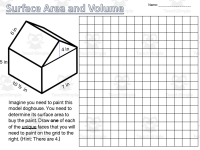
Here's a fun and engaging lesson that helps students apply the geometry skills they are learning in the classroom to a real world mathematical situation: painting a doghouse.
It is designed to address the Common Core State Standards 6.G.A.2 and 6.G.A.4: Finding volume and surface area and drawing nets.
Students will:
Determine how many faces there are on a compound three dimensional shape (including a rectangular prism & a triangular prism).
Sketch the faces/create a net on the grid provided (one face includes a fractional length of ½ inch).
Use a table to help calculate the surface area of all of the faces.
Calculate the volume of this compound shape using a table to organize the information.
Answer the provided discussion questions. These are provided to get students thinking about the concepts of geometry and include the questions:
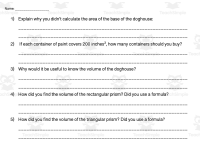
Explain why you didn’t calculate the area of the base of the doghouse.
If each container of paint covers 200 inches², how many containers should you buy?
Why would it be useful to know the volume of the doghouse?
Students are also asked about the formulae for volume of a rectangular prism and triangular prism.
Grades to Use With: This lesson is designed to target Common Core State Standards for 6th grade geometry. It could also be used for enrichment in 5th grade, review in 7th or 8th grades, or in a high school special education classroom.
What's Included:
6 Page PDF
Title Page
Grid for Drawing Nets
Extra Grid Paper
Tables for Calculating Surface Area and Volume
Discussion Questions
Complete Answer Key
If you enjoy this geometry activity, check out others in my store:
Geometry Project: Park Design: Area, Perimeter, and Volume with Budgeting
Middle School Math Stations or Centers: Triangles, Angles, Area
Middle School Math Stations or Centers: Area, Perimeter, and Volume
Relationship Between Area and Perimeter: Math Inquiry Prompt
Related resources
More resources teachers may find useful
24 related resources were found using this product's title, contributor, categories and tags.


In the classroom
Teaching tips & learning objectives

Learning objectives
Students calculate the surface area of a compound 3-D shape by finding and summing the area of each unique face.
Students calculate the volume of a rectangular prism and a triangular prism that together form one compound shape.
Students apply a surface-area calculation to a real-world purchasing decision (how many containers of paint to buy).

Teaching tips
Sketch the four unique face shapes on the grid before completing the area table.
The doghouse length is 10½ inches, not ½ inch. Use that full length for the side and roof rectangles and for both prism volumes.
The supplied key totals 329 square inches to paint and 514.5 cubic inches of volume. At 200 square inches per container, two containers are needed.

Skills covered
Surface area of compound 3-D shapes — students find and sum the area of each unique face of a combined rectangular-and-triangular prism.
Volume of rectangular and triangular prisms — students calculate and total the volume of each prism section separately.
Real-world measurement application — students convert a calculated surface area into a paint-container purchasing decision using a given coverage rate.

No reviews yet
Downloaded this resource? Tell other teachers how it went.
Curriculum
Standards, concepts & topics
Standards
 Standards
- 6.G.A.4 — Represent three-dimensional figures using nets made up of rectangles and triangles, and use the nets to find the surface area of these figures. Apply these techniques in the context of solving real-world and mathematical problems.
- 6.G.A.2 — Find the volume of a right rectangular prism with fractional edge lengths by packing it with unit cubes of the appropriate unit fraction edge lengths, and show that the volume is the same as would be found by multiplying the edge lengths of the prism. Apply the formulas V = l w h and V = b h to find volumes of right rectangular prisms with fractional edge lengths in the context of solving real-world and mathematical problems.
Core concepts
 Core concepts
Surface area
Volume
Rectangular prism
Triangular prism
Topics
 Topics
Explore more
Categories this resource belongs to
Explore related searches
More to explore
You may also like