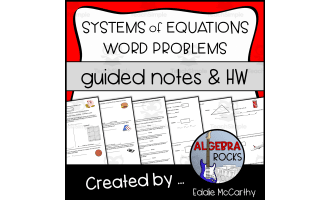
System of Equations Word Problems Worksheet


- Grades
- Grades 8–10, Middle School, High School
- Pages
- 7
- File type
- Answer key
- Included


- Subject
- Math, Algebra
- Topic
- systems of equations, algebra
- Resource types
- Worksheets & Printables, Word Problems, Worksheets
- Answer key
- Included
- Standards
- 8.EE.C.8 HSA-REI.C.6
About this resource
What's inside this resource
Algebra 1 students practice solving systems of linear equations by substitution, starting with stories and ending with a word problem they write themselves. Page 1 defines a system and works one example from start to finish: a smoothie stand sells $3 and $5 sizes, 40 drinks and $168 in sales. A five-step table shows how to name the unknowns, write two equations, isolate one letter, substitute and solve, then find the other value and check it.
The 14 tasks are grouped into six parts. Students first turn two stories into systems without solving, then substitute into three systems where one letter is already alone, including one with a negative answer. Next they decide which letter to isolate and explain why, and test whether a classmate's proposed solution works in both equations. Five word problems follow: aquarium tickets, bicycles and tricycles counted by wheels, a jar of dimes and quarters, two gym plans that reach the same cost, and a garden fence perimeter. The set closes with an error-analysis task and a prompt to write a story that fits a given system.
- Grades 8–9: Algebra 1, solving systems by substitution
- Seven pages: ruled work boxes on every student page and an answer key that shows each step
- Print options: a full-color copy or a grayscale copy
Related resources
More resources teachers may find useful
24 related resources were found using this product's title, contributor, categories and tags.


In the classroom
Teaching tips & learning objectives

Learning objectives
Define variables and write a system of two linear equations from a word problem.
Solve a system by substituting an equivalent expression for one variable.
Choose the most efficient variable to isolate and justify the choice.

Teaching tips
Walk through the smoothie example row by row before Part 1; each Part 1 blank matches a step in the table.
Watch tasks 4, 5 and 13, where students often multiply only the first term inside the parentheses; the key lists this as a slip to watch for.
For the coin jar problem, point students to the printed tip to work in cents.

Skills covered
Modeling with equations: students name two unknowns and write one equation for each fact in a story, such as items sold and dollars collected.
Substitution: students replace one variable with its equal expression and solve the resulting one-variable equation.
Strategic thinking: one task asks which letter is easiest to isolate, such as a variable with a coefficient of 1, and why.
Good to know
Questions teachers ask about this resource
Does this worksheet use only the substitution method?
Yes. Every task is solved by substitution. The answer key accepts any letters and either unknown isolated first, as long as each step is valid.
Are there worked examples?
Page 1 has one complete example, The Smoothie Stand, broken into five steps from naming the unknowns to checking the answer.
What kinds of word problems are included?
Tickets for a field trip, bicycles and tricycles counted by wheels, dimes and quarters, two gym memberships with different fees, and the length and width of a fenced garden.
Does the answer key show the work?
Yes. It shows each substitution step and a check for every solved task, plus a note on common slips such as sign errors.

No reviews yet
Downloaded this resource? Tell other teachers how it went.
Curriculum
Standards, concepts & topics
Standards
 Standards
- 8.EE.C.8 — Analyze and solve pairs of simultaneous linear equations. a. Understand that solutions to a system of two linear equations in two variables correspond to points of intersection of their graphs, because points of intersection satisfy both equations simultaneously. b. Solve systems of two linear equations in two variables algebraically, and estimate solutions by graphing the equations. Solve simple cases by inspection. For example, 3x + 2y = 5 and 3x + 2y = 6 have no solution because 3x + 2y cannot simultaneously be 5 and 6. c. Solve real-world and mathematical problems leading to two linear equations in two variables. For example, given coordinates for two pairs of points, determine whether the line through the first pair of points intersects the line through the second pair.
- HSA-REI.C.6 — Solve systems of linear equations exactly and approximately (e.g., with graphs), focusing on pairs of linear equations in two variables.
Core concepts
 Core concepts
systems of equations
substitution method
linear equations
word problems
distributive property
Algebra 1
 Topics
Explore more
Categories this resource belongs to
Explore related searches
More to explore
You may also like