"The Tell-Tale Heart" Booklet Project


- Grades
- Grades 9–12
- Pages
- 7
- File type
- Preparation
- Print ready


- Subject
- ELA, Literature, Writing
- Topic
- The Tell-Tale Heart, Edgar Allan Poe
- Resource types
- Projects
- Preparation
- Print ready
- Standards
- CCSS.RL.9.2 CCSS.W.9.9
Product description
From the author
If your students are reading The Tell-Tale Heart, you may be on the hunt for all the resources to pair alongside this renowned short story.
This resource is a The Tell-Tale Heart Booklet Project that was designed to give your students the opportunity to reflect on the text and show what they know.
For the teacher: Print the booklet pages back to back. The pages should be cut on the dotted lines and around the tabs. Put the pages in order and staple. It would be best to staple in one corner or at the top of the booklet. Stapling on the sides will cut off part of the project. Once the book is properly assembled, students will be able to work from page to page.
The pages are as follows:
1. The Narrator. Students will illustrate and write a reflection on what they envision the narrator to look like. Students will describe whether the narrator is reliable or unreliable and use evidence to support their answer.
2. Mini-Essays. There are 3 short writing prompts for students to respond to.
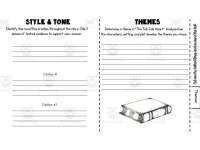
3. Style & Tone. Students will identify the mood Poe creates in the story and cite 2 pieces of textual evidence.
4. Theme. Students will determine a theme and reflect on how it is developed in the story.
5. Style & Tone. Students will reflect on the words Poe used to describe a certain event in the story.
6. Themes. Students will read The Black Cat by Edgar Allan Poe and compare and contrast the two stories.
7. Symbols and relationships. Students explore symbols and their connections.
This resource was designed for 9th grade students and higher. This is great for independent work, but students may also enjoy discussing pages with a partner before formulating their individual answers.
An answer key is not included, as most pages are reflective writing pieces.
Related resources
More resources teachers may find useful
24 related resources were found using this product's title, contributor, categories and tags.



In the classroom
Teaching tips & learning objectives

Learning objectives
Evaluate the reliability of the narrator using two pieces of textual evidence.
Identify a theme in 'The Tell-Tale Heart' and explain how character, setting, and plot develop it.
Compare the narration of 'The Tell-Tale Heart' to Poe's 'The Black Cat.'

Teaching tips
Model how to support an interpretation with a quotation from the story.
Read The Black Cat before assigning the comparison task.
Select the sections that fit the lesson; one strengths-and-weaknesses box carries an unrelated character label.

Skills covered
Narrator reliability analysis — students cite two pieces of textual evidence to argue whether the narrator is telling the truth.
Tone and mood analysis — students identify Poe's word choices and explain the mood those choices create.
Cross-text comparison — students compare the narration styles of 'The Tell-Tale Heart' and 'The Black Cat.'
Good to know
Questions teachers ask about this resource
Which stories are needed?
The project focuses on The Tell-Tale Heart and includes a comparison task using The Black Cat.
How is the booklet assembled?
The directions call for back-to-back printing, cutting around the tabs and stapling at the top or a corner.

No reviews yet
Downloaded this resource? Tell other teachers how it went.
Curriculum
Standards, concepts & topics
Standards
 Standards
- CCSS.RL.9.2 — Determine a theme or central idea of a text and analyze in detail its development over the course of the text, including how it emerges and is shaped and refined by specific details; provide an objective summary of the text.
- CCSS.W.9.9 — Draw evidence from literary or informational texts to support analysis, reflection, and research. a. Apply grades 9–10 Reading standards to literature (e.g., “Analyze how an author draws on and transforms source material in a specific work [e.g., how Shakespeare treats a theme or topic from Ovid or the Bible or how a later author draws on a play by Shakespeare]”). b. Apply grades 9–10 Reading standards to literary nonfiction (e.g., “Delineate and evaluate the argument and specific claims in a text, assessing whether the reasoning is valid and the evidence is relevant and sufficient; identify false statements and fallacious reasoning”).
Core concepts
 Core concepts
Narrator reliability
Theme
Symbolism
Literary comparison
 Topics
Explore related searches
More to explore
You may also like