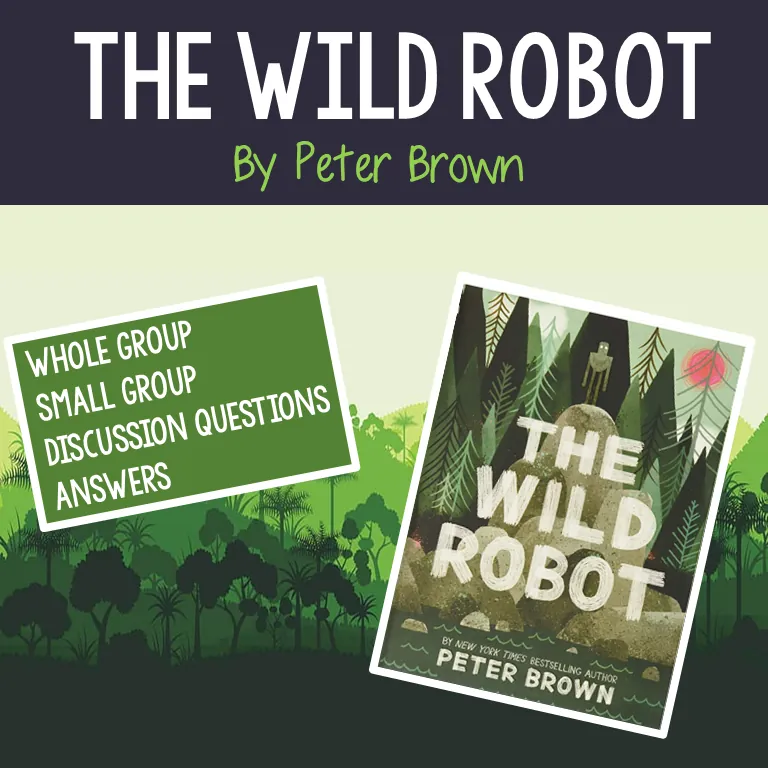
The Wild Robot Book 1 by Peter Brown Discussion Questions
- Grades
- Grades 2–7, Elementary, Middle School
- File type
- Microsoft Word


- Subject
- ELA
- Topic
- peter brown, the wild robot
- Resource types
- Worksheets & Printables, Novel Studies
About this resource
What's inside this resource
his is a complete page guide that can be used in small groups or as a whole group.
It includes thoughtful questions to help students better understand and enjoy what they read, and to help you check for their comprehension. The guide is broken into sections and includes chapters so it is easy to follow and helpful when creating student's reading assignments. This is a Microsoft doc. and is a great resource for both traditional written responses and digital reader's notebooks.
It includes:
-Chapter assignments
-Thoughtful comprehension questions (character analysis, prediction, drawing conclusions, inferring, etc.)
-Answers
-Key Terms/ Vocabulary
Related resources
More resources teachers may find useful
24 related resources were found using this product's title, contributor, categories and tags.


In the classroom
Teaching tips & learning objectives

Learning objectives
Answer text-dependent questions chapter by chapter, citing details such as the crab whose climbing Roz copies (Ch. 6) or the favour Mr. Beaver owes the goose (Ch. 29)
Draw inferences about why characters change — the fox's new interest in Roz (Ch. 23), Brightbill's temper after being refused permission to fly (Ch. 44)
Work out unfamiliar words from surrounding context, including sweltering, nimble, trudging and grappled

Teaching tips
Students need their own copies of The Wild Robot alongside the questions — several prompts send them to particular novel pages, including 111, 119, 121, 152, 182, 185 and 249.
The suggested responses share the page with their questions, so strip or hide them before the document goes to students.
Chapters 3, 11, 14, 17, 19, 22, 24 and 34 carry no question, so plan a reading-log entry or free response for those if the class reads straight through.

Skills covered
Citing textual evidence — students answer prompts such as "Use the text to explain how Roz cares for herself" (Ch. 7) and "How does the story end, use text evidence to support your thinking" (Chs. 77–80).
Inferring character motive and change — students account for the fox's shift toward Roz in Ch. 23, the goose's advice to act like a mother in Ch. 28, and Brightbill's moodiness in Chs. 43–44.
Context-clue vocabulary — students define melted, celestial, sweltering, nimble, trudging and grappled from the sentences around them on novel pages 119, 121, 152, 182 and 249.
Good to know
Questions teachers ask about this resource
What do students need in hand to work through these questions?
Their own copies of The Wild Robot. The prompts are keyed to chapters and, in several places, to particular novel pages — 111, 119, 121, 152, 182, 185 and 249 — so the questions are written to sit alongside the book rather than to stand in for it.
Which chapters of the novel do the prompts cover?
Chapter 1 through Chapter 80, with the shorter late chapters grouped into blocks — Chs. 61 & 62, 65–69, 70–72 and 77–80 each carry several questions together. Eight chapters are passed over: 3, 11, 14, 17, 19, 22, 24 and 34.
What do the prompts marked "Discuss student responses" expect?
They flag the open items where no single response is right: defining "survival instincts" in Ch. 5, the annotate-and-illustrate task in Ch. 57, retelling Brightbill's migration in Ch. 63, listing how the animals helped Roz in Ch. 76, and the closing prediction about the next book.

No reviews yet
Downloaded this resource? Tell other teachers how it went.
Resource details
Concepts & topics
Core concepts
 Core concepts
Novel study
Reading comprehension
Inference
Context clues
Character analysis
 Topics
Explore more
Categories this resource belongs to
Explore related searches
More to explore
You may also like