Too Big to Fail (2011): Complete Movie Guide



- Grades
- Grades 10–12
- Pages
- 4
- File type
- Answer key
- Included


- Subject
- Social Studies, Economics
- Topic
- Too Big to Fail, Financial crisis
- Answer key
- Included
Product description
From the author
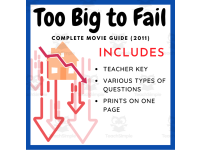
Follow the 2011 film Too Big to Fail with twenty chronological questions about the figures, institutions and events shown. Short answers and quotation completions support attentive viewing.
The four-page PDF contains two student pages and two completed key pages, including a Great Recession statistics infographic. Supply the film separately and preview it for your class.
Related resources
More resources teachers may find useful
22 related resources were found using this product's title, contributor, categories and tags.


In the classroom
Teaching tips & learning objectives

Learning objectives
Identify the key public and private figures involved in the 2008 financial crisis by their role, such as the Treasury Secretary or the CEO of AIG.
Complete direct quotations from the film, such as Ben Bernanke's remarks on credit, to reinforce close listening to primary dialogue.
Sequence the major events of the crisis in chronological order, from early housing-market warnings through the passage of TARP.

Teaching tips
Remind students the questions are numbered in chronological order, since the worksheet's own instructions note this — it can help students track their place in a long film.
Preview key names before viewing, such as Henry Paulson, Timothy Geithner, and Ben Bernanke, since several questions ask students to identify who said or did something by role rather than by name alone.
Use the completed answer key to run a quick post-viewing discussion on quotation-completion items such as questions 15 and 18, since those require closer listening than the identification questions.

Skills covered
Informational listening — students extract specific facts (names, roles, figures) from an extended video source.
Close-listening quotation completion — students fill in exact missing words from direct quotations spoken in the film.
Chronological sequencing — students track a complex sequence of financial and political events in the order they occurred.
Good to know
Questions teachers ask about this resource
Are the questions mostly asking for names, or do any require a fuller written answer?
Mostly names and short fill-in phrases, but several items ask students to complete quotations, which take closer listening than the identification questions.
Does the guide explain who each real-world figure is, or does the film alone provide that context?
The film alone — the worksheet only asks students to identify a person by role, such as 'the CEO of AIG,' after watching, without providing background information on any individual itself.

No reviews yet
Downloaded this resource? Tell other teachers how it went.
Resource details
Concepts & topics
Core concepts
 Core concepts
2008 Financial crisis
TARP
Bank bailouts
Lehman Brothers collapse
Credit and the economy
 Topics
Explore more
Categories this resource belongs to
Explore related searches
More to explore
You may also like