Nets Of 3d Shapes Worksheet PDF


- Year groups
- Years 6–9 (Key Stages 2–3)
- Pages
- 2
- File type
- Answer key
- Included


- Subject
- Geometry, Maths
- Topic
- 3D Shapes, Geometry Worksheet
- Resource types
- Diagrams, Graphic Organizers, Worksheets & Printables
- Answer key
- Included
From the author
About this resource
3D Shape Nets Identification Worksheet
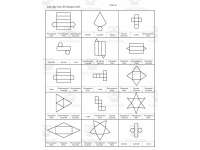
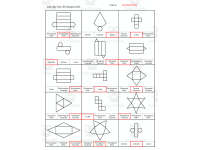
Learning about 3D shapes doesn’t have to be complicated. This activity makes it easy for students to understand how 2D nets fold to form familiar 3D solids such as prisms, pyramids, cones, and cylinders. The worksheet is neatly organised, showing each net alongside three possible shape names for students to choose from. It’s a simple and visual way to help learners make connections between flat shapes and the solids they create.
This resource is ideal for lessons on 3D geometry, shape nets, and solid figures. It’s especially helpful for visual learners who benefit from seeing geometric relationships illustrated clearly, and it makes a great addition to maths centres, small-group work, or independent review activities. Using this worksheet helps students build confidence in recognising and naming 3D shapes while developing stronger spatial reasoning and geometry vocabulary.
Teachers will appreciate that it’s ready to print and use right away. The file comes as a two-page PDF, one page for student practice and one page with the answer key for quick checking. It works best for Years 6–9, but it can also be used as a review tool for older students who need extra support. Whether you project it for class discussion or print copies for individual use, this geometry worksheet is a practical and engaging way to explore 3D nets and shapes in any maths classroom.
Related resources
More resources teachers may find useful
More resources on the same subject and topic.


In the classroom
Teaching tips & learning objectives

Learning objectives
Identify a 3D solid, such as a cube, cone, or hexagonal prism, from its two-dimensional net diagram.
Recognise and correctly name less common solids, including pentagonal and octagonal prisms and pyramids.
Distinguish between visually similar nets, such as a triangular prism's net versus a triangular pyramid's net.

Teaching tips
Use the second page as a quick-check answer key rather than a separate assignment, since it repeats the identical grid layout.
Preview vocabulary for less common solids (hexagonal, pentagonal, and octagonal prisms and pyramids) before assigning the worksheet independently, since these appear alongside more familiar shapes like cubes and cones.
Use physical 3D solids or fold-up net models in class first, so students can connect a flattened net to the solid it forms before working the worksheet.

Skills covered
Net-to-solid identification — students match a two-dimensional net diagram to the correct 3D solid name from a set of candidate options.
Geometric vocabulary — students use precise solid names, such as pentagonal pyramid and octagonal prism, rather than generic terms.
Spatial visualisation — students mentally fold a flat net into its three-dimensional form to identify the resulting solid.
Good to know
Questions teachers ask about this resource
Does the worksheet only cover common solids like cubes and cones, or more advanced ones too?
Both — alongside common solids like cubes, cones, and spheres, the grid also includes less common shapes such as hexagonal, pentagonal, and octagonal prisms and pyramids.

No reviews yet
Downloaded this resource? Tell other teachers how it went.
Resource details
Concepts & topics
Core concepts
 Core concepts
3D shape nets
Geometric solids
Spatial reasoning
 Topics
Explore more
Categories this resource belongs to
Explore related searches


More to explore