Addition by bridging through 100 up to 1000 - A Mental Strategy


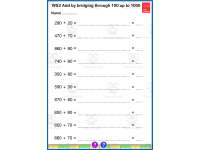
- Year groups
- Year 4 (Key Stage 2)
- Pages
- 5
- File type
- Answer key
- Included


- Subject
- Addition, Addition and Subtraction, Maths
- Topic
- Maths, Addition
- Resource types
- Worksheets
- Answer key
- Included
From the author
About this resource
Bridging through 100s helps students in a number of ways:
It makes addition with large numbers feel much easier because they are broken down into smaller numbers according to their place value and dealt with one step at a time.
It helps in the understanding of place value as students think about tens and ones separately.
It's excellent for developing mental maths skills
It provides an alternative strategy to using the standard method or algorithm.
You have a choice of four sets of worksheets.
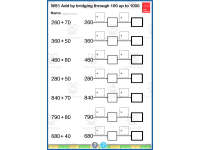
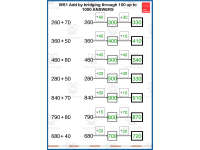
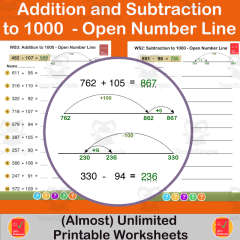
The first set contains addition questions where the first and second addends are multiples of 10, so the focus here is on the bridging of a multiple of 100 in the simplest form.
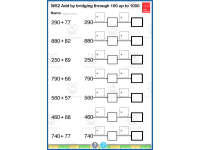
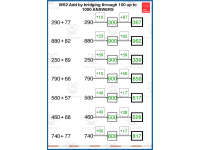
The second set has the first addend a multiple of 10, whilst the second addend is a number between 11 and 99.
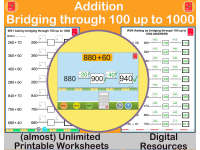
Both of the above sets have the questions laid out in a visual format that emphasises the bridging through 100.
The third and fourth sets contain the same range of numbers for both addends as above. but now the worksheets are presented in a way that students can either continue with the visual format of the previous two sets or choose how to present their workings demonstrating their understanding of addition through bridging.
How many worksheets in each set ?
A standout feature is the worksheet randomisation. With a single click, educators can generate an entirely new set of questions, making it a renewable resource for the entire school year. Be it for classwork, revision, or homework, adaptability ensures students achieve proficiency in the topic.
As these worksheets need little explanation and no preparation, they are ideal if you need to leave work for a substitute teacher.
Answers found on the second page of every worksheet are automatically generated when you create a new worksheet.
Teaching Pages
These cover the visual format of the first two worksheets. They are ideal for a whole class activity as an introduction to the worksheets or as a means to review the topic later on if needed. Pupils can come to the Whiteboard and enter solutions and get immediate feedback.
Lastly, it's essential to note that these resources are compatible PDF documents. They operate seamlessly with the official Adobe Acrobat Reader on both Windows and Mac. Plus, the randomising features are effortlessly accessible via touchscreen devices or interactive whiteboards.
Related resources
More resources teachers may find useful
More resources on the same subject and topic.

In the classroom
Teaching tips & learning objectives

Learning objectives
Add a two- or three-digit number and a two-digit number by first bridging to the nearest hundred, then adding the remainder.
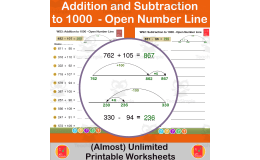
Use a number line as a visual model for representing each addition step.

Teaching tips
Introduce the strategy using the teaching page's number-line model and the guide's 3-step buttons before assigning the worksheets independently.
Use the randomise button to generate a fresh set of problems each time you reuse the file, since the file is designed to stay useful across the school year rather than being a single fixed worksheet.
Use the interactive whiteboard keypad entry for a whole-class introduction, then move to the printable worksheets for independent or homework practice.

Skills covered
Bridging through 100 — students add a first jump to reach the nearest hundred, then a second jump for the remainder, rather than using the standard algorithm.
Place value reasoning — the two-step structure requires thinking about tens and hundreds separately when deciding how much to add first.
Mental addition strategy — the method is explicitly framed as an alternative to standard-algorithm addition for numbers within 1000.
Self-checking practice — students can verify each worksheet's answers on its own matching answer page.

No reviews yet
Downloaded this resource? Tell other teachers how it went.
Resource details
Concepts & topics
Core concepts
 Core concepts
Bridging through 100
Mental addition strategy
Place value
 Topics
Explore more
Categories this resource belongs to
Explore related searches



More to explore
You may also like