Balancing Algebraic Equations Worksheet


- Year groups
- Years 7–8 (Key Stage 3)
- Pages
- 5
- File type
- Preparation
- Print ready


- Subject
- Algebra, Maths
- Topic
- Hands-On Maths, Equations
- Resource types
- Worksheets
- Preparation
- Print ready
From the author
About this resource
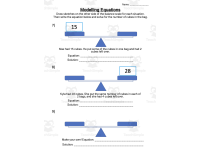
Need an easy and visual activity for your early algebra unit in 6th, 7th, or Year 9 maths class? These simple balance scale worksheets model one and two step equations and show students why the golden rule in algebra works. They are a great addition to any early algebra unit in lower secondary as they show students the basic concepts of solving equations in a visual way which is accessible to lots of different learners in your class!
Teacher instructions:
- Students can physically cross cubes off on their worksheets on each side of a equation to make it balance.
- Or you can pass out bags with cubes to model each equation in a hands-on way.
Grades to Use With:
This activity works well in 6th, 7th, or Year 9 maths classes when introducing early concepts of algebra: one-step equations and simple two-step equations and why we use the opposite operation. These worksheets could also be used in secondary school special education classes to make algebra more accessible for your students.
What's Included: 5-Page PDF: Ready to Print and Use:
Teacher Instructions
3 Student Worksheets with Balance Scales (representing one-step and two-step equations).
Complete Answer Key
Standards:
This lesson helps address Expressions and Equations Common Core Standards in Year 7 and 7.
Year 7 B.5
Solve equations with substitution and understand that solving an equation is finding which values make it true.
Year 7 B.7
Solve simple one-step equations.
Year 8 B.4
Use variables in simple equations
Year 8 B.4a
Solve two-step equations fluently.
If you are looking for other innovative algebra products, check out my store:
Related resources
More resources teachers may find useful
More resources on the same subject and topic.


In the classroom
Teaching tips & learning objectives

Learning objectives
Solve one-step equations such as 6 = 2 + n by performing the same operation on both sides of the scale.
Solve two-step equations such as 3n + 2 = 14 using two sequential inverse operations.
Translate a real-world scenario (cubes split into bags, cubes left over) into an algebraic equation and solve it.
Construct an original one-step or two-step equation using the balance-scale model.

Teaching tips
Print a three-page worksheet for each student before the lesson.
Work through the first problem together as a class before students continue independently.
Distribute paper bags and physical cubes so students can remove or divide cubes on each side of the scale by hand.
Use the printed answer key to check the algebraic steps after the hands-on balance-scale demonstration.

Skills covered
One-step equation solving — students isolate a variable in equations like 6 = 2 + n by removing matching cubes from both sides of the balance scale.
Two-step equation solving — students apply two inverse operations in sequence to equations such as 3n + 2 = 14.
Equation writing from context — students turn two cube word problems (a 15-cube split, a 28-cube split) into algebraic equations before solving.
Visual-to-symbolic translation — students convert a balance-scale drawing of cubes into a written equation and a numeric solution.

No reviews yet
Downloaded this resource? Tell other teachers how it went.
Resource details
Concepts & topics
Core concepts
 Core concepts
Equality/balance property
Inverse operations
One-step equations
Two-step equations
 Topics
Explore more
Categories this resource belongs to
Explore related searches


More to explore