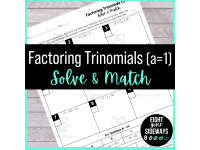
Factoring Trinomials Worksheet – When a = 1


- Pages
- 4
- File type
- Answer key
- Included


- Subject
- Algebra, Maths
- Topic
- Reading Worksheets, Factoring Trinomials
- Resource types
- Worksheets
- Answer key
- Included
From the author
About this resource
Related resources
More resources teachers may find useful
More resources on the same subject and topic.


In the classroom
Teaching tips & learning objectives

Learning objectives
Factor a trinomial of the form x² + bx + c by finding the integer pair whose product is c and whose sum is b
Work confidently with all four sign combinations, including cases such as x² − 11x − 12 where the constant is negative and the middle term negative
Find factor pairs of larger constants such as 55, 56, 77 and 84 rather than relying on small numbers
Recognise which of the two binomials produced is the one listed in the letter bank
Use the one-letter-per-problem constraint as a self-check on a completed block of nine

Teaching tips
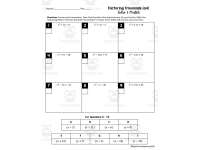
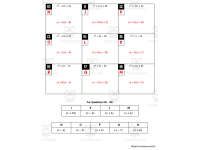
The two pages are self-contained — problems 1 to 9 use letters A to I and problems 10 to 18 use J to R — so one can be classwork and the other homework without breaking the matching
Tell students to work the whole block before writing any letters; the check only works once all nine are placed and every letter has been used once
Problems 5, 12 and 17 lean on factor pairs of 77, 55 and 84, so a quick review of divisibility is worth doing before the sheet goes out
Students who finish early can multiply their binomial pairs back out, since the marked pages show both factors and expansion is the natural verification
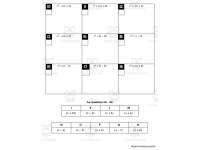
The direction line on the worked copies reads "Solve each equation" while the student pages read "Factor each expression"; use the student wording when you explain the task

Skills covered
Factoring trinomials when a = 1 — students turn eighteen expressions such as x² − 18x + 77 into (x − 11)(x − 7) by finding the integer pair that multiplies to the constant and adds to the middle coefficient.
Handling every sign pattern — the set deliberately mixes x² + 11x + 18, x² + 7x − 60, x² − 13x + 30 and x² − 11x − 12, so both signs in a factor pair have to be reasoned about rather than guessed.
Factor pairs of larger numbers — x² + 5x − 84, x² + 16x + 55 and x² + 15x + 56 push students past the small constants that make trial and error easy.
Partial-factor matching — the bank prints only one binomial from each pair, so students must decide which of their two factors, (x − 4) or (x − 8) for problem 10, is the one on the list.
Built-in self-checking — nine letters serve nine problems in each block and each is used once, so a duplicate or leftover letter tells a student where to look again.
Good to know
Questions teachers ask about this resource
How does the lettered bank relate to the factored expressions?
Each bank entry is one binomial out of a pair, not the whole factorisation. Problem 5, x² − 18x + 77, factors to (x − 11)(x − 7); the bank lists (x − 11) as B, so B goes in the box. Nine letters serve the nine problems in each block and each is used exactly once.
Can the two pages be set separately?
Yes. Problems 1 to 9 match against letters A to I printed on that page, and problems 10 to 18 match against J to R printed on the second, so each page is complete on its own and the pair can be split across a lesson and a homework.
What exactly are students asked to do with each expression?
Factor it, find the letter matching one of the two factors and write that letter in the box beneath the problem number, using each letter only once. The student pages word this as "Factor each expression"; the worked copies repeat the instruction as "Solve each equation", but the task on all four pages is factorisation.

No reviews yet
Downloaded this resource? Tell other teachers how it went.
Resource details
Concepts & topics
Core concepts
 Core concepts
Factoring trinomials
Quadratic expressions
Integer factor pairs
Signs in factor pairs
 Topics
Explore more
Categories this resource belongs to
Explore related searches



More to explore