Cause and Effect Anchor Chart – Reading Reference Set


- Year groups
- Years 2–4 (Key Stages 1–2)
- File type
- Preparation
- Print ready


- Subject
- Reading, English
- Topic
- Cause and Effect, Reading Notebook
- Resource types
- Anchor Charts
- Preparation
- Print ready
From the author
About this resource
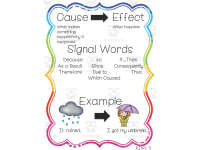
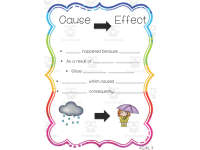
This is a set of 3 anchor charts for cause and effect. The first anchor chart is complete. The following 2 charts are fill in the blank. These charts work well displayed on a bulletin board or inserted into students' interactive reading notebooks.
Related resources
More resources teachers may find useful
More resources on the same subject and topic.


In the classroom
Teaching tips & learning objectives

Learning objectives
Define cause and effect and recognise common signal words that indicate a cause-and-effect relationship (because, so, as a result, since, consequently, therefore, due to, thus, which caused).
Complete a partially blanked cause-and-effect definition using the correct missing terms.
Compose an original sentence expressing a cause-and-effect relationship using a provided signal-word sentence frame.

Teaching tips
Display the completed Chart 1 on a bulletin board as a permanent reference, and use Chart 2 as a guided fill-in activity during initial instruction so students help reconstruct the definition themselves.
Have students glue a reduced copy of Chart 1 into an interactive reading notebook, for a take-home reference.
Use Chart 3's sentence frames as a quick formative check after teaching the signal words, since students must generate original content rather than just recognising a completed example.

Skills covered
Cause-and-effect signal-word recognition — students learn to associate specific words and phrases (because, since, as a result, consequently, etc.) with cause-and-effect text structure.
Guided-notes completion — Chart 2 requires filling in key terms within an otherwise-familiar structure, reinforcing the Chart 1 definition through active recall.
Original sentence composition — Chart 3's open sentence frames require students to supply their own cause-and-effect content rather than only identifying an example.

No reviews yet
Downloaded this resource? Tell other teachers how it went.
Resource details
Concepts & topics
Core concepts
 Core concepts
Cause and effect
Signal words
Text structure
 Topics
Explore more
Categories this resource belongs to
Explore related searches




More to explore