Compare and Contrast Anchor Chart – Set of 4



- Year groups
- Years 2–4 (Key Stages 1–2)
- File type
- Preparation
- Print ready


- Subject
- Reading, English
- Topic
- Compare, Contrast
- Resource types
- Anchor Charts
- Preparation
- Print ready
From the author
About this resource
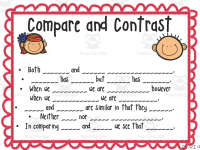
This resource is a set of 4 anchor charts for compare and contrast. The first anchor chart is complete. The following 3 charts are fill in the blank. These charts work well displayed on a bulletin board or inserted into students' interactive reading notebooks.
Related resources
More resources teachers may find useful
More resources on the same subject and topic.


In the classroom
Teaching tips & learning objectives

Learning objectives
Recognise the signal words that mark a comparison and those that mark a contrast
Answer a comparison question in a full sentence using a supplied frame such as "___ and ___ are similar in that they ___"
Read a two-circle diagram, telling the shared middle from the two outer sides
Restate a comparison question in their own words, working from the five stems on the chart

Teaching tips
Display the complete version first and keep the blanked version back; asking students to supply SIMILAR, ALIKE and DIFFERENT themselves turns the same chart into a check on the vocabulary
The sentence frames work as a scaffold for spoken answers as much as written ones — take one frame a day and have the class fill it about two things in the room
The worked example uses two children in the same class, so it transfers directly: swap in two of your own students, two characters or two books and the diagram still works
Shrink the charts to fit a reading notebook if you want each student to carry the clue words rather than looking up at a wall display
The clue word panels are the piece worth copying onto the board during a lesson, since students reach for them while writing rather than while listening

Skills covered
Recognising comparison signal words — students learn to spot like, both, same, also and have in common as markers of similarity, and but, yet, although, unlike and whereas as markers of difference.
Reading a two-circle diagram — the worked example puts brother against sister and basketball against soccer on the outsides, with room 39, the bus, a dog and pizza in the shared middle.
Answering with a sentence frame — six openings, from "Both ___ and ___" to "In comparing ___ and ___ we see that ___", give students a way into a full written answer.
Interpreting the question — five stems on the chart show the different ways a comparison question can be worded, including "How can you tell ___ and ___ apart?"

No reviews yet
Downloaded this resource? Tell other teachers how it went.
Resource details
Concepts & topics
Core concepts
 Core concepts
Compare and contrast
Signal words
Sentence frames
Anchor chart
 Topics
Explore more
Categories this resource belongs to
Explore related searches




More to explore