Crash Course Psychology #15: Cognition (How Your Mind Can Amaze and Betray…


- Pages
- 2
- File type
- Zip


- Subject
- Psychology, Social Studies
- Topic
- Psychology, Crash Course
- Resource types
- Worksheets
From the author
About this resource
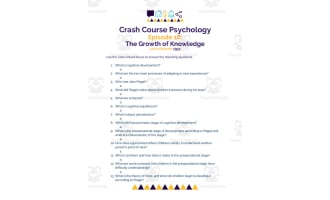
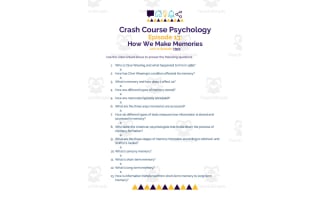
This informative worksheet accompanies the Crash Course Psychology video that explores the complex topic of cognition. Students will learn how the mind forms concepts and prototypes, as well as common cognitive biases like prejudice, confirmation bias, and mental sets. The video and worksheet cover problem-solving techniques like algorithms and heuristics and the neuroscience behind cognition. With 15 critical thinking questions that prompt students to analyse the video content, this worksheet is a valuable companion resource for the popular Crash Course video series. Presented in an engaging workbook format that works well for in-class assignments or independent learning, it encourages students to actively process each cognitive psychology concept introduced in the video.
Related resources
More resources teachers may find useful
More resources on the same subject and topic.



In the classroom
Teaching tips & learning objectives

Learning objectives
Define cognition and describe the mental processes it involves.
Distinguish between algorithms and heuristics as problem-solving strategies, with an example of each.
Explain how the framing of a risk (e.g., survival rate vs. death rate) can change how people perceive that risk.
Identify how concepts and prototypes can lead to prejudice when new information doesn't match an existing prototype.

Teaching tips
Play the linked Crash Course Psychology video and pause at the relevant point for each question, since all 15 prompts follow the video in sequence.
Use the separate teacher answer key to check that student responses capture the same core idea, since answers are short written responses rather than fill-in-the-blank recall.
Because the worksheet is an editable Word document, adjust individual question wording to match your class's reading level before printing.

Skills covered
Cognitive-concept vocabulary — students define cognition, concepts, and prototypes and explain how each shapes thinking (questions 1, 5, 6).
Comparative reasoning — question 10 asks students to distinguish algorithms from heuristics as two different problem-solving approaches.
Framing-effect analysis — question 15 asks students to explain how identical risk information, framed differently, changes perception.
Video-based note-taking — all 15 questions require students to extract and restate information presented in the linked video.
Good to know
Questions teachers ask about this resource
What accompanies the cognition viewing questions?
A teacher-response guide and editable Word versions accompany the PDFs. Use the worksheet’s link to open the separate cognition episode.

No reviews yet
Downloaded this resource? Tell other teachers how it went.
Resource details
Concepts & topics
Core concepts
 Core concepts
Cognition
Concepts and prototypes
Problem-solving strategies
Framing effect
 Topics
Explore more
Categories this resource belongs to
Explore related searches


More to explore