ESL Multilingual Vocabulary Flashcards - 100 most common verbs - Malay


- Year groups
- Adult Education
- Pages
- 10
- File type
- Preparation
- Print ready


- Subject
- ESL, Foreign Languages, Vocabulary, Language Development, English
- Topic
- ESL, English
- Resource types
- Flashcards, Worksheets
- Preparation
- Print ready
From the author
About this resource
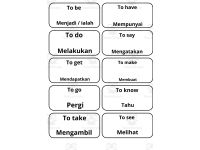
This high-quality English language teaching resource is designed for Malay speaking students (Southeast Asia - Brunei + Malaysia + Singapore) learning English as a second or foreign language. It includes 10 printable PDF pages featuring vocabulary flashcards centred around the 100 most common verbs in the English Language
This ESL Multilingual Vocabulary Flashcards on "the 100 most common verbs in the English Language" Worksheets Activity can be ideal for Beginner level ESL - EFL - TESOL learners, including newcomers and English language learners of all ages.
🌟 What's Included?
In this ESL Multilingual Vocabulary Flashcards Activity on "the 100 most common verbs in the English Language", ESL EFL TESOL (English Second or Foreign language) teachers can find:
✅ 100 Printable Flashcards (ten printable PDF pages)
✅ Verb vocabulary in both English and Malay (Southeast Asia - Brunei + Malaysia + Singapore)
🏫 Who Can Benefit from This Resource?
📌 Beginner ESL/EFL students looking to improve their English vocabulary
📌 Newcomers & English Language Learners (ELLs) in schools, tutoring sessions, or self-study
📌 Teachers and tutors looking for fun and engaging vocabulary-building activities
📌 Language centres, homeschool educators, and ESL programs that aim to support Malay speaking students (Southeast Asia - Brunei + Malaysia + Singapore)
🎯 How Does this ESL Teaching Resource Help you and your Students?
✨ Strengthens essential English communication skills
✨ Provides bilingual vocabulary (English & Malay) for better understanding (Southeast Asia - Brunei + Malaysia + Singapore)
✨ Encourages engaging learning with printable flashcards that can be used in various ESL EFL (English Second or Foreign Language) class activities
Whether you're an ESL teacher or an English tutor these ESL Multilingual Vocabulary Flashcards on "the 100 most common verbs in the English Language" for Malay speaking students (Southeast Asia - Brunei + Malaysia + Singapore) are a valuable and fun resource to improve basic conversation skills in English. Start learning today and make English introductions simple, engaging, and effective!
ESL with Alan is a Teaching Resources Store whose aim is to help English as a Second or foreign Language (ESL EFL TESOL) Teachers, Educators and Tutors around the world (be it online or offline) to achieve their teaching objectives while creating an enjoyable and stimulating learning environment. Learning is fun, So should English! Always
If you want to browse more of my ESL, EFL, TESOL Teaching Resources, click here right ESL with Alan!
Related resources
More resources teachers may find useful
More resources on the same subject and topic.


In the classroom
Teaching tips & learning objectives

Learning objectives
Recall the Malay equivalent of one hundred high-frequency English verbs, and the English equivalent of each Malay verb
Recognise the English infinitive - "to" plus the base verb - as the form dictionaries and word lists use
Choose between two Malay renderings of one English verb by context, as with "Memanggil / menelefon" for to call
Notice where a single Malay verb covers more than one English verb, and check meaning from the surrounding sentence rather than the card alone

Teaching tips
Work down the pages in order rather than shuffling: the earliest cards are the highest-frequency verbs (to be, to have, to do, to say), so a beginner gets the most useful hundred words in the most useful order
Fold or cover the lower line to drill in one direction, then swap and cover the upper line to drill the reverse - the two-line layout supports both without any second printing
The slashed entries make good discussion cards: ask learners when "Melihat" fits and when "memandang" fits before accepting either as the answer for to look
Pair the cards with sentence work of your own, since the deck supplies the verb in citation form only and never shows it inside a sentence

Skills covered
Bilingual vocabulary recall - each card sets an English infinitive directly above its Malay equivalent, so a Malay-speaking learner drills from the known language to the target one and back.
Recognising the citation form of a verb - all one hundred entries are printed as "to" plus the base form, fixing the shape learners will meet in dictionaries and word lists.
Choosing between near-synonyms - around a dozen cards offer two Malay renderings for one English verb, so the learner decides which sense is wanted rather than accepting a single fixed gloss.
Building core action vocabulary in frequency order - the deck runs from to be, to have and to do through to less common items such as to consider, to suggest and to develop.
Good to know
Questions teachers ask about this resource
Do any of the English verbs share the same Malay word?
Several do. Melihat appears for both to see and to look, Bercakap covers to talk and to speak, Membawa is given for to bring and for to carry, and Tinggal is used for to live and to stay - useful pairs to compare side by side once learners have both cards.
What is printed on each card besides the two words?
Nothing else. Each card carries the English infinitive and the Malay translation beneath it - no picture, no example sentence and no conjugated form - so the cards drill meaning and leave usage to be modelled around them.

No reviews yet
Downloaded this resource? Tell other teachers how it went.
Resource details
Concepts & topics
Core concepts
 Core concepts
ESL vocabulary
High-frequency verbs
English-Malay translation
Infinitive form
 Topics
Explore more
Categories this resource belongs to
Explore related searches


More to explore