Final Exam Review: Algebra 1


- Year groups
- Years 9–10 (Key Stages 3–4)
- File type
- Microsoft Word


- Subject
- Algebra, Maths
- Topic
- Algebra 1, Final
- Resource types
- Word Problems, Assessments
From the author
About this resource
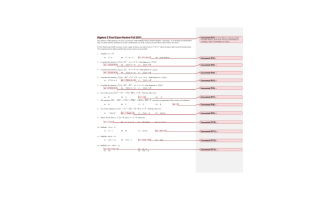
This includes 72 review questions and an answer key.
Related resources
More resources teachers may find useful
More resources on the same subject and topic.



In the classroom
Teaching tips & learning objectives

Learning objectives
Students solve exponential growth and decay word problems by identifying the initial value, rate, and number of time periods.
Students factor polynomials using the GCF, special-case patterns, and trinomial factoring.
Students solve systems of linear equations by graphing, substitution, and elimination, and interpret no-solution or infinite-solution cases.
Students apply the Pythagorean theorem and the distance formula to find missing side lengths and distances between points.
Students solve and graph one-variable, two-variable, and compound inequalities.

Teaching tips
Assign as a multi-day take-home review before a cumulative final exam, given its breadth of 72 problems across roughly 35 named topics.
Use the answer key's worked solutions — such as the elimination and substitution walk-throughs — as a model for students who are stuck, rather than only checking final answers.
Review by topic heading (e.g. 'Factoring Trinomials,' 'Solving Systems of Equations by Elimination') since the packet is organised by named Algebra 1 skill rather than by difficulty.

Skills covered
Exponential growth and decay modelling — students write and evaluate equations for scenarios like a car losing 15% of its value yearly or savings growing at compound interest.
Polynomial factoring — students factor out the GCF and factor special cases and trinomials completely.
Systems of equations — students solve systems using graphing, substitution, and elimination, including cases with no solution or infinitely many solutions.
Pythagorean theorem and distance — students find missing triangle sides and the distance between two coordinate points.
Inequalities — students write, solve, and graph one-variable, two-variable, and compound inequalities from word descriptions and number-line graphs.

No reviews yet
Downloaded this resource? Tell other teachers how it went.
Resource details
Concepts & topics
 Core concepts
 Topics
Explore more
Categories this resource belongs to
Explore related searches


More to explore