Force and Motion Science Experiment

- Year groups
- Years 4–6 (Key Stage 2)
- File type
- Preparation
- Print ready


- Subject
- Physics
- Topic
- Science Experiment, Force
- Resource types
- Activities
- Preparation
- Print ready
From the author
About this resource
Explore force and motion by predicting and observing how different balls begin to roll when blown.
This is a Force and Motion Science Experiment for your students to take part in.
It may be used best with 3rd – Year 6 students.
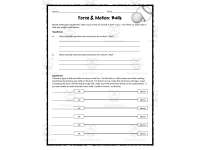
Students will work with a set of balls to apply what they know about force and motion. Students will complete the 2 page printable along the way.
They will begin by making a hypothesis, as scientists do, before engaging in the experiment. Students will hypothesise which ball they believe will need the most wind-force for motion and which ball will need the least wind-force. You may choose to have your students decide on this hypothesis individually or in small groups.
When students have wrapped up their hypothesis, they will move forward into the experiment portion. Students will follow the directions on page 1 to test out the force and motion of each ball. There is space for them to test out 6 balls. Your class may love completing this in small groups or with a partner.
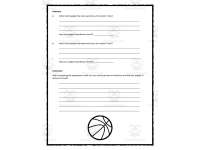
On page 2, they will reflect on the experiment by writing their particular outcome and formulating a conclusion about the wind-force needed to put balls in motion.
I hope you enjoy!
I can be contacted for questions and concerns at sallyplant12@hotmail.com.
Related resources
More resources teachers may find useful
More resources on the same subject and topic.


In the classroom
Teaching tips & learning objectives

Learning objectives
Formulate a testable hypothesis about how a ball's physical properties affect the force needed to move it.
Apply increasing force (breath) to an object and record the point at which motion begins.
Compare experimental outcomes to an original hypothesis and revise thinking based on evidence.
Draw a conclusion linking an object's size, weight, and texture to the amount of force required to move it.

Teaching tips
Gather six balls of varying size, weight, and texture before class, since the sheet assumes students already have them in front of them.
Model the soft-to-vigorous scale with one ball as a class before students test independently or in pairs.
Have students share their conclusions aloud afterward to compare whether weight or texture had a bigger effect on the force needed.

Skills covered
Hypothesis formation — students predict and justify which of several balls will need the most/least force to move.
Controlled variable testing — students apply gradually increasing wind-force to six different balls and record the force level at which each moves.
Evidence-based conclusion writing — students compare their results to their hypothesis and explain the relationship between an object's properties and the force needed to move it.

No reviews yet
Downloaded this resource? Tell other teachers how it went.
Resource details
Concepts & topics
Core concepts
 Core concepts
Force
Motion
Hypothesis
Scientific method
 Topics
Explore more
Categories this resource belongs to
Explore related searches



More to explore