Instant Ice Experiment

- Year groups
- Years 3–9 (Key Stages 2–3)
- Pages
- 1
- File type
- Preparation
- Print ready


- Subject
- Art, Creative Arts, Science
- Topic
- Instant Ice Experiment, Ice Experiment
- Resource types
- Activities
- Preparation
- Print ready
From the author
About this resource
Activity Introduction
An amazing activity/craft designed for the students to have fun learning about our daily activities or even to have fun doing some DIY crafts.
Instant Ice
Do you like group activities or crafts that you can enjoy with your friends and family? Or do you like individual activities and crafts that you can do on your own then show the world how creative you are?
Have you ever tried to do a do it yourself craft? If yes tell us more about it, like has anyone helped you, what was it about, what materials did you use to create it and how much time did you spend creating it?
Do you like colouring? What is your favourite colour?
Instant Ice Activity
The activity is perfect for encouraging the creativity skills for the students, while having fun with our cool activities and crafts.
Instant Ice
This friendly designed worksheet is suitable for students at school, homeschooling, and as a group activity.
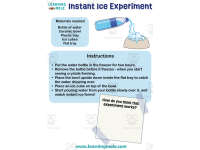
Instructions
Put the water bottle in the freezer for two hours.
Remove the bottle before it freezes - when you start seeing crystals forming.
Place the bowl upside down inside the flat tray to catch the water dripping over.
Place an ice cube on top of the bowl.
Start pouring water from your bottle slowly over it, and watch instant ice forms!
Format
Available in a PDF format.
Related resources
More resources teachers may find useful
More resources on the same subject and topic.


In the classroom
Teaching tips & learning objectives

Learning objectives
Observe supercooled water turning to ice on contact with an ice cube
Propose an explanation for how the instant ice forms

Teaching tips
Timing is the tricky part: the bottle comes out of the freezer when ice crystals first appear, before it freezes solid.

Skills covered
Scientific observation — watching and describing ice forming as the water is poured
Good to know
Questions teachers ask about this resource
What materials does the experiment need?
A bottle of water, a freezer, ice cubes, a ceramic bowl and a flat plastic tray to catch the runoff.

No reviews yet
Downloaded this resource? Tell other teachers how it went.
Resource details
Concepts & topics
Core concepts
 Core concepts
States of matter
Freezing point
Supercooling
 Topics
Explore more
Categories this resource belongs to
Explore related searches



More to explore