Multiplying and Dividing Decimals by Powers of 10





- Year groups
- Year 6 (Key Stage 2)
- Pages
- 25
- File type
- Answer key
- Included


- Subject
- Multiplication and Division, Maths
- Topic
- Maths, Division
- Resource types
- Worksheets
- Answer key
- Included
From the author
About this resource
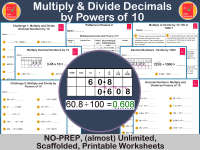
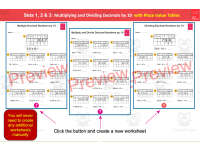
These sets of (virtually unlimited) worksheets on multiplying and dividing decimals by 10, 100, and 1000 are designed to help students understand and see the pattern in decimal point placement when multiplying or dividing by powers of 10,
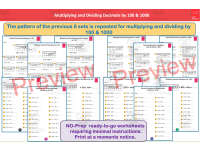
They start by using place value tables as a visual aid to illustrate the shift in digit positions when operating with powers of 10. Then the method commonly used of moving the decimal point is introduced, and then both methods of visual support are removed. This progression is repeated for multiplication and division by 10, then for 100 & finally for 1000.
The resource is structured to support various learning styles and paces. There are separate worksheets for multiplication and division, as well as combined exercises that integrate both operations, allowing for targeted practice in specific areas of difficulty.
There are also advanced worksheets that require learners to identify missing elements in equations, such as multiplicands, multipliers, dividends, or divisors as well as Word Problems mixing up multiplication and division by 10, 100 & 1000.
In the last 3 sets, students are introduced to writing numbers with powers or indices, by investigating patterns connecting the various forms of writing powers of 10 then practice with mixed exercises and a final challenge.
How many Worksheets in each Set ?
Almost unlimited. At the click of a button all numbers are randomised, so the questions change every time. This will allow you to create as many new worksheets you will need for practice throughout the year (classwork, homework, revision, fillers etc) or even give small groups of students in your class different sets of questions either at the same level or differentiated. Choose repeated practice according to student need.
As these worksheets need little explanation, they are ideal if you need to leave work for a replacement teacher.
Answers can be found on the second page of every worksheet, automatically generated when you create a new worksheet.
Note
These resources are PDF documents and work with the official Adobe Acrobat Reader on Windows or Mac computers with the randomising buttons also working via a touchscreen (PC or Mac) or on an Interactive Whiteboard.
Related resources
More resources teachers may find useful
More resources on the same subject and topic.


In the classroom
Teaching tips & learning objectives

Learning objectives
Multiply and divide decimals by 10, 100, and 1000 by shifting the decimal point.
Solve for a missing multiplicand, multiplier, dividend, or divisor in a powers-of-10 equation.
Apply powers-of-10 multiplication and division rules to word problems.
Recognise the pattern connecting the numeral form (10, 100, 1000) and exponential form of a power of ten.

Teaching tips
Start students on the place-value-table worksheets (Sets 1-3) before moving to the decimal-point-shift worksheets (Sets 4-6), following the guide's recommended progression.
Use the separate multiplication-only and division-only sets for classwork, and the combined sets for homework or a mini-test, as the guide suggests.
Save the Word Problems set and Challenge sets for early finishers or as an extension once the core skill is secure.

Skills covered
Decimal place-value shifting — students multiply and divide decimals by 10, 100, and 1000 by moving the decimal point the correct number of places.
Missing-factor problem solving — students work backward in challenge sets to find an unknown multiplicand, multiplier, dividend, or divisor.
Powers-of-10 notation — students apply the same multiply/divide rules when the power of ten is written with an exponent instead of the numeral 1000.
Word problem application — students translate real-world scenarios into a multiply-or-divide-by-a-power-of-10 calculation.
Good to know
Questions teachers ask about this resource
What is different about the Challenge sets compared to the regular practice sets?
Instead of computing a product or quotient, students must find a missing multiplicand, multiplier, dividend, or divisor -- and in later challenges, the power of 10 or the operation sign itself may also be missing.

No reviews yet
Downloaded this resource? Tell other teachers how it went.
Resource details
Concepts & topics
Core concepts
 Core concepts
Multiplying decimals by powers of 10
Dividing decimals by powers of 10
Place value
Exponents
 Topics
Explore more
Categories this resource belongs to
Explore related searches


More to explore