Novel Study Worksheets on "Pride and Prejudice" by Jane Austen

- Pages
- 5
- File type
- Preparation
- Print ready


- Subject
- Reading Comprehension, Reading, English
- Topic
- Novel Study, English
- Resource types
- Worksheets
- Preparation
- Print ready
From the author
About this resource
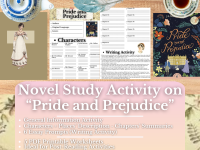
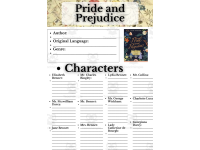
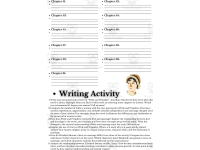
These five printable Pride and Prejudice worksheet pages provide fields for book details, descriptions of twelve characters and notes on six settings. A blank log covers all 61 chapters for students to write their own summaries.
Six essay prompts include a personal review and analysis of gender, marriage, irony and the Elizabeth–Darcy relationship. Use the notes alongside reading, then select extended writing tasks. Supply the novel separately.
Designed for middle- and high-school literature study, with reading support chosen for the class. No completed answer key is supplied.
Related resources
More resources teachers may find useful
More resources on the same subject and topic.


In the classroom
Teaching tips & learning objectives

Learning objectives
Summarise the events of each chapter of a full-length novel in a few sentences
Describe a character's role and traits using details drawn from the text
Compare historical and contemporary perspectives on gender roles and marriage, citing specific evidence from the novel
Analyse an author's use of irony to critique social norms and character flaws

Teaching tips
Assign the chapter-summary log in weekly batches (for example, ten chapters at a time) alongside the reading schedule, rather than all 61 chapters as a single assignment.
Complete the character and setting pages early, since students will keep returning to them as new characters and locations appear across the later chapters.
Save the six essay prompts for after the novel is finished, since several — such as the Elizabeth-Darcy relationship prompt — require knowledge of the full arc of the story.

Skills covered
Chapter summarisation — students condense the plot of each of the novel's 61 chapters into a short written summary.
Character analysis — students describe traits and roles for major characters such as Elizabeth Bennet, Mr. Darcy, and Mr. Wickham.
Comparative social analysis — students compare Regency-era and present-day attitudes toward marriage, independence, and women's roles, citing specific examples from the novel.
Literary device analysis — students identify and analyse Austen's use of irony to critique social norms and the institution of marriage.
Good to know
Questions teachers ask about this resource
What kind of writing do the six closing prompts ask for?
Extended personal and analytical essays — one asks for a personal book review and recommendation, while the others ask students to compare eras, analyse irony, and trace how Elizabeth and Darcy's misunderstandings resolve into mutual respect.

No reviews yet
Downloaded this resource? Tell other teachers how it went.
Resource details
Concepts & topics
Core concepts
 Core concepts
Novel study
Character analysis
Chapter summarisation
Irony
Gender and marriage themes
 Topics
Explore more
Categories this resource belongs to
Explore related searches




More to explore