Posters: Homophones and Homographs

- Year groups
- Years 4–7 (Key Stages 2–3)
- File type
- Multiple File Types


- Subject
- Grammar, English
- Topic
- Homophones, Homographs
- Resource types
- Posters
From the author
About this resource
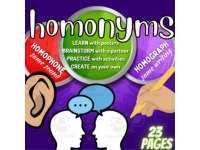
Posters: Homophones and Homographs - A Unique Teaching Resource
Designed for students between Years 4–7, our product seeks to demystify the complexities of language arts. Its focused approach targets a critical area of confusion amongst learners- the difference between homophones and homographs.
The Posters:
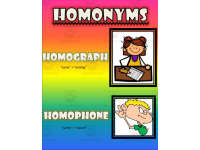
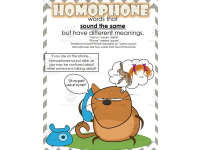
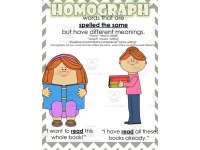
Precisely explain when a word is pronounced similarly or spelled similarly.
Inspire students to identify whether words are homographs (spelled alike with varying meanings) or homophones (spoken alike but differ in spelling/meaning).
Bloom's Taxonomy approach:
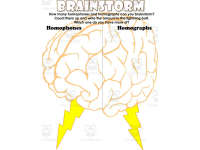
The Bloom's Taxonomy framework underpins each element promoting understanding and memory retention. Each term is consolidated within learner's existing English Language Art notebooks, forming an interactive page. Ideas are then applied via group based brainstorming sessions for generating further examples of homographs and homophones.
Creativity & Understanding:
Students explore their creative side by developing individual graphical illustrations, this aids comprehension whilst engaging visual learning techniques. Included within this resource are multiple practice sheets allowing recurrent contact with these important grammar elements, thereby bolstering fluency.
A Comprehensive Package:
A total of 23 pages make up our accessible PDF format product. Filled with succinct graphical teaching resources, it provides meaningful yet engaging discussions around primary grammar lessons. Suited not only for full classroom instruction but also small group discussions or as interesting homework assignments, 'Poster: Homophone and Homograph' offers versatility in pedagogical application due to its straightforward yet effective design.
Related resources
More resources teachers may find useful
More resources on the same subject and topic.



In the classroom
Teaching tips & learning objectives

Learning objectives
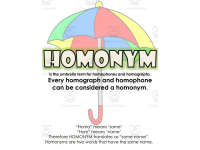
Define homophone and homograph from their word parts - homo plus phone, homo plus graph - and place both under homonym as the umbrella term
Sort a pair of words or pictures into homophone, homograph or both, using sound and spelling as the two separate tests
Choose a word that completes a sentence when more than one spelling of that sound would fit, as in where/wear and piece/peace
Generate homophone and homograph pairs independently and justify each with a written because clause
Identify a second meaning for a homograph and represent it in a drawing, as with bat, scale, bark, wind and present

Teaching tips
The posters teach by morphology - homo, phone, graph - so introducing those roots first makes the two terms distinguishable rather than confusable
The notebook strips print two to a page to save paper, and the teacher note asks for a few dots of glue along the left edge only so the flaps still lift
The sentence worksheet's reminder line adds a third category, BOTH, for words that sound the same and are spelled the same; point that out before students start, since several items are keyed that way
Several answers on the key are alternatives - red/read or read/read for item 7, right/right or write/right for item 9 - so accept either reading rather than marking to a single answer
The homograph puzzle pieces ask students to draw the second meaning themselves, which takes longer than the homophone cards; run the cards first and keep the puzzle pieces for the following session

Skills covered
Distinguishing homophones from homographs - the posters set sound against spelling as two separate tests, and the picture page and sentence worksheet both ask students to apply that distinction to specific pairs.
Word-part analysis - each poster splits its term into roots, so students learn that phone means sound and graph means writing rather than memorising two similar-looking labels.
Using sentence context to choose a spelling - the eighteen-item worksheet supplies sentences where only one spelling of a sound fits, from "Do you know ___ she lives?" to "Do you want a ___ of pie?".
Generating and justifying examples - two pages ask students to think of their own pairs, draw them and finish the sentence "These words are homophones because ___".
Recognising a second meaning - the homograph puzzle pieces hand students one meaning of bat, scale, bark, wind or present and ask them to draw the other.
Good to know
Questions teachers ask about this resource
The sentence worksheet mentions a third category - what is it?
BOTH. Its reminder line defines a homophone as sounding the same, a homograph as spelled the same, and BOTH as "sound the same and spelled the same". The key uses it for pairs such as duck/duck and right/right.
How do the picture cards and the puzzle pieces differ in what students do?
The homophone cards are cut out and paired, and the two spellings of each pair are written on the recording sheet - Mail and Male, Deer and Dear, Eight and ate. The homograph puzzle pieces show one meaning and leave the adjoining piece blank, so the student draws the second meaning before recording it.

No reviews yet
Downloaded this resource? Tell other teachers how it went.
Resource details
Concepts & topics
Core concepts
 Core concepts
Homophones
Homographs
Homonyms
Word roots
Multiple-meaning words
 Topics
Explore more
Categories this resource belongs to
Explore related searches




More to explore