Prefixes and Suffixes Worksheets and Vocabulary Activities for Year 3


- Year groups
- Years 2–6 (Key Stages 1–2)
- Pages
- 6
- File type
- Preparation
- Print ready


- Subject
- Grammar, Language Development, English
- Topic
- Prefix and Suffix Worksheets, Prefixes and Suffixes Activities
- Resource types
- Worksheets
- Preparation
- Print ready
From the author
About this resource
Introduction
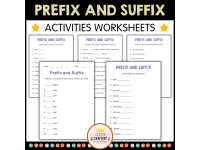
This worksheet pack helps students practice prefixes and suffixes through a variety of engaging word-building and vocabulary activities. Learners strengthen reading, spelling, and vocabulary skills while learning how prefixes and suffixes change the meaning of words.
What’s Included:
A variety of prefix and suffix activities
Word-building exercises with prefixes and suffixes
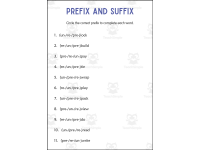
Circle-the-correct-prefix activities
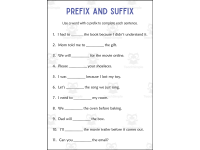
Sentence completion tasks
Vocabulary development exercises
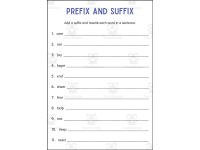
Sentence-writing practice using new words
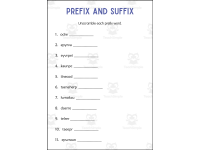
Unscramble-the-word activities
Fun and interactive literacy exercises for young learners
Grades / Ages:
Ideal for Years 2–6
Implementation Format:
Perfect for classwork, homework, literacy centres, or independent practice
Great for phonics lessons, vocabulary review, and reading practice
Supports both guided and independent learning
Answer Key:
Not included
File Type:
PDF (Non-editable)
Number of Pages:
6 pages total
License:
Paid product for personal or single-classroom use only
Tags to Use:
prefix and suffix worksheets, prefixes and suffixes activities, word building worksheets, vocabulary development, phonics worksheets, literacy centres, primary grammar worksheets
Related resources
More resources teachers may find useful
More resources on the same subject and topic.


In the classroom
Teaching tips & learning objectives

Learning objectives
Add a prefix to a base word to make a new word, working from the base word alone
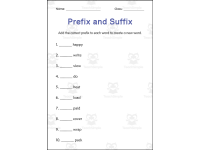
Add a suffix to a base word in the same way, across eleven common bases
Choose correctly between un-, re- and pre- when all three are offered against the same word
Select the prefix word that fits the meaning of a sentence, rather than one that merely sounds right
Use a newly suffixed word inside a sentence of their own, showing they know what it means as well as how it is spelled

Teaching tips
The six pages rise in demand rather than repeating: supplying an affix from nothing on pages 1 and 2, choosing from three on page 3, fitting meaning to a sentence on page 4, and producing an original sentence on page 5
Page 3 is the most supportive page in the set, since un-, re- and pre- are printed beside every word, so it makes a better starting point than page 1 for a class meeting prefixes for the first time
Several base words appear on more than one page - view, do, wrap, pack, write on the prefix pages, and care, use, hope, end, fear, help on the suffix pages - which lets a teacher compare a student's first attempt with a later one
The sentence-completion page carries the meaning clues, so it is the page to use when checking whether a student understands what re- and pre- actually do rather than just where they go
Only the first page has Name and Class lines, which matters if the six pages are handed out separately rather than stapled
Read through the unscrambling page before setting it - several of the jumbles do not resolve using only the letters printed

Skills covered
Building words with prefixes - ten base words on the first page and eleven on the multiple-choice page are turned into new words by adding un-, re- or pre-.
Building words with suffixes - eleven base words are given a suffix, and a second page repeats the demand with the added requirement of a sentence.
Choosing an affix by meaning - the sentence page supplies a context for each gap, so the choice depends on what re-, un- and pre- mean rather than on how the word looks.
Using a new word in writing - the suffix sentence page asks students to produce their own sentence for each word they have formed.
Recognising a prefix word from its letters - the closing page scrambles eleven prefix words for students to reconstruct.
Good to know
Questions teachers ask about this resource
Which prefixes does the set concentrate on?
Three: un-, re- and pre-. The multiple-choice page prints all three against each of eleven base words - lock, build, pay, tie, wrap, play, pack, view, do, read, write - and the sentence page draws on the same set, with gaps pointing at rereading a book, unwrapping a gift, paying for a film online and untying shoelaces.
How do the two suffix pages differ from each other?
By what has to be produced. The first asks only for the suffix, across eleven base words - help, use, quick, care, thank, friend, hope, love, fear, end, home. The second raises the demand: add a suffix and then use the new word in a sentence of your own, working from care, use, joy, hope, end, cheer, fear, help, rest, sleep and need.
Is any support given for choosing the right prefix?
On one page. The multiple-choice page prints un-, re- and pre- beside every word, which turns the task into a choice between three. The other prefix pages give only the base word or the sentence, so the affix has to come from the student.

No reviews yet
Downloaded this resource? Tell other teachers how it went.
Resource details
Concepts & topics
Core concepts
 Core concepts
Prefixes
Suffixes
Word building
Vocabulary
 Topics
Explore more
Categories this resource belongs to
Explore related searches


More to explore