Animals And Their Movements Worksheets





- Year groups
- Years 2–4 (Key Stages 1–2)
- Pages
- 6
- File type
- Preparation
- Print ready


- Subject
- Animals, Life Sciences, Science
- Topic
- Movement of Animals Worksheets, Animal Movement Activities
- Resource types
- Worksheets
- Preparation
- Print ready
From the author
About this resource
Introduction
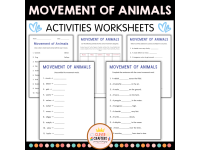
This Movement of Animals worksheet set helps young learners understand how different animals move while building early science and vocabulary skills. Students explore various types of animal movement such as running, flying, swimming, hopping, and crawling. These engaging activities strengthen observation, comprehension, and word recognition in a fun and interactive way.
What’s Included:
Matching animals with their correct movements
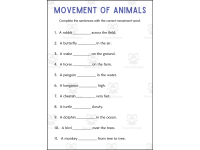
Fill-in-the-blank sentences using movement words
True or False statements to reinforce understanding
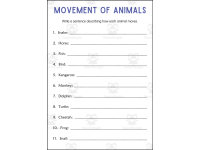
Sentence writing practice describing how animals move
Unscrambling movement-related words
Grades / Ages:
Ideal for Years 3–6
Implementation Format:
Perfect for science lessons, literacy centres, morning work, small group instruction, independent learning, classroom activities, or homework.
Answer Key:
Not included
File Type:
PDF (Non-editable)
Number of Pages:
6 pages total
License:
Paid product for personal or single-classroom use only
Related resources
More resources teachers may find useful
More resources on the same subject and topic.


In the classroom
Teaching tips & learning objectives

Learning objectives
Match an animal to its correct movement verb, such as cheetah to gallops or snail to crawls.
Complete a sentence with the movement verb that correctly describes a named animal.
Sort a list of twenty animals into the correct movement category: runs, flies, swims, hops, or crawls/slithers.
Evaluate true/false statements about how specific animals move and identify inaccurate claims, such as "A fish flies in the sky."
Write an original sentence describing how a given animal moves.

Teaching tips
Use the sort-into-categories page (page 3) as a whole-class warm-up before the more independent true/false and sentence-writing pages.
The true/false page (page 4) contains several deliberately incorrect statements, such as "A fish flies in the sky"; review these as a class to catch and correct the misconception rather than assigning the page purely independently.
Save the unscramble page (page 6) for last as a vocabulary review of the same movement verbs used throughout the set.

Skills covered
Vocabulary matching -- students connect an animal name to the verb that names how it moves, such as cheetah to gallops.
Sentence completion -- students supply the correct movement verb to complete a sentence about a named animal.
Categorical sorting -- students classify twenty animals into five movement categories (runs, flies, swims, hops, crawls/slithers).
Fact evaluation -- students judge true/false statements about animal movement and identify factual errors.
Descriptive sentence writing -- students compose an original sentence describing how a specific animal moves.
Good to know
Questions teachers ask about this resource
Which movement categories does the sorting page use?
Five: Runs, Flies, Swims, Hops, and Crawls/Slithers, applied across twenty listed animals from snake and squirrel to whale and hare.

No reviews yet
Downloaded this resource? Tell other teachers how it went.
Resource details
Concepts & topics
Core concepts
 Core concepts
Animal movement
Action verbs
Categorisation
 Topics
Explore more
Categories this resource belongs to
Explore related searches


More to explore