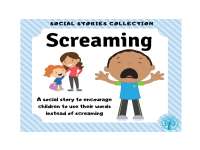
Screaming Social Story

- File type
- Preparation
- Print ready


- Subject
- Social Skills, Special Resources
- Topic
- Social Story, Screaming
- Preparation
- Print ready
From the author
About this resource
Social stories use a patient and reassuring tone to teach children about social situations in a way that can be easily understood. Social stories are particularly useful for children on the autistic spectrum for whom social cues can be challenging and who often suffer anxiety if they do not know what to expect from a situation however social stories can also be useful for any child who is struggling to understand a situation or concept or needs help to understand a social skill or social cue, expectations, perspectives, common responses or is troubled about an upcoming event.
This social story is to support children with a tendency to scream loudly in times of high emotion.
These books should be used over and over to reinforce the point so I would suggest either putting the pages into a display book or laminating and binding them.
Clipart images courtesy of Kari Bolt.
Related resources
More resources teachers may find useful
More resources on the same subject and topic.



In the classroom
Teaching tips & learning objectives

Learning objectives
Name the feelings that come before the urge to scream — frustrated, angry, upset
Describe what screaming does to the people nearby and why it does not solve the problem
Choose one of four alternatives when those feelings arrive: words, a trusted adult, deep breaths, or a quiet place
Repeat the closing resolution as a plan for the next time the feeling comes

Teaching tips
Read it well before a difficult moment rather than during one; the story is written to be familiar in advance, not used as a correction
The four alternative pages are the ones worth returning to — pick the one that suits the child and rehearse it while they are calm
The wording "frustrated or angry or upset" repeats on five pages, which makes it a phrase a child can learn to use about themselves
Bind or laminate the pages, or slide them into a display book, so the story survives being read many times over
The pages are short enough to split: the first half explains the problem, the second half offers what to do instead, and either half can be read alone

Skills covered
Emotional vocabulary — the story gives a child the words frustrated, angry and upset and attaches them to a moment they recognise.
Understanding effect on others — four pages set out what screaming does to the people nearby, including that it hurts their ears and stops anyone helping.
Learning replacement behaviours — using words, seeking a grown up, taking deep breaths and going somewhere quiet are each given a page of their own.
Rehearsing a plan — the closing page states the resolution in the child's own voice, ready to be repeated on later readings.
Good to know
Questions teachers ask about this resource
What alternatives does the story offer instead of screaming?
Four, each on its own page: using words rather than screaming, going to a grown up and talking about what is wrong, trying deep breaths, and going to a quiet place to relax and calm down. All four are written in the child's own voice as things they can do.
How is the text laid out across the pages?
One short sentence to a page, in the first person and the present tense, across eleven story pages between a title page and a credits page. The phrase "frustrated or angry or upset" recurs, which is what lets a child pick it up over repeated readings.
How does the story explain why screaming does not work?
Through four consequences rather than a rule: it makes other people feel upset, it hurts their ears, it does not help solve the problem, and while it is happening nobody can help. The reasoning stays concrete and stops short of telling the child they are being naughty.

No reviews yet
Downloaded this resource? Tell other teachers how it went.
Resource details
Concepts & topics
Core concepts
 Core concepts
Social story
Emotional regulation
Calming strategies
Social skills
 Topics
Explore more
Categories this resource belongs to
Explore related searches


More to explore