Spring Addition & Subtraction Worksheets

- Year groups
- Nursery–Reception (Early Years), Years 1–2 (Key Stage 1)
- File type
- Preparation
- Print ready


- Subject
- Numbers, Maths
- Topic
- Addition, Subtraction
- Resource types
- Worksheets
- Preparation
- Print ready
From the author
About this resource
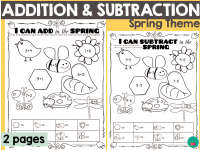
Spring-themed worksheets to help your early learners practice addition, subtraction, and mental maths.
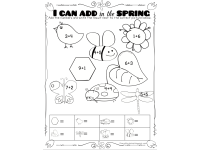
Addition - add the numbers and write the result next to the correct picture on the bottom of the page.
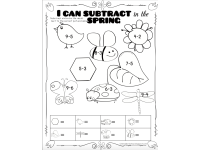
Subtraction - subtract and write the result next to the correct picture on the bottom of the page.
Related resources
More resources teachers may find useful
More resources on the same subject and topic.


In the classroom
Teaching tips & learning objectives

Learning objectives
Add two single-digit numbers with sums up to 10
Subtract within 10, taking a single-digit number from a number no greater than 9
Match a computed answer to the picture it belongs to rather than writing it in place
Recognise that different pairs give the same total — 3+4 and 1+6 both make 7, and 9+1 and 5+5 both make 10

Teaching tips
Because the answers go beside pictures rather than under the sums, children have to keep the result in their head while they find where it belongs — worth modelling one item together before letting the class start
Several answers repeat within a page (7 appears twice on the addition sheet, 2 and 5 twice each on the subtraction sheet), so tell children a picture may share a value with another rather than assuming each answer is unique
The two pages are independent, so the addition sheet can be set weeks before the subtraction one without either losing sense
The headings are "I can" statements, which makes them usable as the wording for a learning objective on the board

Skills covered
Addition within 10 — eight facts including doubles (4+4, 5+5) and near-ten pairs (9+1), all with single-digit addends.
Subtraction within 10 — eight facts taking a single digit from a number up to 9, with differences between 2 and 5.
Equivalent pairs — different addends land on the same total (3+4 and 1+6 both make 7; 6+3 and 4+5 both make 9), which gives children repeated results to notice while they match answers to pictures.
Matching an answer to a target — the direction sends each result to a picture at the foot of the page, so the task ends with a matching step rather than a written column.
Good to know
Questions teachers ask about this resource
How large do the numbers get?
The addition facts use single-digit addends with sums from 7 to 10. Subtraction starts with numbers up to 9 and produces differences from 2 to 5.

No reviews yet
Downloaded this resource? Tell other teachers how it went.
Resource details
Concepts & topics
Core concepts
 Core concepts
Addition
Subtraction
Numbers to 10
Spring
Topics
 Topics
Explore more
Categories this resource belongs to
Explore related searches


More to explore