Subtraction by bridging through 10s up to 100



- Year groups
- Year 3 (Key Stage 2)
- File type
- Preparation
- Print ready


- Subject
- Subtraction, Addition and Subtraction, Maths
- Topic
- Maths, Subtract
- Resource types
- Worksheets
- Preparation
- Print ready
From the author
About this resource
Bridging through 10 is a mental maths technique used when a subtraction means 'breaking through' a multiple of 10 to get to the final answer. e.g. 23 - 7 = 16. This example bridges through 20.
The process of bridging divides the subtraction into 3 simple steps each of which can be handled mentally in order to get to the final answer
This resource has 2 parts
1. Almost Unlimited Worksheets
Worksheet Set 1
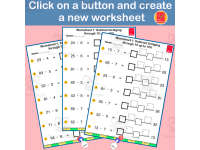
Subtracting 1 digit numbers to 2 digit numbers, bridging up to 100 with visual support
Worksheet Set 2
Pupils have the opportunity to practice this topic further either by using the visual method from Worksheet Set 1 or using their own graphics that support the concept of bridging.
Almost Unlimited Worksheets ?
At the click of a button all numbers are randomised, so the questions change each time. This means you can create as many new worksheets you will need for practice throughout the year (classwork, homework, revision, fillers etc) or even give small groups of students in your class different sets of questions either at the same level or differentiated. There will certainly be enough to ensure fluency in this topic.
As these worksheets need little explanation and no preparation, they are ideal if you need to leave work for a replacement teacher.
Answers can be found on the second page of every worksheet, are automatically generated when you create a new worksheet.
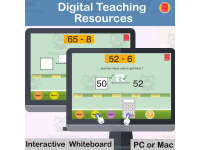
2. Self Checking Interactive Presentation
Ideal for a whole class activity as an introduction to the worksheets, pupils can come to the Whiteboard and enter solutions and get immediate feedback. Examples are randomly generated, as with the worksheets, so you can use this one page as many times as needed until you feel confident your pupils are ready to start the worksheets.
There is also the option to take the pupils through the process in 3 separate steps, one at a time.
You may also like Adding by bridging through 10 up to 100
Note
These resources work with the official Adobe Acrobat Reader on Windows or Mac computers.
Ccss2.nbt.b.5
Fluently add and subtract within 100 using strategies based on place value, properties of operations, and/or the relationship between addition and subtraction.
Related resources
More resources teachers may find useful
More resources on the same subject and topic.


In the classroom
Teaching tips & learning objectives

Learning objectives
Students will subtract a one-digit number from a two-digit number by bridging through the nearest multiple of ten.
Students will use a number-line model to break a subtraction problem into three steps.
Students will check completed subtraction problems against a fully worked answers page.

Teaching tips
Use the interactive whiteboard page first to model the three bridging steps as a whole class before assigning either worksheet.
Assign Worksheet 1 for guided practice with the printed number-line scaffold, then move to Worksheet 2 once students can bridge through ten without it.
Because the worksheet numbers are randomised before printing, generate a fresh set of problems for extra practice, homework, or a substitute teacher.
Have students compare their completed worksheet against the answers page themselves to check each of the three bridging steps.

Skills covered
Bridging-through-10 subtraction — students subtract a one-digit number from a two-digit number by breaking the problem into three steps that cross a tens boundary, such as 52 − 6 becoming 52 → 50 → 46.
Mental-maths strategy use — the three-step process replaces column subtraction with a place-value-based mental strategy.
Number-line reasoning — each problem is modelled as jumps back along a number line to reach the answer.
Self-checking practice — students compare their completed worksheet against a fully worked answers page for every problem.
Good to know
Questions teachers ask about this resource
How does the randomised worksheet feature work?
Clicking the orange button on Worksheet 1 or Worksheet 2 generates a new set of subtraction problems before printing, so a fresh worksheet with different numbers can be produced each time more practice is needed.
What is the difference between Worksheet 1 and Worksheet 2?
Worksheet 1 gives each problem the three-step number-line structure for guided practice, while Worksheet 2 removes that printed scaffold so students bridge through ten using their own drawn steps or method.

No reviews yet
Downloaded this resource? Tell other teachers how it went.
Resource details
Concepts & topics
Core concepts
 Core concepts
Subtraction within 100
Bridging through ten
Number line strategy
Place value
 Topics
Explore more
Categories this resource belongs to
Explore related searches


More to explore