Bridges Maths Worksheets


- Year groups
- Years 3–4 (Key Stage 2)
- File type
- Preparation
- Print ready


- Subject
- Numbers, Maths
- Topic
- Bridges, Ordering Numbers
- Resource types
- Worksheets
- Preparation
- Print ready
From the author
About this resource
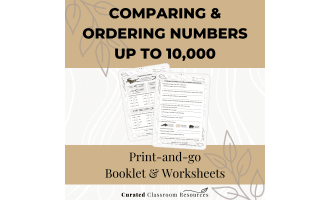
This resource is a U.S. Bridge Lengths Maths Worksheet.
There will be a list of 12 bridges and their lengths. Students will use that information to list the bridges in order from shortest to longest.
There is an additional worksheet ideal for your Year 4 students or advanced Year 3 maths students. On this worksheet, students will read the bridge lengths and round as instructed. Underline the place you’re rounding to. They will answer estimation questions and a bonus division question.
Answer keys are included.
Related resources
More resources teachers may find useful
More resources on the same subject and topic.



In the classroom
Teaching tips & learning objectives

Learning objectives
Order a set of multi-digit numbers (bridge lengths) from least to greatest.
Round multi-digit whole numbers to a specified place, from the nearest ten to the nearest ten thousand.
Use a rounded benchmark (5,000 feet per mile) to estimate a real-world measurement in different units.
Solve a division word problem involving equal spacing (beams every 25 feet).

Teaching tips
Assign the ordering worksheet (pages 1-2) before the rounding worksheet, since both use the same twelve bridges and the ordering task builds familiarity with the numbers first.
Have students underline the digit they are rounding to before writing an answer, per the rounding worksheet's own instruction, to make their reasoning visible.
Use the bonus beam-spacing problem as an extension for students who finish early, since it applies division to the same bridge-building theme.

Skills covered
Ordering multi-digit numbers -- students sequence twelve bridge lengths from 400 to 35,720 feet from shortest to longest.
Rounding to a specified place -- students round the same twelve lengths to the nearest ten, hundred, thousand, or ten thousand as instructed per item.
Real-world estimation -- students convert rounded bridge lengths into approximate miles using a 5,000-feet-per-mile benchmark.
Division word problem -- students calculate a beam count for a 1,000-foot bridge spaced every 25 feet in the bonus question.

No reviews yet
Downloaded this resource? Tell other teachers how it went.
Resource details
Concepts & topics
Core concepts
 Core concepts
Place value
Rounding
Ordering multi-digit numbers
Estimation
 Topics
Explore more
Categories this resource belongs to
Explore related searches



More to explore
You may also like