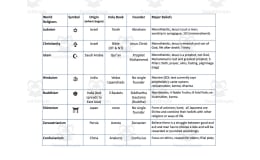
World Religions Comparison Chart Reference


- Year groups
- Years 7–9 (Key Stage 3)
- File type
- Preparation
- Print ready


- Subject
- Religion, Life Studies
- Topic
- World Religions, Review Chart
- Resource types
- Charts
- Preparation
- Print ready
From the author
About this resource
This is a World Religions Review Chart.
This is a 1-page printable for students to use before an assessment.
Related resources
More resources teachers may find useful
More resources on the same subject and topic.

In the classroom
Teaching tips & learning objectives

Learning objectives
Identify the founder, holy book, and core beliefs of five major world religions.
Compare the geographic distribution of each religion in 1500 AD to its distribution today.
Recognise key religious concepts such as the Five Pillars of Islam and the Four Noble Truths of Buddhism.

Teaching tips
Use as a pre-test review handout rather than a first-exposure teaching tool, since entries are condensed to single words and short phrases.
Address the chart's own noted discrepancy over Hinduism's classification directly with students to prevent test-day confusion.
Pair with primary-source excerpts or a documentary for each religion, since the chart summarises but does not explain each belief system.

Skills covered
World religions comparison — students cross-reference five religions' founders, holy books, and beliefs using a single chart.
Historical geographic reasoning — students compare where each religion was concentrated in 1500 AD versus its distribution today.

No reviews yet
Downloaded this resource? Tell other teachers how it went.
Resource details
Concepts & topics
Core concepts
 Core concepts
World religions
Comparative religion
Judaism
Christianity
Islam
Hinduism
Buddhism
 Topics
Explore more
Categories this resource belongs to
Explore related searches



More to explore