


Search results for Physics
Results use exact search terms from the released United Kingdom inventory.


Light Bulb Experiment
, Not Grade Specific,
Paper circuit experiment: students lay copper tape along an illustration, tape LED pins across a gap, add a button battery to close the circuit and glue a cut-out light bulb over the glowing LED.
Author Educational Voice
Rating
Tags Light Bulb Experiment, Light Bulb, Light Bulbs, Light Bulb Facts, Light Bulb Facts For Kids, Physics, Physics For Kids, Physics Facts For Kids

Magnetic Objects Worksheet
, Not Grade Specific,
Magnets turns prior knowledge into a testable prediction. Students inspect everyday object pictures, decide whether each is likely to respond to a magnet, and circle their choices. The closing questions explicitly invite discussion and hands-on testing, making room for revision when a prediction is incorrect. The activity supports the important distinction between an object’s appearance and the material it contains, since not every shiny or metal-looking item is necessarily attracted to a magnet.
Author Have Fun Teaching
Rating
Tags Force And Motion, Objects That Are Magnetic, Magnetic Objects

Make A Kite Activity
, Not Grade Specific,
Kite design activity: students answer questions about gravity and lift, choose a soft, box or diamond kite, plan materials and construction stages, then build the kite and record whether it flies.
Author Elementary Resources 4 U
Rating
Tags Kite Making, Science, Forces, Science Activities, Physical Science, Gravity, Movement, Graphic Organizers, Data, Kites Lesson Plan

Making Things Move Worksheet
, Not Grade Specific,
Five labelled spaces organise the worksheet by source of motion. Rather than matching a supplied picture, learners draw their own example for manpower, electrical power, wind, gravity, and an engine. The open response makes differences among energy or force sources visible through selected objects. Comparing the finished drawings can also reveal cases where an object uses more than one source or where learners need to distinguish a source from the mechanism that transfers motion.
Author Elementary Resources 4 U
Rating
Tags Charts, Science Worksheet, Movement, Physics, Gravity, Electricity, Graphic Organizers, Engines, Power Sources, Makingthingsmove, Things That Move

Musical Instrument Design Challenge
, Not Grade Specific,
Maker design challenge in which students research how instruments produce sound, then build an original one-person instrument from cardboard, rubber bands, containers and other upcycled materials, testing and redesigning until it plays.
Author WhyMaker
Rating
Tags Musical Instrument Design, Creativity, Hands-on Learning, STEAM Education, Problem-solving

Nuclear Energy – Fission and Fusion - Digital Science Reading Article-Years 6–8
, Not Grade Specific,
Nuclear fission and fusion are explained in a short nonfiction article covering power-plant operation, the two families of nuclear weapon, current applications and radioactive waste, followed by eight comprehension questions, two extension questions and a worked answers page.
Author Teach With Fergy
Rating
Tags Nuclear Energy, Fission, Fusion, Science Curriculum, Disciplinary Literacy, Fission And Fusion Worksheet, Fission Vs Fusion Worksheet

Physics Google Form Test: Lens
, Not Grade Specific,
A copy link provides access to a hosted physics form on lenses. The supplied document is an access page; open the form before assigning it to students.
Author Schrim's Chem
Rating
Tags Physics Quiz, Converging Lens, Ray Diagrams, Magnification Calculations, Interactive Learning
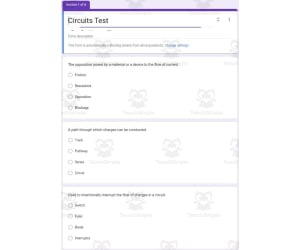
Physics Google Form Test:Circuits
, Not Grade Specific,
Access a hosted physics form on circuits through the copy link in the supplied document. Open the form to review the activity before assigning it to students.
Author Schrim's Chem
Rating
Tags Physics, Circuits, Google Forms, Automatic Grading, Real-life Applications

Pulleys Worksheet
, Not Grade Specific,
Fixed, moving, and combined pulley systems appear alongside a concise simple-machines explanation. The reading notes that adding pulleys can reduce the effort needed to lift a load. In the application section, learners inspect diagrams, draw arrows along each portion of rope, and label the load and effort locations. The task emphasises how motion travels through the system as well as the names of its working parts.
Author Have Fun Teaching
Rating
Tags Energy, Machines, Simple Machines, Force

Push or Pull Force Worksheet – Year 3 Science
, Not Grade Specific,
Push or Pull introduces force direction through familiar pictured actions. Students inspect what is happening, decide whether the object is being moved away from the source of force or drawn toward it, and label the image accordingly. The simple two-word response keeps the focus on conceptual classification. Teachers can extend the page with classroom demonstrations in which the same object is first pushed and then pulled, emphasising that the force depends on the action rather than the object itself.
Author Have Fun Teaching
Rating
Tags Force And Motion, Push Or Pull Worksheets, Push And Pull Force Examples, Examples Of Pushing And Pulling Forces, Pull Forces Examples, Push And Pull Experiments, What Is Pull Force, Pull Force Examples, Force Worksheets, What Is A Pull Force, Is Force A Push Or Pull, Push Or Pull Force, Force Worksheet

Push or Pull Worksheet 2
, Not Grade Specific,
Students list objects that move and use a two-column table to mark whether each one is pushed, pulled, or both.
Author Elementary Resources 4 U
Rating
Tags Push Or Pull, Gravity, Force, Physical Science, Physics, Science Worksheet, Motion, Graphic Organizer, Chart

Renewable and Nonrenewable Energy Crossword Puzzle Review Activity
, Not Grade Specific,
Crossword review of energy vocabulary: students use short definition clues, with or without a word bank, to fill in terms such as solar, geothermal, biomass, uranium and fossil fuels.
Author Teach With Fergy
Rating
Tags Crossword Puzzle, Science Crossword, Crossword Review, Renewable Energy, Nonrenewable Energy, Energy

Scratch: Platform Physics (Game Mechanics #6)
, Not Grade Specific,
Platformer physics guide for Scratch covering custom blocks, variables, ground and wall detection, and gravity for moving and jumping a character.
Author Roombop
Rating
Tags Scratch, Platform Physics, Game Mechanics, Custom Blocks, Physics-Based Games, Simple Physics Game, Physic Games Download, Science Physics Game, Simple Game Mechanics

Shadows Drawing Worksheet
, Not Grade Specific,
Several pictured scenes pair an object with a visible light-source position. Several pictured situations show both an object and the location of its light source. Learners draw the missing shadow in a position consistent with that light direction. The task turns a verbal definition into spatial reasoning, requiring students to imagine the path of light and place the shadow on the opposite side of the object.
Author Have Fun Teaching
Rating
Tags Energy, Light, Shadow Drawing Easy

Shadows Worksheet
, Not Grade Specific,
The directions explain that a shadow forms when an object blocks sunlight and note that sun height affects shadow length. Learners examine several object-and-sun arrangements and draw the shadow each would cast. This requires translating light direction into an opposite-side projection rather than copying a supplied example. A short public-domain poem also appears on the page.
Author Have Fun Teaching
Rating
Tags Cause And Effect, Light

Solid Liquid Gas Worksheet
, Not Grade Specific,
Solid Liquid Gas Worksheet connects observable examples with particle models. For each state of matter, learners draw an object, illustrate how its molecules are positioned or moving, and add a description that distinguishes it from the other states. The three-column structure keeps solid, liquid, and gas evidence side by side for comparison. An introductory statement explicitly connects molecular position and movement with a material's state.
Author Have Fun Teaching
Rating
Tags States Of Matter, Matter

Sound Energy Printable – How We Hear Visual
, Not Grade Specific,
Vibrating objects, sound waves, and moving air particles are traced through a single diagram that also explains how vibration speed sets a sound's pitch.
Author Teaching on the Island
Rating
Tags Sound Energy, Physical Science, Sound Waves, Anchor Chart, Parts Of A Wave

Sources of Light Worksheet
, Not Grade Specific,
Two charts headed "Investigating Light and Shadows" - one collecting words associated with light and dark in labelled columns, one recording sources of light with the sun given as the opening example.
Author Elementary Resources 4 U
Rating
Tags Sources Of Light, Investigating Light, Investigating Shadows, Graphic Organizer, Science Chart, Science Vocabulary, Small Group Work

Static Electricity - Electrostatics Word Search and Scramble Activity
, Not Grade Specific,
Static electricity and electrostatics vocabulary — charge, induction, Faraday cage, and more — is reviewed through a word search, a word scramble, and a define-the-term sheet.
Author Teach With Fergy
Rating
Tags Word Search, Word Scramble, Static Electricity, Electrostatics

Static Electricity Experiments with Household Items
, Not Grade Specific,
Ten hands-on static electricity experiments use household items like balloons, combs, and wool to demonstrate charge attraction, repulsion, and everyday examples.
Author Bright Classroom Ideas Marketplace
Rating
Tags Static, Electricity, Experiment, Elementary, Science, Physics

Tools Worksheet
, Not Grade Specific,
Tools places practical vocabulary inside use-based contexts. The word bank includes common hand and power tools, while each sentence describes a task or situation requiring one of them. Students choose the item that fits the action, using both tool knowledge and sentence meaning. Since several tools may be familiar but serve different purposes, the page encourages precise distinctions among cutting, fastening, gripping, levelling, smoothing, drilling, and clamping functions.
Author Have Fun Teaching
Rating
Tags Have Fun Teaching

Who Has the Lab Equipment? – Interactive Science + Chemistry Game
, Not Grade Specific,
Who Has the Lab Equipment? uses a call-and-response card chain to practise science-tool vocabulary. Three levels progress from simple-font terms with pictures, through mixed term-and-image prompts, to a more demanding version. Each set contains thirty cards, for ninety cards overall. Preparation guidance covers printing, optional lamination, cutting, shuffling, and distribution. During play, students listen for the item named on another card and respond with the matching tool, reinforcing both recognition and attentive participation.
Author Lernfitness
Rating
Tags Game, Educational Card Games, Chemistry, Lab, Biology, Laboratory Equipment, Lab Tools, Physics, STEM Science Matching Game, Who Has It?