Science Reading Comprehension Passage 25: Nervous System PDF


- Grades
- Grades 5–7
- Pages
- 8
- File type
- Microsoft PowerPoint
- Answer key
- Included


- Subject
- Human Body, Reading Comprehension, Life Sciences, ESL, Vocabulary, Science, Reading, Language Development, ELA
- Topic
- Science, Elementary
- Resource types
- Tests, Quizzes and Tests, Assessments, Teacher Tools, Worksheets, Worksheets & Printables
- Answer key
- Included
From the author
About this resource
Free Reading Passage on Nervous System for Life Science
What's inside this free product?
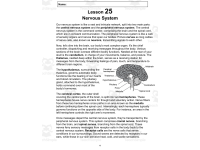
Science Reading Comprehension Passage: Nervous System
Independent PDF Version:
This is the independent PDF version containing one lesson.
Product Info:
8 PAGES (US English with Answers) PDF Version
Teaching Duration: 90 Minutes
Science Reading Comprehension Outline:
The passages present a diverse set of questions – from multiple choice to data analysis and fill-in-the-blanks. This ensures a rich blend of high-interest content and fundamental curriculum-based science themes.
With its versatility, you can seamlessly integrate these lessons into various classroom settings, whether it's whole class discussions, morning exercises, independent desk tasks, small group engagements, contingency plans for substitute teachers, regular homework assignments, or even themed activities for holidays.
FULL CATALOG OF DOWNLOAD LINKS HERE
Grade 5/6 Links:
Physical Science Part 1 - Physical and Chemical Properties
Google Docs/Slides/Forms
PPT
Word
Free Supplementary Pack
Accompanying Videos
Physical Science Part 2 - Motion and Energy
Google Docs/Slides/Forms
PPT
Word
Free Supplementary Pack
Accompanying Videos
Physical Science Part 3 - Electricity and Magnets
Google Docs/Slides/Forms
PPT
Word
Free Supplementary Pack
Accompanying Videos
Life Science Part 1 - Cells, Reproduction and Genetics
Google Docs/Slides/Forms
PPT
Word
Free Supplementary Pack
Accompanying Videos
Life Science Part 2 - Human Body Systems
Google Docs/Slides/Forms
PPT
Word
Free Supplementary Pack
Accompanying Videos
Life Science Part 3 - Plant Parts and Ecosystems
Google Docs/Slides/Forms
PPT
Word
Free Supplementary Pack
Accompanying Videos
Earth Science Part 1 - Plate Tectonics and Rock Cycle
Google Docs/Slides/Forms
PPT
Word
Free Supplementary Pack
Accompanying Videos
Earth Science Part 2 - Ocean Exploration and Natural Resources
Google Docs/Slides/Forms
PPT
Word
Free Supplementary Pack
Accompanying Videos
Earth Science Part 3 - Weather and Solar System
Google Docs/Slides/Forms
PPT
Word
Free Supplementary Pack
Accompanying Videos
For similar products and other frees, do check out Cored Group on TeachSimple.
Related resources
More resources teachers may find useful
10 related resources were found in the released localized catalogue using shared categories and topics.


In the classroom
Teaching tips & learning objectives

Learning objectives
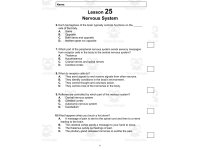
Students identify the functions of specific brain regions: cerebellum, thalamus, hypothalamus, pituitary gland, and cerebral cortex.
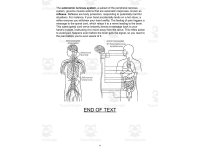
Students distinguish the central, peripheral, and autonomic nervous systems by function.
Students explain the reflex-response process using the passage's hot-stove example.
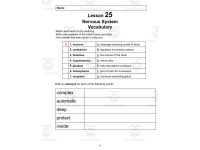
Students match domain-specific vocabulary terms to their definitions and produce antonyms for five passage words.

Teaching tips
Preview the seven vocabulary terms (neurons, cerebellum, thalamus, hypothalamus, pituitary, hemispheres, receptors) before reading, since question 11 and the vocabulary match both depend on them.
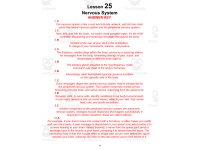
Use the answer key's passage excerpts to show students exactly where each multiple-choice answer comes from, modeling how to cite textual evidence.
Assign the antonym exercise (complex, automatic, deep, protect, inside) as a quick vocabulary extension once the comprehension questions are checked.

Skills covered
Informational text comprehension — students answer ten multiple-choice and two matching-style questions using details from a nervous-system passage.
Domain-specific vocabulary — students match seven anatomy terms (neurons, cerebellum, thalamus, etc.) to their definitions.
Antonym identification — students produce an antonym for each of five passage words.
Citing textual evidence — the answer key models pointing to the exact sentence in the passage that supports each answer.
Good to know
Questions teachers ask about this resource
How does the passage explain why a reflex happens so quickly?
It uses the example of touching a hot stove: a reflex withdraws the hand immediately, acting before the brain has even registered the pain, illustrating how the nervous system can act faster than conscious thought.

No reviews yet
Downloaded this resource? Tell other teachers how it went.
Resource details
Concepts & topics
Core concepts
 Core concepts
Nervous system structure
Brain region functions
Reflex response
Domain-specific vocabulary
 Topics
Explore more
Categories this resource belongs to
Explore related searches

More to explore