



Search results for Statistics
Results use exact search terms from the released Canada inventory.


Adding Tens and Ones Worksheet
, Not Grade Specific,
Adding Tens and Ones provides varied notation while keeping the place-value demand focused. Early problems are arranged vertically, and later ones appear as horizontal expressions, requiring students to recognize the same addition structure in both formats. The directions specify no regrouping, so learners can concentrate on combining tens with tens and ones with ones. A filled reference page gives the final sums. The mixed layout supports transfer from column notation to mental or written horizontal calculation.
Author Have Fun Teaching
Rating
Tags Statistics, Adding Tens Worksheet, Adding Tens And Ones

Author's Claims Anchor Chart
, Not Grade Specific,
A claim-and-reasons anchor chart names the signal words that mark an argument, and comes with a blank version to fill in together plus a worked passage about dogs. A claim-and-reasons anchor chart names the signal words that mark an argument, backed by a blank fill-in version and a worked passage about dogs.
Author First in Line
Rating
Tags Reading Printable, Interactive Notebook, Author, Point Of View, Language Arts, What Is The Author's Claim?, What Is The Author’s Main Claim?, How Do The Authors Use Statistics To Support Their Claim, Authors Claims, Author's Claim, Author Study Worksheet, What Is Author's Claim, What Is The Author’s Claim?, How To Find The Author's Claim, How Do The Authors Use Statistics To Support Their Claim?, What Is The Author’s Purpose? What Is The Author’s Claim?, What Is The Author's First Claim, What's An Author's Claim, Whats An Authors Claim, Teaching Authors

Compose and Decompose Numbers 11-19 Activity
, Not Grade Specific,
This activity is perfect for helping students build number sense! Using ten frames, students will compose and decompose numbers 11-19. This is a great way to help students understand place value and how to build numbers.
Author Have Fun Teaching
Rating
Tags Statistics, Numbers 11-19, Compose Numbers

Counting Bugs Worksheet
, Not Grade Specific,
Counting Bugs gives repeated one-to-one counting practice across differently arranged insect sets. Each square contains one picture collection, and students determine its total before recording the number nearby. Changing density and placement means learners need a consistent tracking strategy rather than relying on visual estimation alone. The bug-count checking sheet supplies the totals for checking. Teachers can use errors to discuss marking counted images, grouping, or scanning in rows when pictures are crowded.
Author Have Fun Teaching
Rating
Tags Statistics
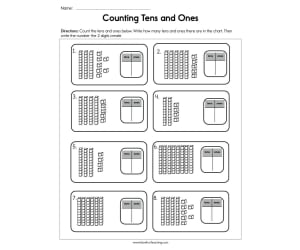
Counting Tens and Ones Worksheet
, Not Grade Specific,
Learners inspect place-value representations and record how many tens and ones are shown in a chart. They then combine those quantities to write the two-digit number represented by the model. The sequence moves from concrete grouping to place-value notation, making each digit's role visible. A labelled second page supplies a completed reference after students have counted the groups and connected them with numerical form.
Author Have Fun Teaching
Rating
Tags Statistics, How To Teach Tens And Ones To Kindergarten

Creating Dot Plots and Histograms: Grade 6 Statistics and Graphing
, Not Grade Specific,
A five-step statistics project has students write their own survey question, collect real responses from 20 people, and chart the results as both a dot plot and a histogram.
Author Grace Under Pressure
Rating
Tags Graphing, Statistics, 6th Grade Math, Grade 6 Math, Applied Math

Determining Place Value Worksheet
, Not Grade Specific,
For every three-digit numeral, learners fill three labelled blanks identifying its hundreds, tens, and ones values. The label order changes from item to item, preventing responses from being copied mechanically by position. This design requires reading each place name before selecting the corresponding digit, including cases where a place contains zero. The labelled second page gives the completed decompositions for all nine numerals.
Author Have Fun Teaching
Rating
Tags Statistics

Drawing Tens and Ones Worksheet
, Not Grade Specific,
Each box starts with a numeral rather than a pre-drawn model. Learners decompose the value, draw groups for the tens and units for the ones, and attempt an equation that recombines the parts. This requires translating from abstract notation into a visual base-ten representation and expanded addition. The second supplied page is labelled for checking, allowing teachers to review both the drawing structure and equation relationship.
Author Have Fun Teaching
Rating
Tags Statistics
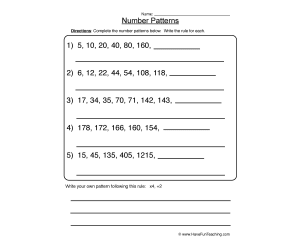
Finding Number Patterns Worksheet
, Not Grade Specific,
Number Patterns moves beyond filling a single missing value by requiring rule identification. The sequences combine multiplication, addition, and subtraction structures, and some alternate between two operations. Students continue each list, then write the rule that explains every transition. A final open prompt supplies a compound rule and asks for an original sequence. This arrangement helps distinguish genuine structural reasoning from guessing the next number based only on the most recent change.
Author Have Fun Teaching
Rating
Tags Statistics, Number Pattern Worksheet, Find The Number Worksheet, Math Patterns Worksheet
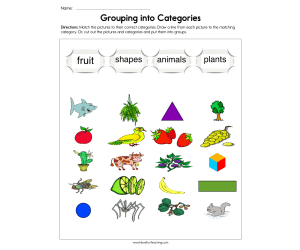
Grouping into Categories Worksheet
, Not Grade Specific,
Grouping into Categories provides two ways to complete the same classification task. Learners may draw lines from pictures to their matching category, or cut apart the pictures and labels to build physical groups. The four headings require attention to what each image represents rather than a superficial visual feature. A completed reference page shows the intended grouping. The flexible response format supports pencil work, small-group manipulation, or oral sorting with explicit category explanations.
Author Have Fun Teaching
Rating
Tags Statistics

Hundreds Tens and Ones Worksheet
, Not Grade Specific,
The page displays eight numerals with separate response lines for the three place names. Learners read the full number, examine each digit’s location, and record which digit occupies hundreds, tens, and ones. One example contains zero in the ones position, ensuring that an empty quantity is still represented as a meaningful place. The completed second page gives a direct reference for all eight place-value identifications.
Author Have Fun Teaching
Rating
Tags Statistics
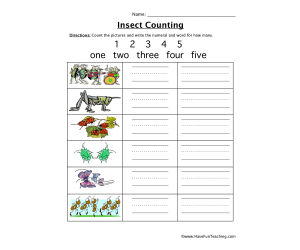
Insect Counting Numbers 1-5 Worksheet
, Not Grade Specific,
Insect Counting links three representations of small quantities. Learners count each illustrated insect group, write the matching numeral, and also record the corresponding number word. A printed bank of values from one through five supports the written responses, while a completed companion page shows the intended matches. Moving from objects to digits and words helps children see that each form names the same amount and gives early practice with conventional number-word spelling.
Author Have Fun Teaching
Rating
Tags Statistics

Less and More Worksheet
, Not Grade Specific,
Less and More Worksheet separates quantity comparison into two focused tasks. On the first page, learners inspect each pair of pictured groups and circle the set containing fewer objects; the second page reverses the prompt and asks for the set containing more. Keeping the layouts parallel lets teachers introduce the two comparison words one at a time before asking learners to contrast their meanings.
Author Have Fun Teaching
Rating
Tags Statistics, More Or Less Worksheet
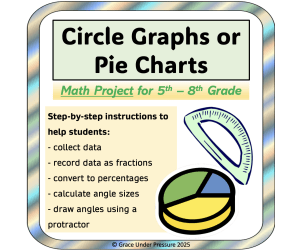
Math Project: How to Make Circle Graphs and Pie Charts
, Not Grade Specific,
Students survey 25 classmates on a six-answer question, convert the tally results into fractions, percents, and degrees, then use a protractor to hand-draw their own circle graph.
Author Grace Under Pressure
Rating
Tags Math Project, Pie Charts, Graphing, Data Collection, Percent, Angles, Protractor, Equivalent Fractions, Circle Graphs Math, Circle Graphs
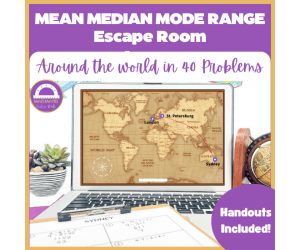
Mean Median Mode Range Escape Room
, Not Grade Specific,
Four themed statistics worksheets — range, median, mean, and mode — send students through a city-to-city escape-room storyline, ten data-set problems per stop.
Author Matemaths
Rating
Tags Matemaths, Escape Room, Statistics, Mean, Median, Mode, Range, Printable, Worksheets, Task Cards

Penny Spinners STEAM Activity with Spinner Template
, Not Grade Specific,
Students build a spinning-penny top from a printed template, time and record eight spins, then graph the results and calculate mean, median, and mode from their own data.
Author O'Hoppy Day
Rating
Tags Science, Penny Spinners, STEAM, Cross-curricular, Template, Craft
Probability Problems Code Breaker
, Not Grade Specific,
Probability practice runs as a digital code-breaker on Google Forms, reached through the launch sheet included in the download.
Author Matemaths
Rating
Tags Probability, Escape Room, Code Breaker, Google Forms, 7th Grade Simple Probability Games, Fun Probability Problems, Probability Problems 7th Grade
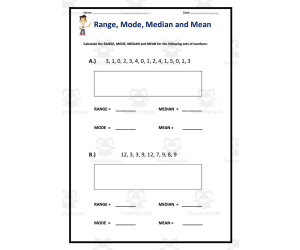
Range, Mode, Median, and Mean Worksheet Set
, Not Grade Specific,
Six data sets of six to fifteen numbers ask students to calculate range, mode, median, and mean, with a full answer key and a separate teaching-notes sheet explaining the four measures using its own example data.
Author Elementary Resources 4 U
Rating
Tags Math Worksheet, Math Homework, Range, Median, Mode, Mean, Data Analysis, Data Worksheet, Measuring Data, Worksheet

Sorting and Grouping Worksheet
, Not Grade Specific,
Sorting and Grouping Worksheet presents two different kinds of classification on the same activity page. Learners place cats, birds, dogs, pigs, vans, boats, cars, jets, and bikes into animal or vehicle groups, then sort bees, lemons, suns, cheese, drums, horns, songs, buses, babies, and yelling by yellow or loud attributes. The checking page lists the intended membership for each of the four groups.
Author Have Fun Teaching
Rating
Tags Statistics, Sorting And Grouping Worksheets, Grouping Worksheets

Sorting Animals into Groups Worksheet
, Not Grade Specific,
Sorting Animals into Groups develops biological classification through a broad animal-name bank. Students read each name, recall its defining traits, and place it under one of six class headings. The collection includes familiar and less common examples, so they must use features such as body covering, breathing, development, and anatomy rather than habitat alone. A completed companion page supplies the intended groups for review and can support discussion of animals that are often misclassified.
Author Have Fun Teaching
Rating
Tags Statistics

Sorting Objects Worksheet – Group by Category
, Not Grade Specific,
Sorting Objects Worksheet combines category membership with counting. Learners use the letters attached to twelve pictures to place three items in each of four groups—animals, plants, vehicles, and people—then write the number of objects assigned to every group. A checking page identifies the letter set and total for each category, preserving both parts of the task and allowing the classification and counting responses to be reviewed independently.
Author Have Fun Teaching
Rating
Tags Statistics, Kindergarten Sorting Worksheet, Kindergarten Sorting Worksheets, Sorting Videos For Kindergarten, Sorting For Kindergarten Worksheets, Sorting Worksheet Kindergarten, Preschool Sorting Worksheets

Tens and Ones Adding Worksheet
, Not Grade Specific,
The page presents sixteen equations using two-digit numbers and explicitly states that regrouping is not required. Early items use stacked notation, while later items switch to horizontal equations, requiring learners to preserve place-value alignment across both layouts. Focusing on separate tens and ones supports calculation by place rather than counting all units individually. The second page is labelled as the completed reference for the full problem set.
Author Have Fun Teaching
Rating
Tags Statistics