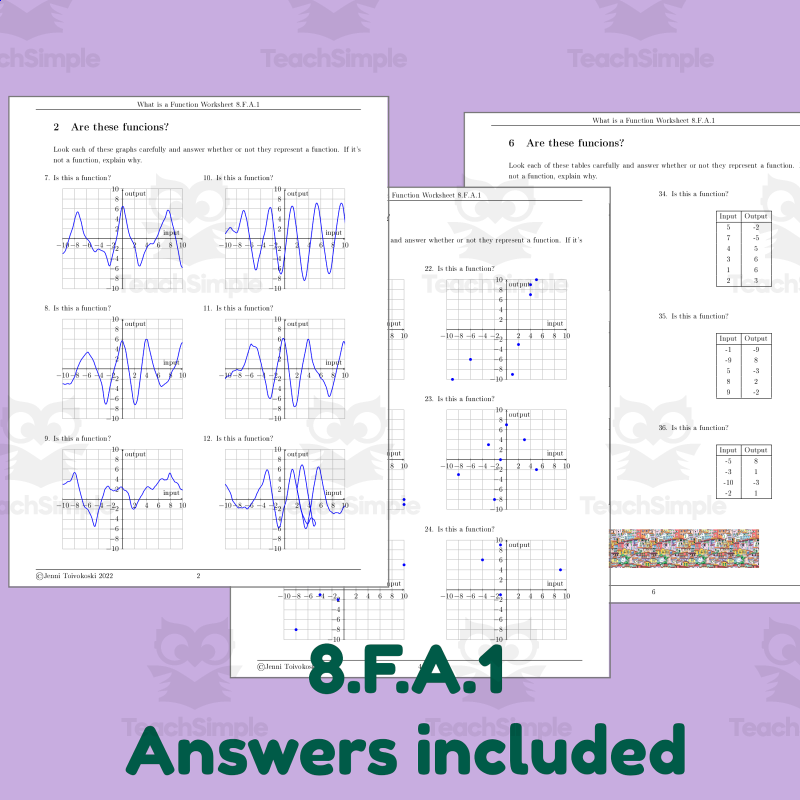
What is a Function? Worksheet 8.F.A.1
A practice worksheet (CCSS 8.F.A.1) where students determine whether a series of graphs represent functions.




50 resources
Explore calculus concepts with comprehensive worksheets. Prepare students for college-level math.
Explore sub-categories
1 sub-categories · 50 resources
A practice worksheet (CCSS 8.F.A.1) where students determine whether a series of graphs represent functions.

A worksheet for 8th-grade algebra practice comparing linear functions represented in different formats (graph, table, equation, verbal description), aligned to Common Core 8.F.A.2.

Represent the same line in several connected ways. Charts A through H provide starting information for a linear function and ask students to complete equation forms, intercepts, slope, points, a table and a graph. Chart I lets students create a function of their own. The answer key covers A through H and notes where valid responses can vary, helping teachers discuss why different points or tables can still represent the same line.

Eight quadratic-function problems ask students to determine domain, range, intercepts, vertex, increasing and decreasing intervals, and end behavior. Four functions are presented as graphs and four as standard-form equations. Two answer pages provide completed characteristic tables; students should show their algebra separately. The file is labeled Version 2: Standard Form.
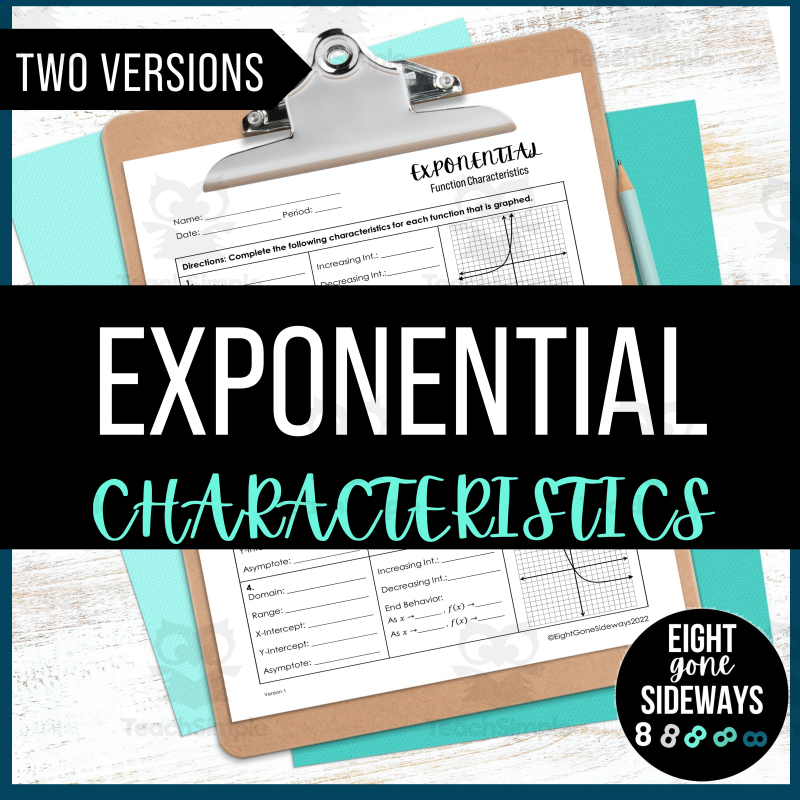
Students read exponential graphs and equations to identify domain, range, intercepts, horizontal asymptotes and end behavior. Two eight-function worksheet versions provide a second opportunity to work with the same concepts using different functions. Use the completed keys to discuss interval and limit notation, and have students keep separate scratch work for equation-based items so their reasoning remains visible.
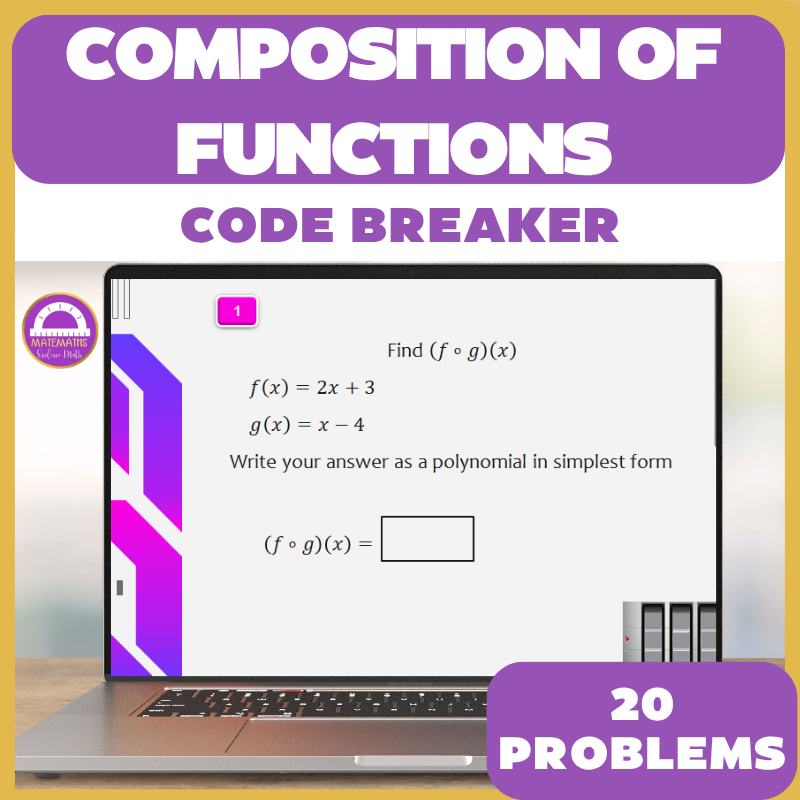
A composition-of-functions practice worksheet paired with a digital "code breaker" activity for algebra/precalculus students.

A math mini-unit of guided notes, extra practice, homework and quizzes for teaching how to graph rational functions and identify key features (intercepts, holes, vertical/horizontal asymptotes).

A practice worksheet with answer key for evaluating limits at infinity of polynomial and rational functions and finding horizontal asymptotes.

Worksheet with 10 questions along with the answers, calculating the limit as the function approaches either to positive or negative infinity of the most common transcendental functions: logarithmic, and trigonometric functions.

Quadratic Functions: Factored Form and Zeros is an informative 9th-12th grade mathematics resource. Students will strengthen their understanding of quadratic functions through detailed guided notes explaining factored form and zeros. Educators can implement this resource in various settings - it works well for whole group instruction,…

Compare the two ends of each exponential function. Students evaluate a limit as x approaches negative infinity and another as x approaches positive infinity for each of ten problems. The expressions include individual exponential terms, sums and differences, and quotients. An answer page lists the two results for each function, making it useful for checking practice after a lesson on exponential end behavior.

Practice evaluating exponential functions f(x) = a*b^x at given input values, using a self-checking color-by-number activity (digital and printable) where each answer maps to a color.

A multiple-choice practice worksheet (with an optional linked digital Google Forms version) for interpreting slope and y-intercept from graphs and tables and comparing properties of two linear functions, aligned to CCSS.MATH.CONTENT.8.F.A.2 and 8.F.B.4.
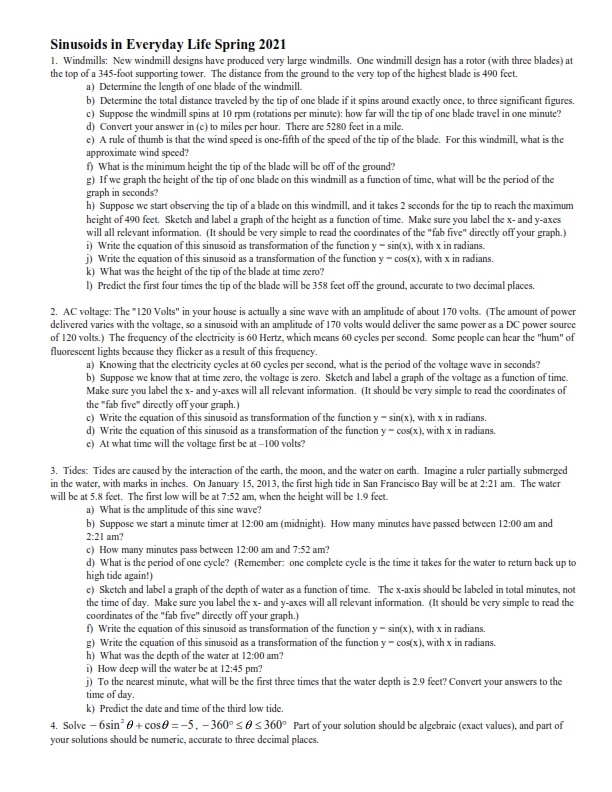
A worksheet applying sinusoidal (sine/cosine) functions to real-world contexts -- windmill blade height, AC voltage, and ocean tides -- to practice writing and interpreting trigonometric equations.

Connect vertex, standard and factored forms through a warm-up, three worked conversion examples, a graphing mini-lesson, eight practice problems and four reflection questions. Some tasks start from a graph. The 26-page PDF contains 13 student/reference sheets, front matter and answer material. Discuss when real linear factors exist and correct the reflection key’s notation before using it.

High-school algebra practice converting between and using three forms of linear equations (slope-intercept, standard, and point-slope), assuming prior instruction in all three forms.

Teach students to choose a function rule by checking its interval before evaluating or graphing. The notes and assignments develop piecewise and step functions through boundary values, open and closed endpoints, overtime pay and stepped prices. Extra graphing practice and a separate key support follow-up work, while the notes’ separate-table method gives students a way to organize each piece before combining the graph.

Scaffolded guided notes teaching absolute value functions and transformations, building from foundational number-line/coordinate-plane concepts.

Guided notes and homework assignments teaching how to graph absolute value functions, including transformations (shifts, stretches, reflections).

Give 8th-grade students a self-checking, classroom scavenger-hunt review of Functions standards (relations & functions, inputs & outputs, slope-intercept form, comparing & interpreting functions), aligned to CCSS.MATH.CONTENT.8.F.A.1, 8.F.A.2, and 8.F.B.4.

Give 8th-grade students a self-checking, classroom scavenger-hunt review of Functions Part 2 topics (linear vs. nonlinear relationships, proportional relationships, similar triangles & slope, and distance/time graphs).
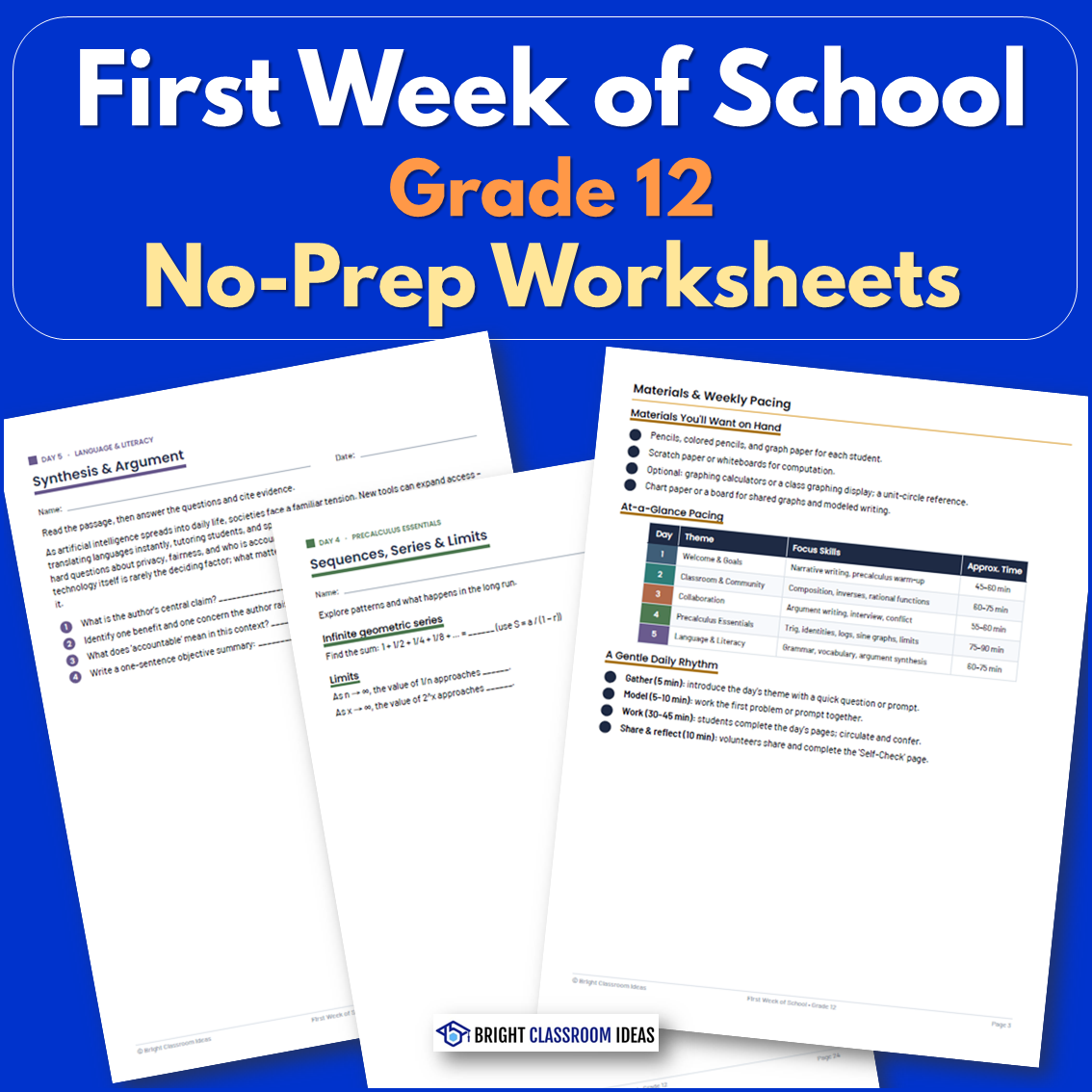
A five-day, no-prep back-to-school packet for 12th grade (seniors) that blends Precalculus review with literacy, writing, collaboration, and post-graduation goal-setting activities
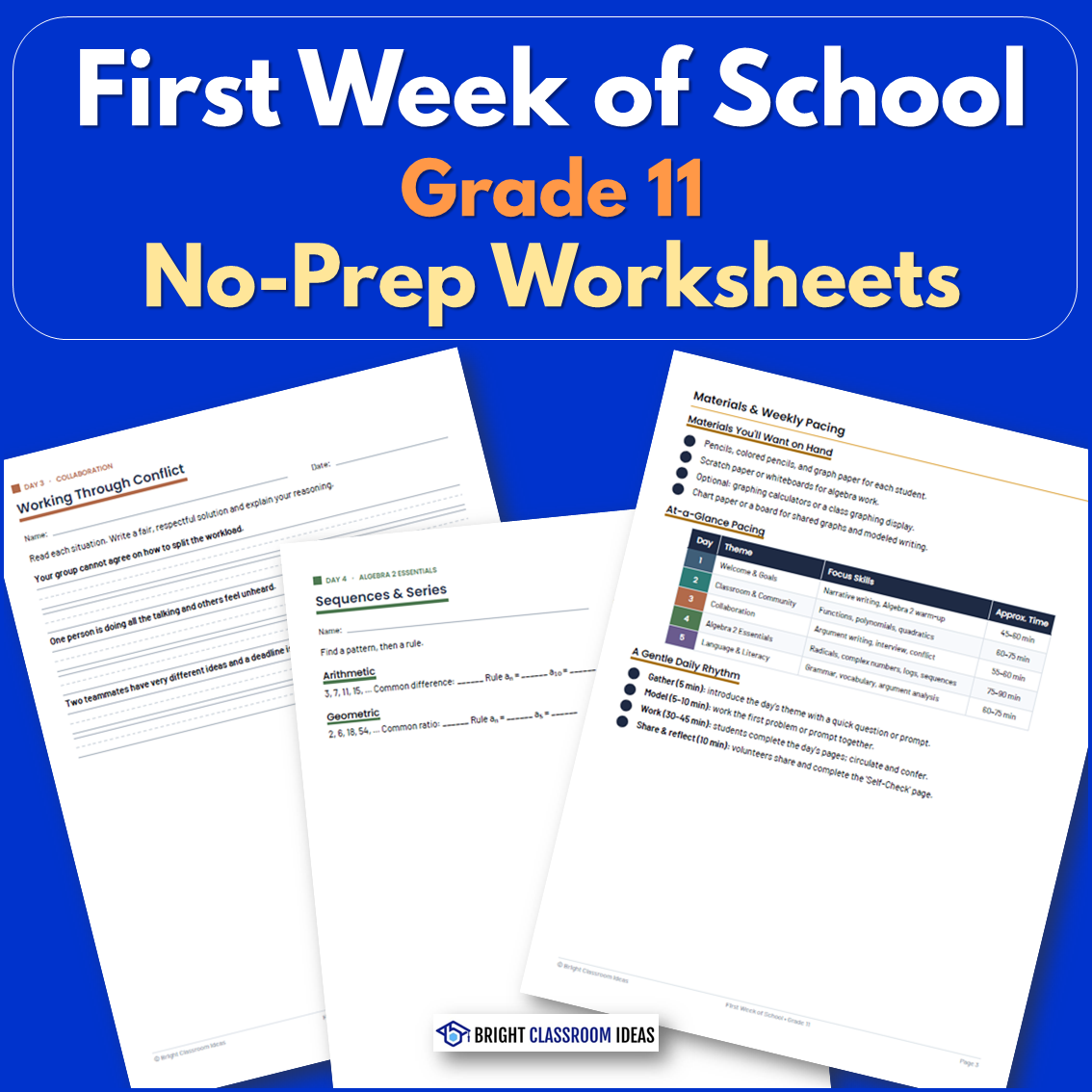
A five-day, no-prep back-to-school packet for 11th grade that blends Algebra 2 review with literacy, writing, collaboration, and community-building activities
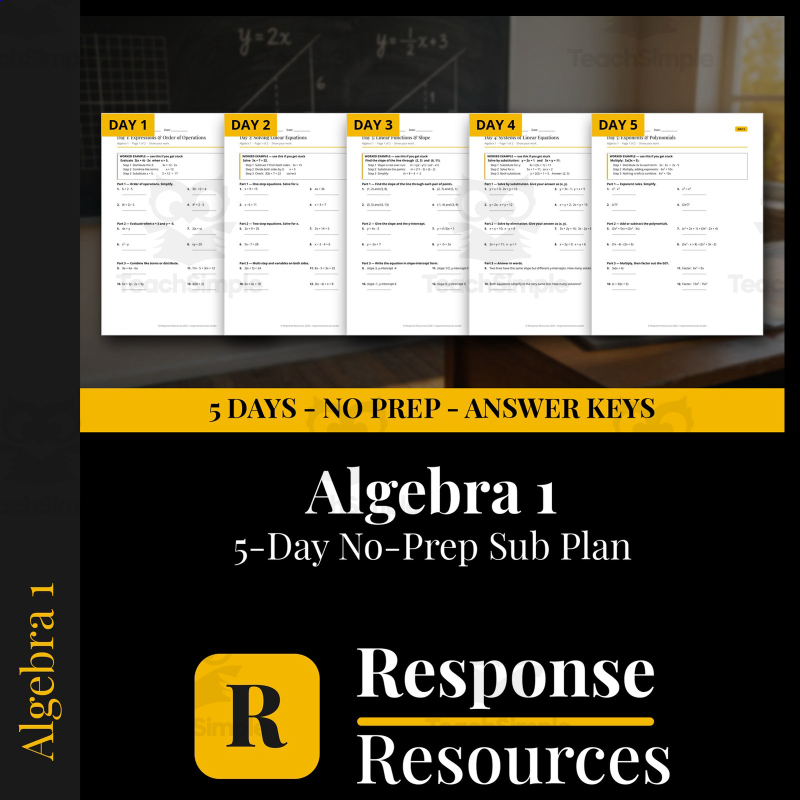
Leave a substitute five independent Algebra 1 lessons that pair worked examples with student practice. The two-page lessons revisit expressions, equations, linear functions, systems and polynomials, using answer paths, decoders or matching tasks to provide feedback. Daily directions and teacher answer pages support the handoff; assign the relevant day’s pages and require written calculations alongside the checking activity.