



4th Grade Grammar Curriculum | Fourth Grade Year-Long Grammar
- Grades
- Grade 4
- Pages
- 368
- File type
- Answer key
- Included


- Subject
- ELA, Grammar
- Topic
- Grade 4 grammar, Yearlong curriculum
- Resource types
- Worksheets, Assessments
- Answer key
- Included
- Standards
- CCSS.L.4.1
Product description
From the author
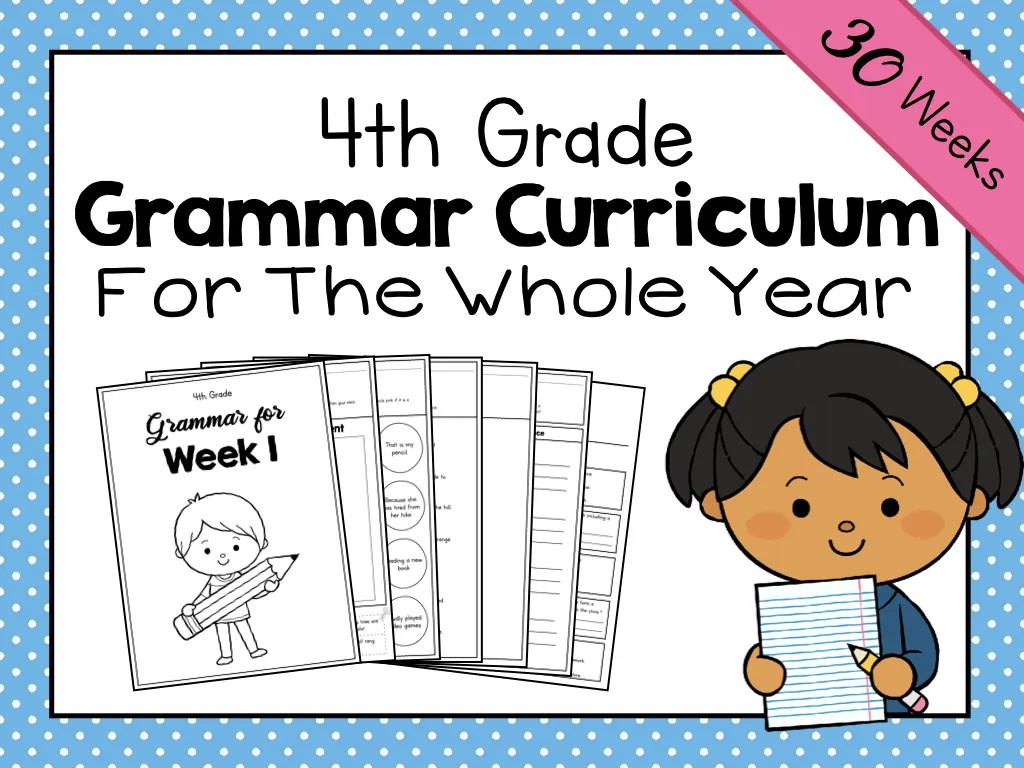
Here’s a complete year-long grammar curriculum created for fourth graders! It’s easy to print and ready for immediate use.
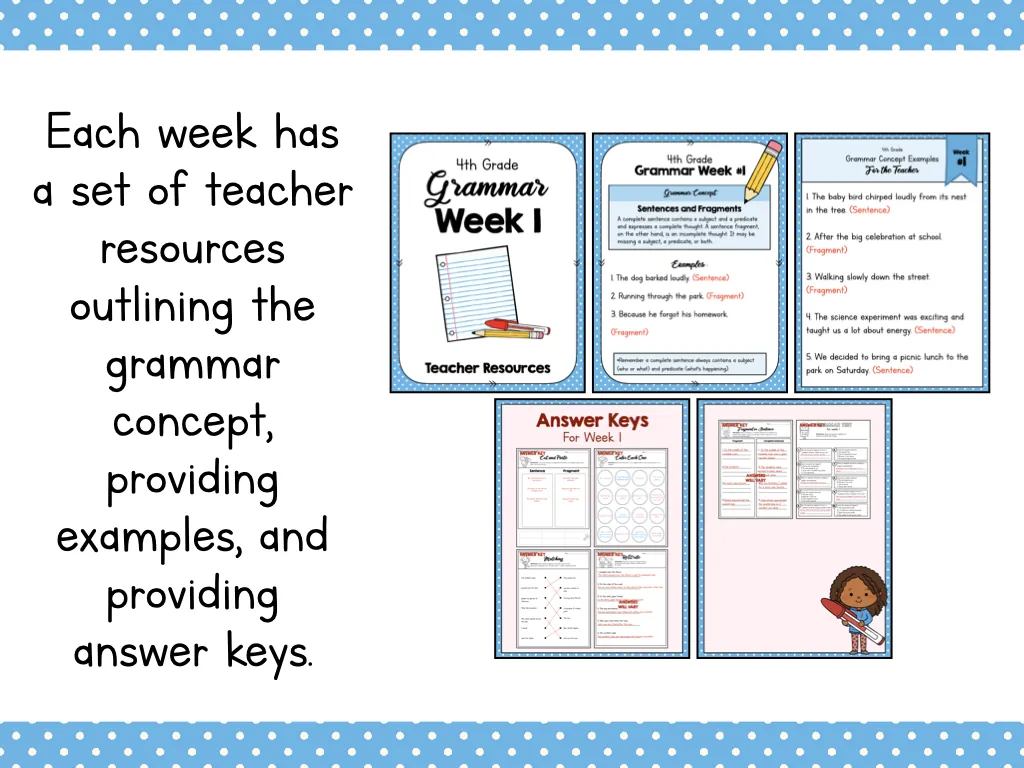
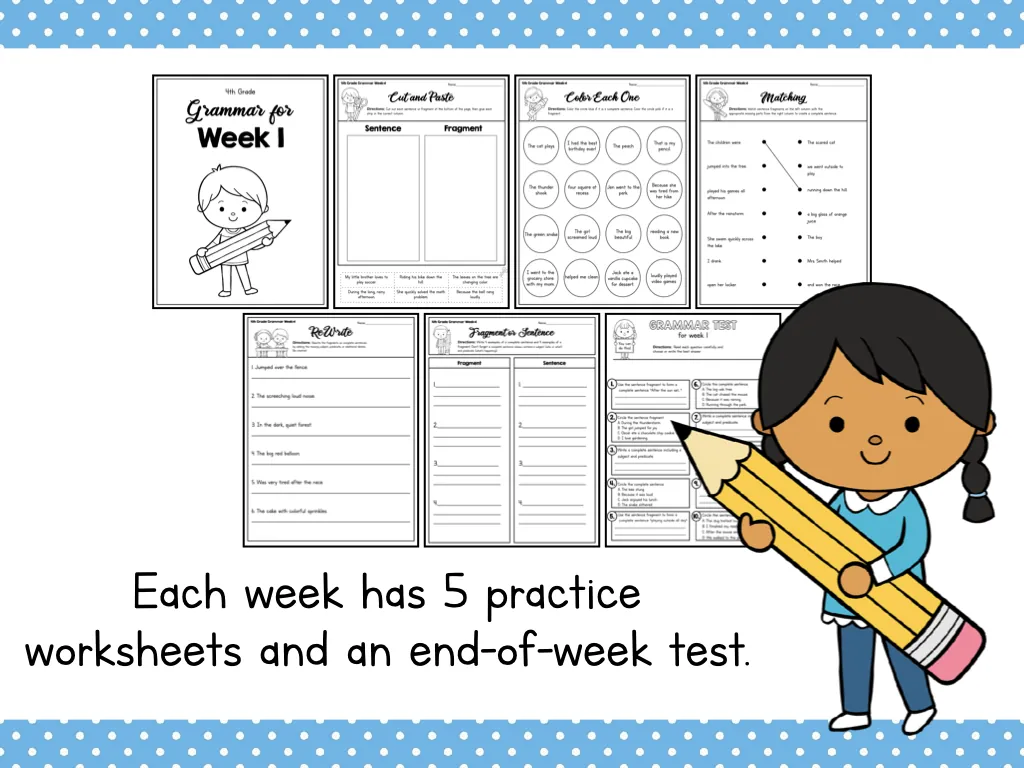
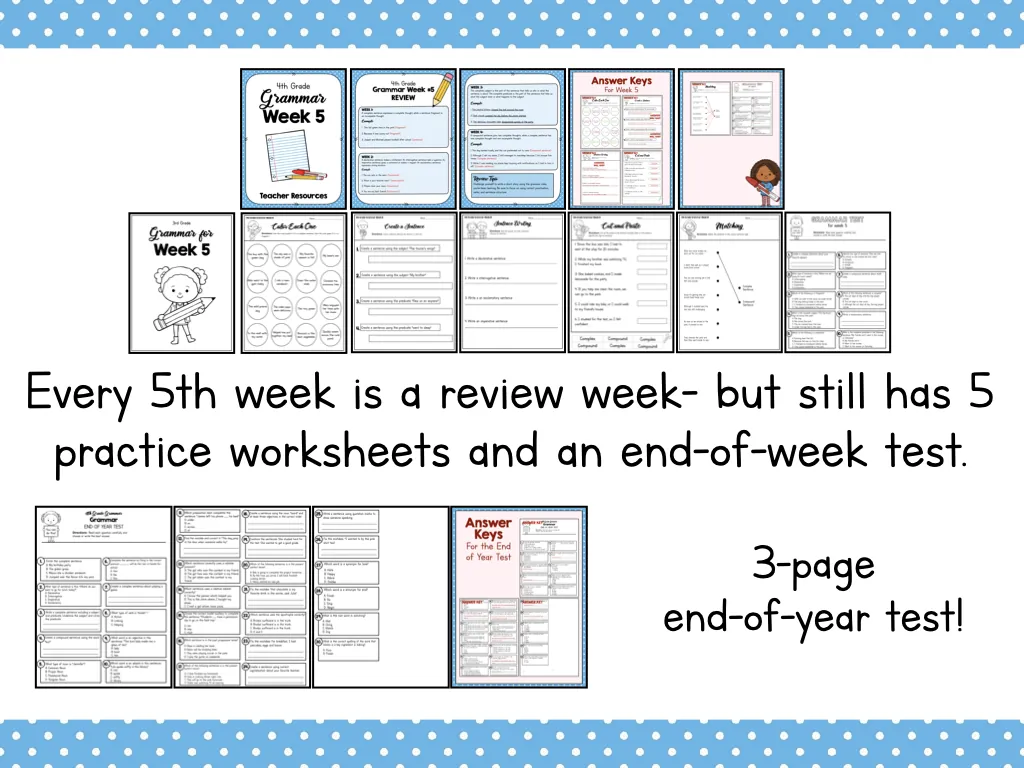
Each week introduces a new grammar topic that aligns with common core standards. You’ll find a teacher packet that includes everything you need to teach, along with answer keys for easy grading. The student packet has five practice worksheets and a weekly quiz to check their understanding. To keep things fresh, we’ve included a range of activities to keep students engaged. At the end of the year, there’s a cumulative test covering all concepts taught throughout the year.
This curriculum provides 30 weeks of grammar instruction, with over 350 pages of material!
Weekly Resources Include:
Teacher Packet (includes a cover sheet, concept map, example page, and answer keys)
Student Packet (five worksheets and a weekly quiz)
End-of-Year Cumulative Test
Weekly Grammar Concepts Covered:
Week 1: Sentences vs. Fragments
Week 2: Types of Sentences
Week 3: Subject and Predicate
Week 4: Compound and Complex Sentences
Week 5: Review
Week 6: Nouns
Week 7: Pronouns
Week 8: Verbs
Week 9: Adjectives and Adverbs
Week 10: Review
Week 11: Prepositions
Week 12: Subject-Verb Agreement
Week 13: Relative Pronouns and Adverbs
Week 14: Modal Auxiliaries
Week 15: Review
Week 16: Progressive Verb Tenses
Week 17: Perfect Verb Tenses
Week 18: Order of Adjectives
Week 19: Combining Sentences
Week 20: Review
Week 21: Quotation Marks
Week 22: Apostrophes in Contractions and Possessives
Week 23: Commas in a Series
Week 24: Capitalization
Week 25: Review
Week 26: Homophones and Commonly Confused Words
Week 27: Synonyms and Antonyms
Week 28: Prefixes and Suffixes
Week 29: Root Words
Week 30: Final Review
Related resources
More resources teachers may find useful
24 related resources were found using this product's title, contributor, categories and tags.


In the classroom
Teaching tips & learning objectives

Learning objectives
Student can distinguish complete sentences from sentence fragments.
Student can identify and correctly use core parts of speech (nouns, pronouns, verbs, adjectives, adverbs, prepositions).
Student can apply subject-verb agreement and correct verb tense in writing.

Teaching tips
Use the review weeks (every fifth week) as a built-in checkpoint before moving to new material, since they cycle back over the previous four weeks' concepts.
Separate teacher pages from student pages before copying — teacher pages print with a blue border and in color specifically so they're easy to identify.
Staple, hole-punch, or hand out each week's packet individually depending on how the class is organized, since the resource is designed to be flexible for prep.

Skills covered
Sentence and fragment identification — students cut, sort, and glue sentence versus fragment strips into the correct column.
Sentence classification by type — students color-code items as complete sentences or fragments based on given criteria.
Grammar concept application across 30 weekly units — students practice nouns, pronouns, verbs, adjectives/adverbs, prepositions, subject-verb agreement, verb tenses, and punctuation, with new-topic and review weeks.

No reviews yet
Downloaded this resource? Tell other teachers how it went.
Curriculum
Standards, concepts & topics
Standards
 Standards
- CCSS.L.4.1 — Demonstrate command of the conventions of standard English grammar and usage when writing or speaking. a. Use relative pronouns (who, whose, whom, which, that) and relative adverbs (where, when, why). b. Form and use the progressive (e.g., I was walking; I am walking; I will be walking) verb tenses. c. Use modal auxiliaries (e.g., can, may, must) to convey various conditions. d. Order adjectives within sentences according to conventional patterns (e.g., a small red bag rather than a red small bag). e. Form and use prepositional phrases. f. Produce complete sentences, recognizing and correcting inappropriate fragments and run-ons.* g. Correctly use frequently confused words (e.g., to, too, two; there, their).*
Core concepts
 Core concepts
Sentence structure
Parts of speech
Verb tense
Punctuation
Grammar review
 Topics
More to explore
You may also like


