6th Grade Inequality Matching Game – 32 Cards



- Grades
- Grade 6, Middle School
- Pages
- 9
- File type
- Preparation
- Print ready


- Subject
- Math, Algebra
- Topic
- Inequalities, Matching game
- Resource types
- Games, Activities, Task Cards, Worksheets & Printables
- Preparation
- Print ready
- Standards
- 6.EE.B.8
Product description
From the author
Teaching your students about how to write and evaluate inequalities in algebra can sometimes end up being a bit dry. Try adding this game to your algebra unit to bring a little movement and collaboration to your classroom.
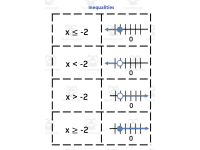
It's a super simple game: just print the cards and cut them out. There are 32 cards in 16 pairs. Deal one card to each student in your class. They should spend half a minute looking at their card and thinking of other ways it could be represented. For example, if they have a number line: what inequality does it show? If they have an inequality, could it be simplified?
Then, all the students get up and move around the room (SILENTLY!). They can use gestures while looking at each others' cards and trying to find their match. Pairs move to the side of the room until everyone is matched up. It's that simple!
Of course, you could also use these cards for a standard memory game where you flip two cards at a time and try to find matches.
I have also included a second set of cards that have pairs of fractions and decimals (for example 1/20 and 0.05).
Grades to Use With:
These cards are designed to target the standard 6EE.B.8 in grade six classrooms, but they could also be an excellent quick review in grades 7 and 8!
What's Included:
9 Page PDF: Title/Instruction Page
4 Pages of Inequality Cards
4 Pages of Fractions and Decimal Cards
Related resources
More resources teachers may find useful
24 related resources were found using this product's title, contributor, categories and tags.

In the classroom
Teaching tips & learning objectives

Learning objectives
Match a number-line graph to its equivalent one-variable inequality.
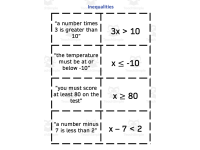
Simplify a one-step inequality and match it to its solved form.
Match a fraction to its equivalent decimal value using the bonus card deck.

Teaching tips
Use the deck as a warm-up or as an end-of-class reward, as the instructions page suggests.
Shuffle one deck and give each student one card; give them a moment to determine their card's value before starting the silent matching round.
Once everyone is paired up, reshuffle and re-deal to play again, or switch to a standard face-down memory-game format with the same cards.

Skills covered
Inequality representation — students match a number-line graph to its equivalent inequality statement, such as x ≤ -2.
One-step inequality solving — students match an unsolved inequality like 3x ≤ 36 to its simplified solution x ≤ 12.
Fraction-decimal equivalence — students match fractions like 1/20 to their decimal equivalents like 0.05 on the bonus card deck.
Good to know
Questions teachers ask about this resource
Do the word-problem cards require solving, or just translating into an inequality?
Both — for example, the card "My tools weigh 10 lbs, and my bag can be 60 lbs. How much more can I pack?" matches to the solved inequality x ≤ 50, so students translate the scenario and simplify it in one step.
Can the fraction-and-decimal deck be played on its own, separate from the inequality cards?
Yes — it's a separate 32-card deck with its own set of fraction-to-decimal matches, such as 1/20 and 0.05, so it can be played as its own round using the same matching or memory-game format.

No reviews yet
Downloaded this resource? Tell other teachers how it went.
Curriculum
Standards, concepts & topics
Standards
 Standards
- 6.EE.B.8 — Write an inequality of the form x > c or x < c to represent a constraint or condition in a real-world or mathematical problem. Recognize that inequalities of the form x > c or x < c have infinitely many solutions; represent solutions of such inequalities on number line diagrams.
Core concepts
 Core concepts
Inequalities
Number lines
One-step inequalities
Fraction-decimal equivalence
 Topics
Explore more
Categories this resource belongs to
Explore related searches
More to explore
You may also like