6th Grade Math Spiral Review: Underwater-Themed


- Grades
- Grades 6–8, Middle School, Elementary
- Pages
- 25
- File type
- Answer key
- Included


- Subject
- Math, Order Of Operations
- Topic
- Matemaths, Math
- Resource types
- Worksheets & Printables, Worksheets
- Answer key
- Included
About this resource
What's inside this resource
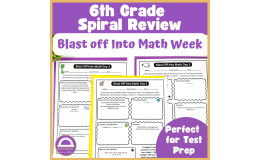
Take your students on an exciting journey underwater with this underwater-themed spiral review! This inspiring resource is a great review of key 6th-grade math concepts through engaging, ocean-themed problems. Use it as daily practice, warm-ups, or tests and your students will love solving math problems while getting the inside story on the ocean deep.
What's Included?
This spiral practice provides 5 days of practice, 5 problems per page on major 6th-grade math skills in the following topics:
Ratios and Proportional Relationships: Solve unit rates and proportions in comparing the rates of different sea creatures.
Number System: Practice operations with fractions, decimals, and integers through underwater treasure maps.
Expressions and Equations: Simplify expressions and equations to help marine biologists understand ocean information.
Geometry: Calculate area, volume, and surface area when designing underwater habitats and learning about coral reef size.
Statistics and Probability: Measure ocean temperature, marine population figures, and so much more using real-life mathematics.
Each page has underwater situations to create practice math that's fun and practical. From helping a scuba diver navigate his way through underwater tunnels to measuring the distance between sunken shipwrecks, these exercises translate abstract ideas into action-packed adventures.
How It Works
Spend one page a day crafting an effective and sustained math practice routine.
Students solve the 5 problems and attempt to get at least 3 correct to earn their daily ocean badge.
Utilize the printables provided—the sea creature, submarine, treasure chest badges—or have students design their own in the space provided.
Teachers Adore This Product Because:
No prep time! Just print and go—the harried teacher's dream!
Immersive Underwater Theme: The ocean-themed problems captivate students' attention and keep them engaged.
CCSS-Aligned: All the problems are matched to significant 6th-grade Common Core State Standards (CCSS).
Motivational Badge System: The badge daily challenge encourages effort, perseverance, and progress.
Perfect For:
Daily Math Practice
Warm-Ups or Exit Tickets
Homework Assignments
Ocean-Themed or End-of-Year Activities
Celebrate Success
At the end of the week, those who finish all 5 badges can be rewarded as "Math Marine Explorers" or given the "Golden Seashell Award" (certificate). This simple, motivating system praises students for their efforts and encourages a growth mindset.
Make a splash in math practice! Download this underwater-themed spiral review today and watch your students' confidence swim as they dive into essential math skills!
Related resources
More resources teachers may find useful
24 related resources were found using this product's title, contributor, categories and tags.
In the classroom
Teaching tips & learning objectives

Learning objectives
- Solve ratio and unit-rate problems
- Solve linear equations and evaluate expressions
- Find the area of triangles, rectangles and circles

Teaching tips
- The solutions page lets students check each day's five problems against the badge goal before the next page.

Skills covered
- Probability — finding the chance of outcomes in ocean-themed problems
- Data analysis — computing mean, median, mode and range
- Decimal operations — calculating with decimals in word problems

No reviews yet
Downloaded this resource? Tell other teachers how it went.
Curriculum
Standards, concepts & topics
Standards
 Standards
- 6.EE.A.1 — Write and evaluate numerical expressions involving whole-number exponents.
- 6.EE.A.2 — Write, read, and evaluate expressions in which letters stand for numbers. a. Write expressions that record operations with numbers and with letters standing for numbers. For example, express the calculation “Subtract y from 5” as 5 – y. COMMON CORE STATE STANDARDS for MATHEMATICS GRADE 6 | 44 b. Identify parts of an expression using mathematical terms (sum, term, product, factor, quotient, coefficient); view one or more parts of an expression as a single entity. For example, describe the expression 2 (8 + 7) as a product of two factors; view (8 + 7) as both a single entity and a sum of two terms. c. Evaluate expressions at specific values of their variables. Include expressions that arise from formulas used in real-world problems. Perform arithmetic operations, including those involving whole-number exponents, in the conventional order when there are no parentheses to specify a particular order (Order of Operations). For example, use the formulas V = s3 and A = 6 s2 to find the volume and surface area of a cube with sides of length s = 1/2.
- 6.EE.B.5 — Understand solving an equation or inequality as a process of answering a question: which values from a specified set, if any, make the equation or inequality true? Use substitution to determine whether a given number in a specified set makes an equation or inequality true.
- 6.EE.B.7 — Solve real-world and mathematical problems by writing and solving equations of the form x + p = q and px = q for cases in which p, q and x are all nonnegative rational numbers
- 6.G.A.1 — Find the area of right triangles, other triangles, special quadrilaterals, and polygons by composing into rectangles or decomposing into triangles and other shapes; apply these techniques in the context of solving real-world and mathematical problems.
- 6.G.A.2 — Find the volume of a right rectangular prism with fractional edge lengths by packing it with unit cubes of the appropriate unit fraction edge lengths, and show that the volume is the same as would be found by multiplying the edge lengths of the prism. Apply the formulas V = l w h and V = b h to find volumes of right rectangular prisms with fractional edge lengths in the context of solving real-world and mathematical problems.
- 6.SP.B.4 — Display numerical data in plots on a number line, including dot plots, histograms, and box plots.
- 6.SP.B.5 — Summarize numerical data sets in relation to their context, such as by: a. Reporting the number of observations. b. Describing the nature of the attribute under investigation, including how it was measured and its units of measurement. c. Giving quantitative measures of center (median and/or mean) and variability (interquartile range and/or mean absolute deviation), as well as describing any overall pattern and any striking deviations from the overall pattern with reference to the context in which the data were gathered. d. Relating the choice of measures of center and variability to the shape of the data distribution and the context in which the data were gathered.
- 6.SP.A.2 — Understand that a set of data collected to answer a statistical question has a distribution which can be described by its center, spread, and overall shape.
- 6.RP.A.2 — Understand the concept of a unit rate a/b associated with a ratio a:b with b ≠ 0, and use rate language in the context of a ratio relationship. For example, “This recipe has a ratio of 3 cups of flour to 4 cups of sugar, so there is 3/4 cup of flour for each cup of sugar.” “We paid $75 for 15 hamburgers, which is a rate of $5 per hamburger.”1
- 6.RP.A.3 — Use ratio and rate reasoning to solve real-world and mathematical problems, e.g., by reasoning about tables of equivalent ratios, tape diagrams, double number line diagrams, or equations. a. Make tables of equivalent ratios relating quantities with whole-number measurements, find missing values in the tables, and plot the pairs of values on the coordinate plane. Use tables to compare ratios. b. Solve unit rate problems including those involving unit pricing and constant speed. For example, if it took 7 hours to mow 4 lawns, then at that rate, how many lawns could be mowed in 35 hours? At what rate were lawns being mowed? c. Find a percent of a quantity as a rate per 100 (e.g., 30% of a quantity means 30/100 times the quantity); solve problems involving finding the whole, given a part and the percent. d. Use ratio reasoning to convert measurement units; manipulate and transform units appropriately when multiplying or dividing quantities.
- 6. NS.A.1 — Interpret and compute quotients of fractions, and solve word problems involving division of fractions by fractions, e.g., by using visual fraction models and equations to represent the problem. For example, create a story context for (2/3) ÷ (3/4) and use a visual fraction model to show the quotient; use the relationship between multiplication and division to explain that (2/3) ÷ (3/4) = 8/9 because 3/4 of 8/9 is 2/3. (In general, (a/b) ÷ (c/d) = ad/bc.) How much chocolate will each person get if 3 people share 1/2 lb of chocolate equally? How many 3/4-cup servings are in 2/3 of a cup of yogurt? How wide is a rectangular strip of land with length 3/4 mi and area 1/2 square mi?
- 6. NS.B.2 — Fluently divide multi-digit numbers using the standard algorithm.
- 6. NS.B.3 — Fluently add, subtract, multiply, and divide multi-digit decimals using the standard algorithm for each operation.
Core concepts
 Core concepts
- Ratios and unit rates
- Linear equations
- Area
- Probability
- Mean, median, mode and range
Topics
 Topics
Explore more
Categories this resource belongs to
Explore related searches
More to explore
You may also like