"A Night Divided" Word Study

- Grades
- Grades 4–7, Middle School, Elementary
- File type
- Preparation
- Print ready


- Subject
- ELA, Reading, Reading Comprehension, Literature, Language Development, Vocabulary
- Topic
- novel study, book companion
- Resource types
- Worksheets & Printables, Novel Studies, Teacher Tools, Assessments, Worksheets
- Preparation
- Print ready
- Standards
- CCSS.L.6.5 CCSS.RL.6.4 +1
About this resource
What's inside this resource
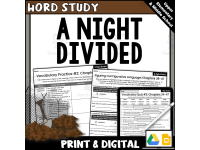
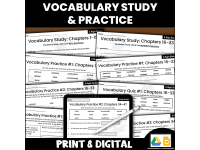
Vocabulary knowledge is a direct link to reading comprehension. This vocabulary study provides vocabulary activities for words that appear in the novel "A Night Divided" by Jennifer A. Nielsen. Printable PDF and Google Slides & Forms (digital) versions are included!
⭐️This resource includes:⭐️
Printable PDF and Google Slides & Forms (digital) versions are included!
Chapters 1 - 15
◾Vocabulary Word Lists WITH Definitions: Students can use this word list as a study sheet to learn the pre-defined words.
◾Vocabulary Word Lists WITHOUT Definitions: Assign this word list for students to define the words on their own. This can be done either as a pre-reading activity or as they read the novel using context clues.
◾Vocabulary Study Activities: Match the word to the definition; Use context clues in quotes from the story to determine word meanings, then draw pictures to represent each word; Crossword Puzzle.
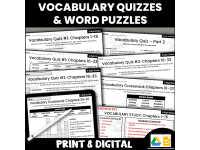
◾Vocabulary Quizzes: Quiz #1 - Match the word to the correct definition; Quiz #2 - Select the correct definition for each word.
Chapters 16 – 33
◾Vocabulary Word Lists WITH Definitions: Students can use this word list as a study sheet to learn the pre-defined words.
◾Vocabulary Word Lists WITHOUT Definitions: Assign this word list to students so they can define the words on their own. This can be done either as a pre-reading activity or as they read the novel, using the context clues.
◾Vocabulary Study Activities: Match the words to the synonyms & write a paragraph with 5 vocabulary words; Determine which word doesn’t relate to the others and then explain how the remaining words are related; Crossword Puzzle
◾Vocabulary Quizzes: Quiz #1 – Complete the sentence with the correct vocabulary word; Quiz #2 - Match the word to the correct definition.
Chapters 34 – 47
◾Vocabulary Word Lists WITH Definitions: Students can use this word list as a study sheet to learn the pre-defined words.
◾Vocabulary Word Lists WITHOUT Definitions: Assign this word list for students to define the words on their own. This can be done either as a pre-reading activity or as they read the novel using the context clues.
◾Vocabulary Study Activities: Tasks vary for each word (e.g. antonyms, synonyms, complete the sentences, name something, etc.); Crossword Puzzle; Match the word to the definition.
◾Vocabulary Quizzes: Quiz #1 - Select the correct definition for each word; Quiz #2 - Complete the sentence with the correct vocabulary word.
ANSWER KEYS for ALL Vocabulary Practice Activities and Quizzes
💡Examples of the vocabulary activities included are listed below.
◾define the word
◾antonyms / synonyms
◾fill in the blank sentences
◾categorize words that are similar
◾write sentences using the word
◾Crossword puzzles
◾multiple choice - choose the correct definition
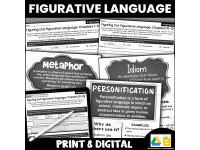
Figurative Language Study (30 pages total)
◾Figurative Language Notes Handouts (Simile, Metaphor, Personification, Hyperbole, Idiom)
◾Figuring Out Figurative Language Activities - Students will identify figurative language in passages taken from the novel, A Night Divided. Then, students will determine the type, meaning, and author’s purpose for including the figurative language identified in each passage. This activity can be divided up by splitting the class into groups and having each group work on different pages for a section of chapters. It could also be divided up and assigned as a bell ringer, warm-up activity, or exit ticket. (ANSWER KEYS INCLUDED)
Related resources
More resources teachers may find useful
24 related resources were found using this product's title, contributor, categories and tags.


In the classroom
Teaching tips & learning objectives

Learning objectives
Define and use vocabulary words drawn directly from the text of A Night Divided, using context clues where definitions are not provided.
Identify similes, metaphors, personification, hyperbole, and idioms in quoted passages from the novel.
Explain the meaning of an identified figurative-language device and analyze the author's purpose for using it in a specific passage.

Teaching tips
Assign the word list without definitions before students read the relevant chapters, then use the word list with definitions afterward as a self-check study sheet.
Split the class into groups and assign each group a different chapter range's figurative-language pages so the full novel gets covered without every student analyzing every passage.
Use the vocabulary quizzes as a quick formative check after each chapter range before moving on to the next word list.

Skills covered
Vocabulary acquisition — students learn 40+ words drawn directly from the novel's text across three chapter-range word lists.
Context-clue reasoning — students define words without provided definitions by using surrounding sentence context, as the 'Word List WITHOUT Definitions' pages require.
Figurative language identification — students underline and classify simile, metaphor, personification, and hyperbole in quoted novel passages.
Good to know
Questions teachers ask about this resource
How does the figurative-language section connect to the specific text of the novel?
Each figurative-language activity quotes an actual passage from A Night Divided (with page citation) and has students identify the device used, explain its meaning, and analyze why the author chose it, rather than working with generic example sentences.
How do the two vocabulary quizzes differ within a single chapter range?
The two quizzes for a given chapter range use different formats from each other; for example, in the Chapters 16-33 set, Quiz #1 has students complete sentences with the correct vocabulary word while Quiz #2 has them match each word to its definition.

No reviews yet
Downloaded this resource? Tell other teachers how it went.
Curriculum
Standards, concepts & topics
Standards
 Standards
- CCSS.L.6.5 — Demonstrate understanding of figurative language, word relationships, and nuances in word meanings. a. Interpret figures of speech (e.g., personification) in context. b. Use the relationship between particular words (e.g., cause/effect, part/whole, item/category) to better understand each of the words. c. Distinguish among the connotations (associations) of words with similar denotations (definitions) (e.g., stingy, scrimping, economical, unwasteful, thrifty)
- CCSS.RL.6.4 — Determine the meaning of words and phrases as they are used in a text, including figurative and connotative meanings; analyze the impact of a specific word choice on meaning and tone.
- CCSS.L.6.4 — Determine or clarify the meaning of unknown and multiple-meaning words and phrases based on grade 6 reading and content, choosing flexibly from a range of strategies. a. Use context (e.g., the overall meaning of a sentence or paragraph; a word’s position or function in a sentence) as a clue to the meaning of a word or phrase. b. Use common, grade-appropriate Greek or Latin affixes and roots as clues to the meaning of a word (e.g., audience, auditory, audible). c. Consult reference materials (e.g., dictionaries, glossaries, thesauruses), both print and digital, to find the pronunciation of a word or determine or clarify its precise meaning or its part of speech. d. Verify the preliminary determination of the meaning of a word or phrase (e.g., by checking the inferred meaning in context or in a dictionary).
Core concepts
 Core concepts
Vocabulary in context
Figurative language
Simile and metaphor
Personification
Author's purpose
A Night Divided (novel)
 Topics
Explore more
Categories this resource belongs to
Explore related searches
More to explore
You may also like