Antagonistic Muscle Pairs
- Grades
- Grades 9–10, High School
- File type
- Microsoft PowerPoint
- Editable
- Yes


- Subject
- Science, Life Sciences, Human Body
- Topic
- antagonistic muscle pairs, human body science
- Resource types
- Lesson Plans, Presentations
- Editable
- Yes
About this resource
What's inside this resource
Antagonistic Muscle Pairs is a resource developed for educators who are reaching beyond the boundaries of their teaching strategies in human body science, specifically on the topic of antagonistic muscle pairs.
The Primary Learning Objective
This learning tool aims to assist students in understanding and defining the complex mechanisms involved within an antagonistic pair and the types of muscle contractions. As learners explore this resource further, they'll gain mastery in linking antagonistic pairs with movement actions at various parts of our bodies including:
- The elbow
- Knee
- Ankle shoulder and hip.
Inquisitive or advanced learners can extend their understanding by analyzing different sporting movements and identifying agonists as well as contraction types.
User-Friendly Format for Seamless Absorption of Information
Our material comprises 31 meticulously crafted slides bundled into an easy-to-understand PowerPoint presentation suitable for screen-sharing during online sessions or projected onto whiteboards in classic classroom settings. What's more? Within seconds, your entire lesson plan stands prepared with this download.
Tailored to Suit Different Educational Levels & Settings
The primary target audience involves Grade 9-10 level science education concerning human body studies; however, educators can easily adjust the difficulty level to suit different grading standards. Whether you wish to use it during smaller work groups or wider scale general class discussions—you have multiple choices whether your preferred medium is traditional classrooms or distance learning setups online.
Gearing Towards A Dynamic Learning Environment Coupled with In-depth Science Education
In conclusion, Antagonistic Muscle Pairs PowerPoint presentation guarantees a dynamic learning coupled with scientific depth that caters both beginners & intermediate-level students alike without compromising complexity essential in understanding crucial components of the human body sciences curriculum objectives.
Related resources
More resources teachers may find useful
24 related resources were found using this product's title, contributor, categories and tags.


In the classroom
Teaching tips & learning objectives

Learning objectives
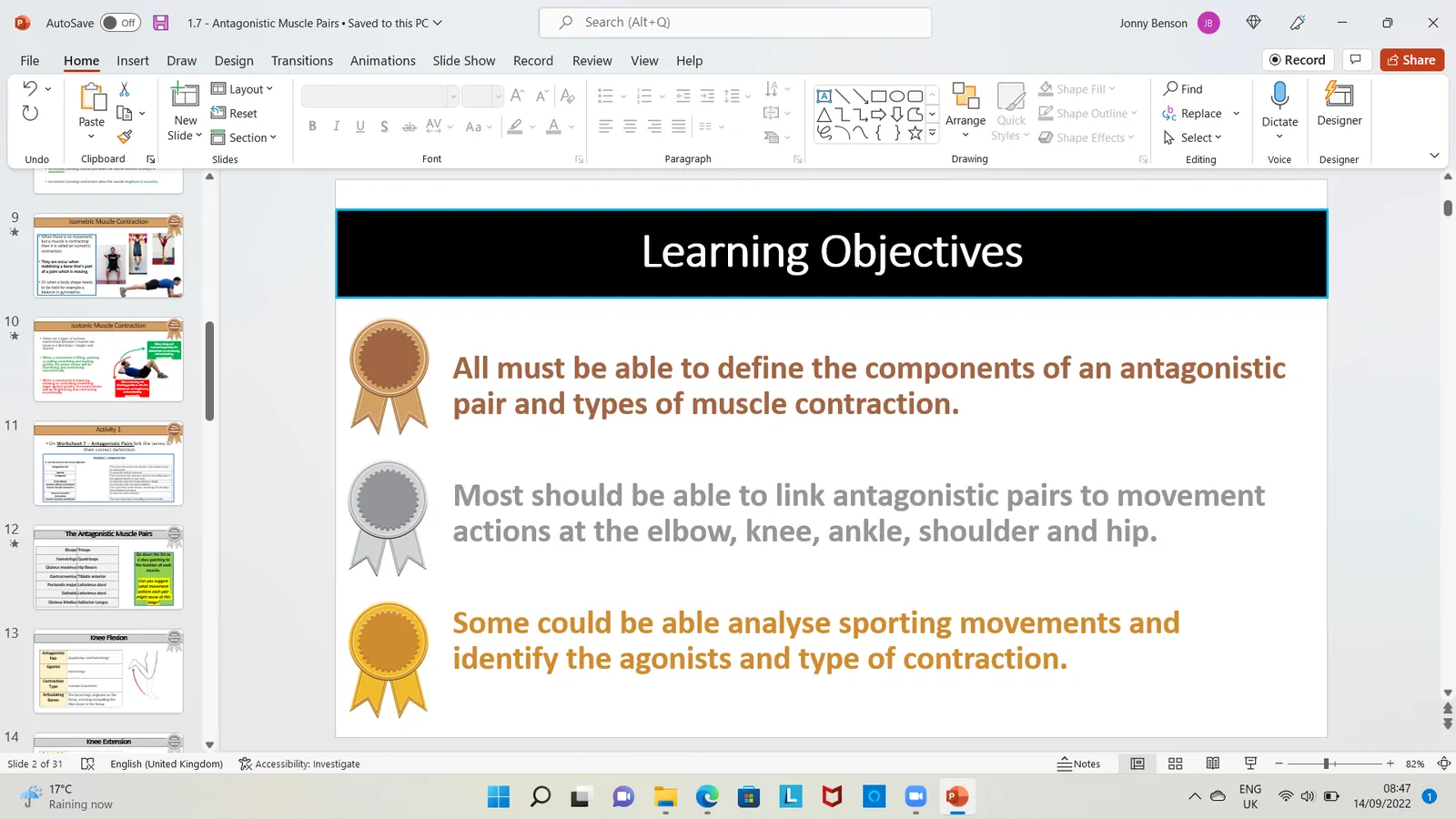
Students define the components of an antagonistic muscle pair and the types of muscle contraction (isometric, isotonic concentric, isotonic eccentric).
Students link antagonistic pairs to movement actions at the elbow, knee, ankle, shoulder, and hip.
Students analyse sporting movements to identify the agonist muscle and its contraction type.

Teaching tips
Have Worksheet 7 – Antagonistic Pairs ready before teaching, since Activities 1 and 4 in this deck direct students to that separate worksheet, which is not included in this file.
Use the worked joint-by-joint slides (e.g. knee flexion, elbow extension) as a model before Activity 3, which asks students to analyse contraction type and joint action for sporting contexts independently.
Point out the concentric/eccentric contrast using the given example (abdominals shortening while rising vs. lengthening while lowering against gravity) before introducing eccentric contraction at other joints.

Skills covered
Antagonistic pair identification — students name the agonist and antagonist muscle for a given joint action across the elbow, knee, ankle, hip, and shoulder.
Contraction type classification — students classify a muscle contraction as isometric, isotonic concentric, or isotonic eccentric based on whether and how the muscle changes length.
Applied movement analysis — students analyse sporting movements (e.g. a hurdles lead leg) to identify contraction type, agonist, antagonist, and joint action.
Good to know
Questions teachers ask about this resource
How does the deck illustrate the difference between concentric and eccentric contraction using the abdominals?
When rising against gravity the abdominals shorten and contract concentrically; when lowering under control against gravity the same abdominals lengthen and contract eccentrically.

No reviews yet
Downloaded this resource? Tell other teachers how it went.
Resource details
Concepts & topics
Core concepts
 Core concepts
antagonistic muscle pair
agonist and antagonist
prime mover
isometric contraction
isotonic concentric/eccentric contraction
 Topics
More to explore
You may also like