Lever Systems of The Body
- Grades
- Grades 9–11, High School
- File type
- Microsoft PowerPoint
- Editable
- Yes


- Subject
- Science, Life Sciences, Human Body, P.E. & Health, Physical Education
- Topic
- levers, fulcrum
- Resource types
- Presentations
- Editable
- Yes
About this resource
What's inside this resource
Full PowerPoint Lesson Presentation that reviews the 3 lever systems at work in the human body; 1st, 2nd and 3rd class levers.
Learning Objectives:
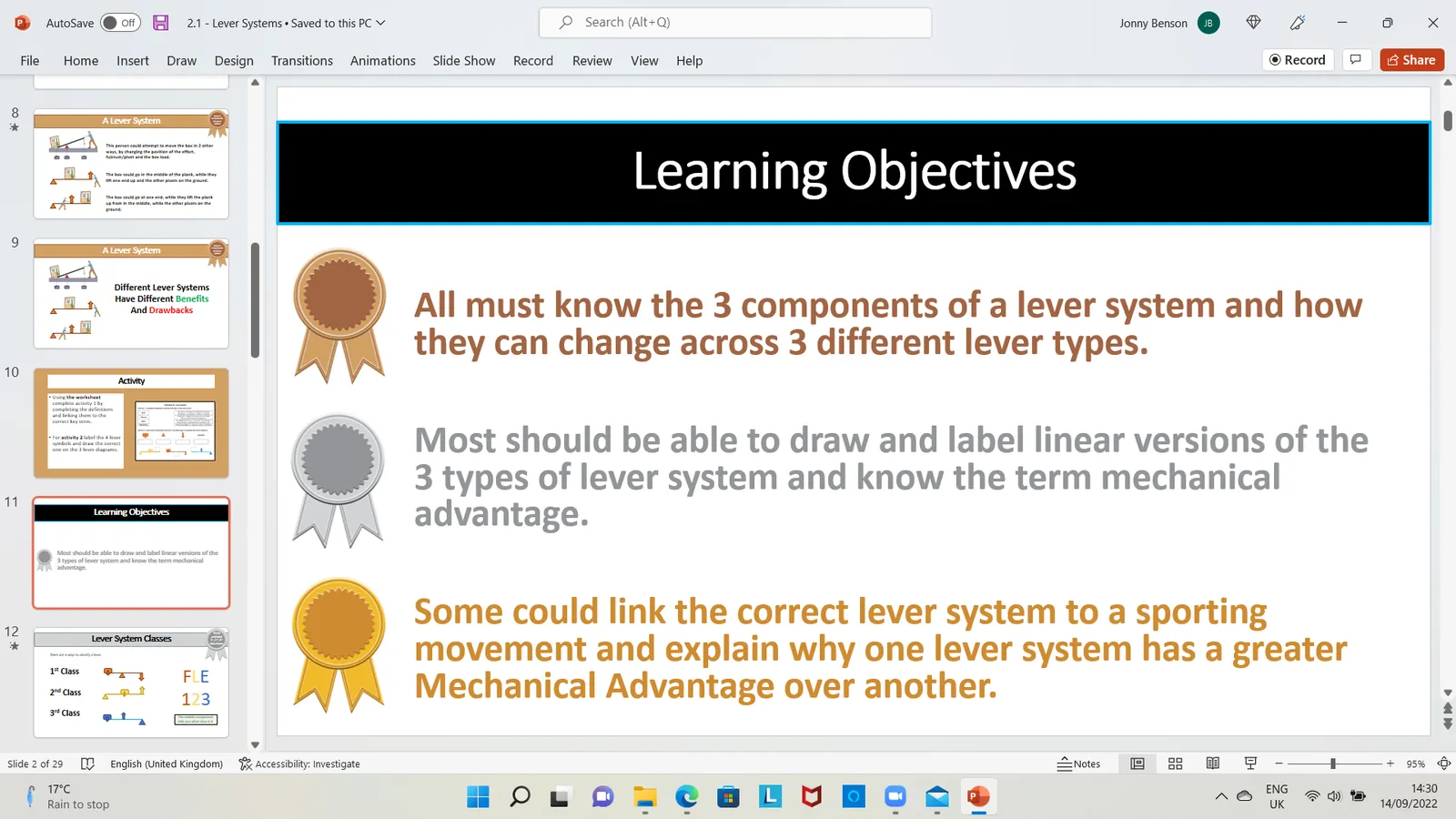
All must know the 3 components of a lever system and how they can change across 3 different lever types.
Most should be able to draw and label linear versions of the 3 types of lever system and know the term mechanical advantage.
Some could link the correct lever system to a sporting movement and explain why one lever system has a greater Mechanical Advantage over another.
Related resources
More resources teachers may find useful
24 related resources were found using this product's title, contributor, categories and tags.



In the classroom
Teaching tips & learning objectives

Learning objectives
Identify the three components of a lever system: fulcrum, effort, and load/resistance.
Classify first-, second-, and third-class levers and label linear diagrams of each.
Calculate mechanical advantage as the ratio of effort arm to resistance arm.

Teaching tips
Because the presentation repeatedly references 'the worksheet' for six numbered activities that are not included in this file, prepare or source a companion worksheet before teaching the lesson.
Use the body-movement examples (elbow extension, plantar flexion, elbow flexion) to connect each lever class to a movement students can physically demonstrate in class.
Revisit the three tiered learning objectives at the end of the lesson as a self-assessment check, since the slides repeat them verbatim as a closing summary.

Skills covered
Lever system classification - students identify first-, second-, and third-class levers from diagrams and label the fulcrum, effort, and resistance in each.
Mechanical advantage calculation - students compute the ratio of effort arm to resistance arm to determine whether a lever system has a mechanical advantage.
Applied movement analysis - students connect lever classifications to specific body movements, such as elbow flexion and plantar flexion, in sporting contexts.
Good to know
Questions teachers ask about this resource
How does the presentation connect lever classification to actual sporting movements?
It walks through worked examples such as elbow extension (a first-class lever, tricep pulling the radius) and plantar flexion during a jump (a second-class lever, gastrocnemius pulling the heel), identifying the bone as the lever, the joint as the fulcrum, and the muscle as the effort in each case.

No reviews yet
Downloaded this resource? Tell other teachers how it went.
Resource details
Concepts & topics
Core concepts
 Core concepts
lever systems
mechanical advantage
fulcrum
effort arm
resistance arm
 Topics
Explore related searches
More to explore
You may also like