Area and Perimeter Farmer Project
- Grades
- Grade 3, Elementary
- Pages
- 9
- File type
- Answer key
- Included


- Subject
- Math, Creative Arts, Addition, Addition and Subtraction, Subtraction, Multiplication, Multiplication and Division, Geometry, Measurements
- Topic
- Area, Perimeter
- Resource types
- Projects, Activities
- Answer key
- Included
Product description
From the author
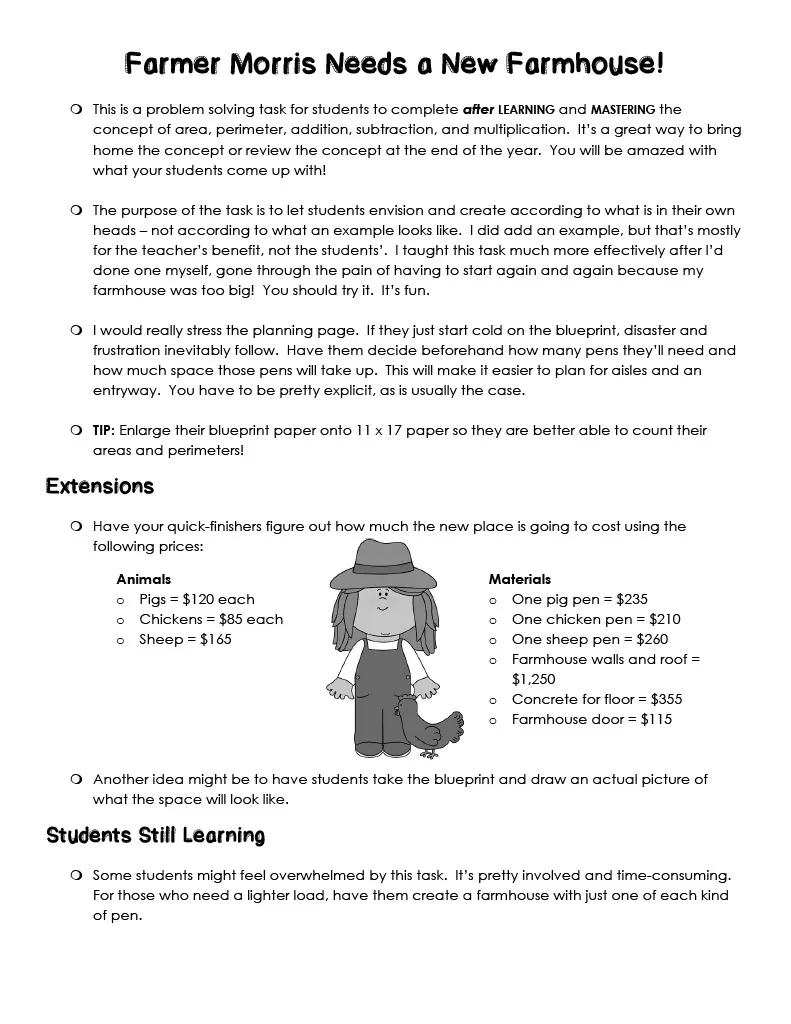
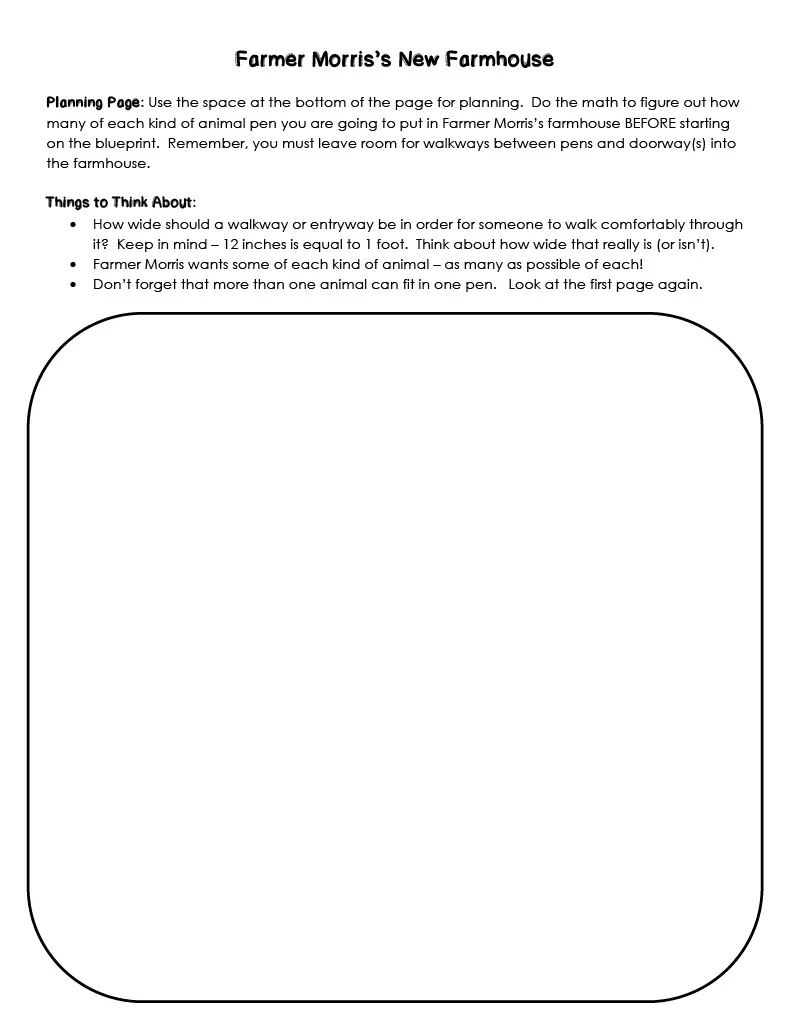
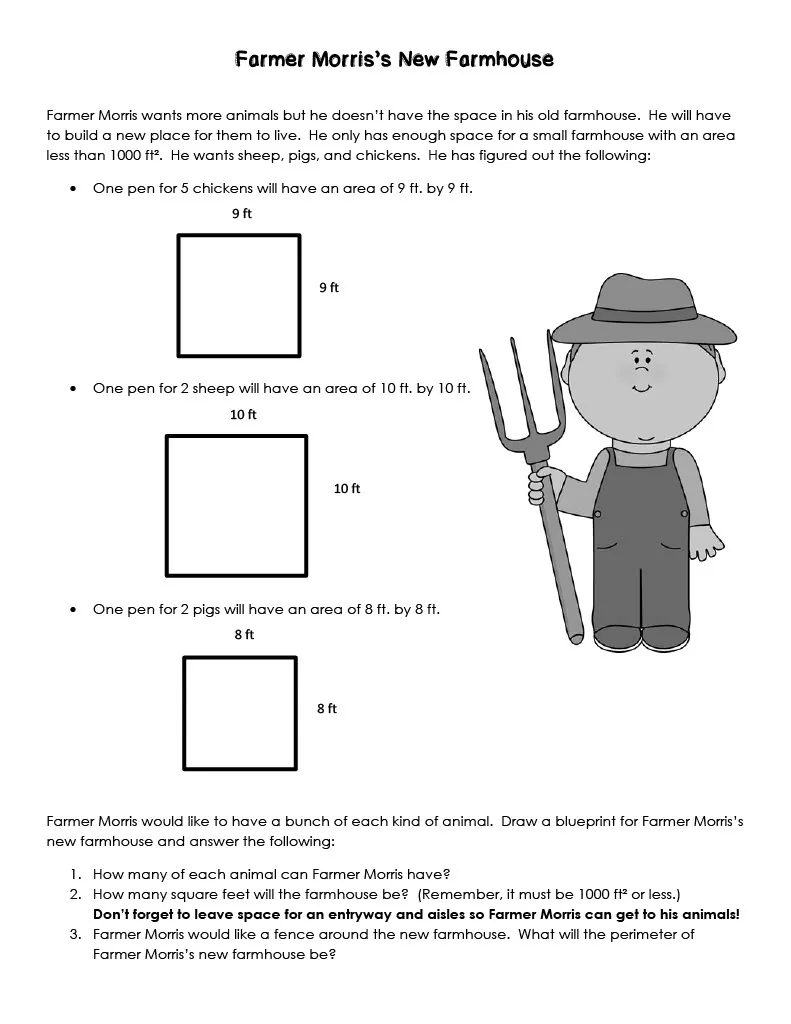
The Area and Perimeter Farmer Project asks grade 3 students to design a farm building within a 1,000-square-foot limit. Students plan chicken, sheep and pig pens, leave room for an entryway and aisles, draw a blueprint, and calculate area, animal capacity and perimeter.
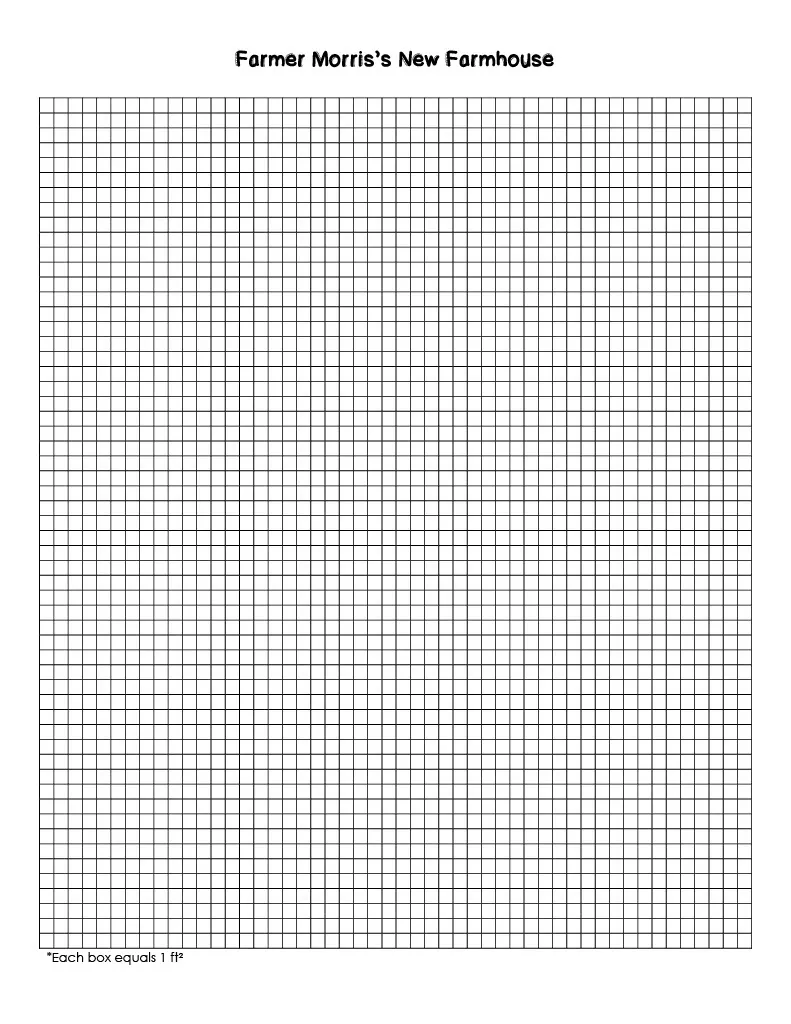
The nine-page PDF includes teacher instructions, the scenario, planning and answer sheets, grid paper, a worked teacher example with responses, student examples and credits. The worked example is one possible solution, not a key for every student design.
Use the project after teaching area, perimeter and the required operations. For a lighter task, use one pen of each animal type. The creator recommends enlarging the grid to 11 × 17 inches. An optional extension supplies animal and material prices for a cost calculation.
The project can support a concluding assessment of students’ application of these skills.
Related resources
More resources teachers may find useful
24 related resources were found using this product's title, contributor, categories and tags.



In the classroom
Teaching tips & learning objectives

Learning objectives
Calculate the area of a rectangular space by counting unit squares on a grid.
Calculate the perimeter of an irregular polygon made up of multiple rectangular pens.
Use given unit prices to calculate a total project cost (optional extension).

Teaching tips
Assign this only after students have already learned area and perimeter, as the instructions page frames it explicitly as a review/culminating task, not an introduction to the concepts.
Enlarge the blueprint grid page onto 11x17 paper, as the file itself recommends, so students can count area and perimeter squares more easily.
Stress the planning page before students start their blueprint — decide pen counts and space needs first, since starting cold on the blueprint 'inevitably' leads to frustrated restarts, per the file's own teacher notes.

Skills covered
Area measurement — counting square units to total a footprint under a 1,000 ft² constraint.
Perimeter measurement — finding the total boundary length of a multi-shape floor plan.
Spatial planning — fitting multiple rectangular pens plus walkways and an entryway into a fixed space.
Good to know
Questions teachers ask about this resource
How much creative freedom do students have in designing the farmhouse?
Students choose their own pen layout and animal quantities as long as the total area stays at or under 1,000 square feet and room is left for an entryway and walkways; the file includes one worked example, but notes it's meant mainly for the teacher's reference rather than as a template for students to copy.

No reviews yet
Downloaded this resource? Tell other teachers how it went.
Curriculum
Standards, concepts & topics
Standards
 Standards
- 3. MD.C.7 — Relate area to the operations of multiplication and addition. a. Find the area of a rectangle with whole-number side lengths by tiling it, and show that the area is the same as would be found by multiplying the side lengths. b. Multiply side lengths to find areas of rectangles with whole-number side lengths in the context of solving real world and mathematical problems, and represent whole-number products as rectangular areas in mathematical reasoning. c. Use tiling to show in a concrete case that the area of a rectangle with wholenumber side lengths a and b + c is the sum of a × b and a × c. Use area models to represent the distributive property in mathematical reasoning. d. Recognize area as additive. Find areas of rectilinear figures by decomposing them into non-overlapping rectangles and adding the areas of the nonoverlapping parts, applying this technique to solve real world problems.
- 3. MD.D.8 — Solve real world and mathematical problems involving perimeters of polygons, including finding the perimeter given the side lengths, finding an unknown side length, and exhibiting rectangles with the same perimeter and different areas or with the same area and different perimeters.
Core concepts
 Core concepts
Area
Perimeter
Spatial planning
Applied multiplication and addition
 Topics
Explore more
Categories this resource belongs to
Explore related searches
More to explore
You may also like