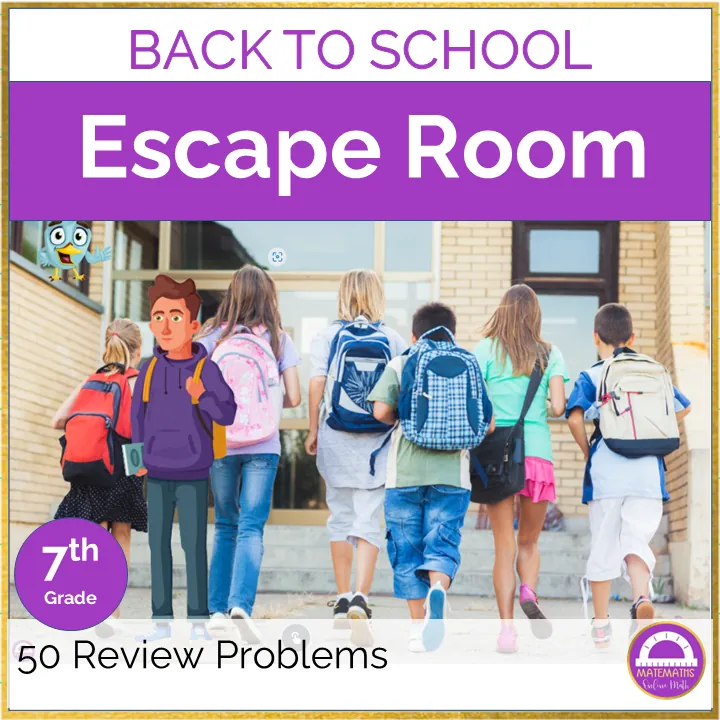
Back to School 7th Grade Math Review Activity| Digital Escape Room


- Grades
- Grades 6–8, Middle School
- File type
- Preparation
- Print ready


- Subject
- Math, Algebra, Fractions
- Topic
- Matemaths, Back to School
- Resource types
- Escape Room, Activities
- Preparation
- Print ready
About this resource
What's inside this resource
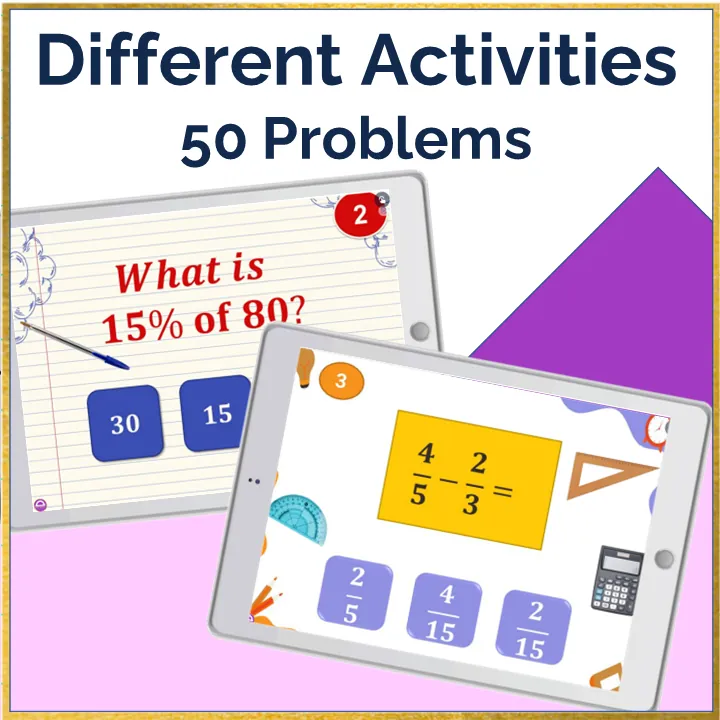
Welcome to this exciting back-to-school themed digital escape room, specially designed to captivate and engage your middle school students while reviewing essential grade six math concepts. This immersive experience offers a fun and interactive way for students to reinforce their understanding of converting fractions, decimals, and percents, percent of a number, operations with fractions, one-step equations, and ratios.
As your students help the protagonist navigate through his first day of school, they will encounter a total of 50 meticulously crafted math problems. These problems are divided into five categories, with 10 problems in each: converting fractions, decimals, and percents; percent of a number; operations with fractions; one-step equations; and ratios. By successfully solving each problem, they will progress through the escape room, unlocking new challenges and advancing the storyline.
One of the outstanding features of this escape room is its accessibility. Students can access and complete the activity on laptops, tablets, or smartphones, ensuring that it is compatible with various devices commonly used by learners. This inclusivity allows all students to participate, regardless of their technological resources.
Flexibility is another key aspect of this escape room. If students need to complete the activity over multiple days, they simply have to save the address at the top of the page, and they can seamlessly resume their progress right where they left off. This feature caters to different learning styles, schedules, and preferences, allowing for a personalized learning experience.
Setting up this escape room is effortless. Unlike traditional escape rooms, there's no need to configure physical locks or hide clues. Everything is conveniently hosted online, saving you valuable preparation time. Simply duplicate the student answer sheet, share the provided link with your students, and they're ready to embark on their escape room adventure. Additionally, there's no requirement for Google Classroom or Microsoft Teams logins, making the process straightforward for both you and your students.
To cater to different classroom setups and preferences, a printable version of the questions is also included. This ensures that you have the flexibility to choose between the digital or physical format based on your students' needs and available resources.
Related resources
More resources teachers may find useful
24 related resources were found using this product's title, contributor, categories and tags.


In the classroom
Teaching tips & learning objectives

Learning objectives
Convert values fluently among fraction, decimal, and percent forms
Calculate the percent of a given number
Add, subtract, multiply, and divide fractions

Teaching tips
Use the printable version for a no-device review day, then follow with the digital escape-room storyline as a reward round once the paper quizzes are checked.
Since each of the five rounds targets a distinct skill, assign rounds individually across a week as daily warm-ups instead of running all 50 problems in one sitting.
Quiz 5's word-problem ratios (tickets, cars, chairs) work well read aloud as a class before students answer independently, since several require picking the right two quantities to compare. Revisit earlier skills with this sixth-grade math escape room when the review shows gaps.

Skills covered
Fraction-decimal-percent conversion — rewriting a given value in each of the other two forms (Quiz 1)
Percent of a number — calculating a stated percentage of a whole number (Quiz 2)
Fraction operations — applying all four operations to fraction pairs (Quiz 3)

No reviews yet
Downloaded this resource? Tell other teachers how it went.
Curriculum
Standards, concepts & topics
Standards
 Standards
- 7.RP.A.3 — Use proportional relationships to solve multistep ratio and percent problems. Examples: simple interest, tax, markups and markdowns, gratuities and commissions, fees, percent increase and decrease, percent error.
- 7.NS.A.2 — Apply and extend previous understandings of multiplication and division and of fractions to multiply and divide rational numbers. a. Understand that multiplication is extended from fractions to rational numbers by requiring that operations continue to satisfy the properties of operations, particularly the distributive property, leading to products such as (–1)(–1) = 1 and the rules for multiplying signed numbers. Interpret products of rational numbers by describing real-world contexts. b. Understand that integers can be divided, provided that the divisor is not zero, and every quotient of integers (with non-zero divisor) is a rational number. If p and q are integers, then –(p/q) = (–p)/q = p/(–q). Interpret quotients of rational numbers by describing real-world contexts. COMMON CORE STATE STANDARDS for MATHEMATICS GRADE 7 | 49 c. Apply properties of operations as strategies to multiply and divide rational numbers. d. Convert a rational number to a decimal using long division; know that the decimal form of a rational number terminates in 0s or eventually repeats.
- 7.EE.B.4 — Use variables to represent quantities in a real-world or mathematical problem, and construct simple equations and inequalities to solve problems by reasoning about the quantities. a. Solve word problems leading to equations of the form px + q = r and p(x + q) = r, where p, q, and r are specific rational numbers. Solve equations of these forms fluently. Compare an algebraic solution to an arithmetic solution, identifying the sequence of the operations used in each approach. For example, the perimeter of a rectangle is 54 cm. Its length is 6 cm. What is its width? b. Solve word problems leading to inequalities of the form px + q > r or px + q < r, where p, q, and r are specific rational numbers. Graph the solution set of the inequality and interpret it in the context of the problem. For example: As a salesperson, you are paid $50 per week plus $3 per sale. This week you want your pay to be at least $100. Write an inequality for the number of sales you need to make, and describe the solutions.
Core concepts
 Core concepts
percent conversion
fraction operations
one-step equations
ratios
math review
 Topics
Explore more
Categories this resource belongs to
Explore related searches
More to explore
You may also like