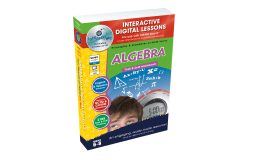
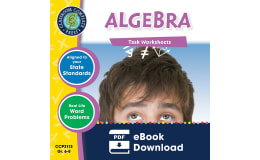
Beginning Algebra


- Grades
- Grades 6–8, Middle School
- File type
- Preparation
- Print ready


- Subject
- Math, Algebra
- Topic
- algebra
- Resource types
- Workbooks
- Preparation
- Print ready
About this resource
What's inside this resource
Beginning Algebra is a foundational pedagogical resource designed to support educators in teaching early algebra concepts to students in 6th, 7th, or 8th grades. Serving as a comprehensive guide for introducing algebra lessons, it provides a focused approach for students learning this complex math subject.
The unique aspect of Beginning Algebra lies in its methodology of addressing common student errors. Through clear explanations offered within the workbook, these frequently made mistakes are highlighted and then demystified for the learners. Demonstrative examples follow these mistake explorations that model the correct processes of solving algebra problems—a strategic way to consolidate understanding and inhibit further confusion.
Exceptional Features:
- An array of engaging puzzles and inventive games based on scientific formulas which add an element of fun to learning while also fostering creative thinking skills within young minds.
- The hands-on activities empower teachers or homeschoolers to break away from traditional methods and venture into an environment where learning is not just theory-based but also involves real-time practice and problem-solving exercises.
- To ensure learners gain valuable algebra skills, self-checking exercises are incorporated throughout the entire workbook promoting independent learning capabilities. These tasks function as checkpoints allowing a consistent evaluation progress.
In addition, Beginning Algebra comes with one product file that is effortless to use given its PDF format - compatible with most digital devices needing no specific applications beyond commonly used PDF readers installed on most computers or mobile devices. This ideally makes it convenient both for classroom instruction—whether given individually or in groups—and even as take-home work for continuous practice outside school hours.
To wrap up,
Essentially, Beginning Algebra doesn't just aim to be a structured roadmap towards mastering beginning algebra but earnestly seeks too in nurturing disciplined thinkers who can appreciate abstract mathematical ideas – positioning them well ahead in their future academic pursuits involving more advanced mathematics.
Related resources
More resources teachers may find useful
24 related resources were found using this product's title, contributor, categories and tags.

In the classroom
Teaching tips & learning objectives

Learning objectives
Apply the order of operations, including exponents and grouping symbols, to evaluate numeric expressions.
Use the distributive property and properties of whole numbers to simplify and manipulate expressions.
Write and solve one- and two-step linear equations and inequalities, including from word problems.

Teaching tips
Assign one puzzle page per skill as either guided practice or an independent center, since each page is self-contained with its own worked example.
Use the hidden-message and code-breaking format as a built-in error check — a garbled result signals a computational mistake before the teacher even reviews the page.
Sequence pages by topic (order of operations, then properties, then equations, then graphing) rather than strictly by page order, since topics build in difficulty within the book. Revisit the ideas behind the errors with these algebraic expressions guided notes.

Skills covered
Order of operations — students solve nested expressions with parentheses, brackets, and exponents across three escalating difficulty levels.
Equation and inequality solving — students write and solve one- and two-step equations and inequalities from numeric and word-problem prompts.
Integer and rational number operations — students add, subtract, multiply, and divide integers, fractions, decimals, and percents in both abstract and applied problems.
Good to know
Questions teachers ask about this resource
How does the puzzle format let students check their own work as they go?
Correct numeric answers are matched to a code (letters, symbols, or grid positions) that spells out a hidden word, mnemonic, or mathematician's name, so an answer that doesn't fit the emerging pattern signals a computational error before a teacher reviews it.

No reviews yet
Downloaded this resource? Tell other teachers how it went.
Curriculum
Standards, concepts & topics
Standards
 Standards
- 6.EE.A.2 — Write, read, and evaluate expressions in which letters stand for numbers. a. Write expressions that record operations with numbers and with letters standing for numbers. For example, express the calculation “Subtract y from 5” as 5 – y. COMMON CORE STATE STANDARDS for MATHEMATICS GRADE 6 | 44 b. Identify parts of an expression using mathematical terms (sum, term, product, factor, quotient, coefficient); view one or more parts of an expression as a single entity. For example, describe the expression 2 (8 + 7) as a product of two factors; view (8 + 7) as both a single entity and a sum of two terms. c. Evaluate expressions at specific values of their variables. Include expressions that arise from formulas used in real-world problems. Perform arithmetic operations, including those involving whole-number exponents, in the conventional order when there are no parentheses to specify a particular order (Order of Operations). For example, use the formulas V = s3 and A = 6 s2 to find the volume and surface area of a cube with sides of length s = 1/2.
- 7.EE.B.4 — Use variables to represent quantities in a real-world or mathematical problem, and construct simple equations and inequalities to solve problems by reasoning about the quantities. a. Solve word problems leading to equations of the form px + q = r and p(x + q) = r, where p, q, and r are specific rational numbers. Solve equations of these forms fluently. Compare an algebraic solution to an arithmetic solution, identifying the sequence of the operations used in each approach. For example, the perimeter of a rectangle is 54 cm. Its length is 6 cm. What is its width? b. Solve word problems leading to inequalities of the form px + q > r or px + q < r, where p, q, and r are specific rational numbers. Graph the solution set of the inequality and interpret it in the context of the problem. For example: As a salesperson, you are paid $50 per week plus $3 per sale. This week you want your pay to be at least $100. Write an inequality for the number of sales you need to make, and describe the solutions.
- 6.EE.A.3 — Apply the properties of operations to generate equivalent expressions. For example, apply the distributive property to the expression 3 (2 + x) to produce the equivalent expression 6 + 3x; apply the distributive property to the expression 24x + 18y to produce the equivalent expression 6 (4x + 3y); apply properties of operations to y + y + y to produce the equivalent expression 3y
Core concepts
 Core concepts
order of operations
linear equations
integers
properties of operations
graphing linear equations
Topics
 Topics
More to explore
You may also like