Bible Character Facts - Kings of Judah 1



- Grades
- Preschool–Pre-K, Grades 1–3, Elementary
- File type
- Preparation
- Print ready


- Subject
- ELA, Social Studies, Literature, Reading, Language Development, Vocabulary, Writing, History, History: Ancient
- Topic
- #biblestories #biblelessonskids #charactertraits #criticalthinking
- Resource types
- Teacher Tools, Lesson Plans, Activities, Projects
- Preparation
- Print ready
- Standards
- CCSS.RF.4.1.a CCSS.RF.4.1.c +20
About this resource
What's inside this resource
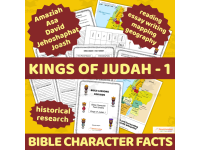
The Kings of Judah Bible Character Facts Study Part 1
The Kings of Judah Bible Character Study Activity Pack Part 1 has been fashioned to get children to be more assertive, and not only study but also comprehend, in depth, the Bible. The Pack is tuned to enhance the children’s research skills, reading skills and comprehension. It will also impact their writing skills and coloring creativity.
Every pack has been enriched with various verified truths about each king and features the following:
The period (in years) that each King governed.
The age that each became King.
The Parents of each King.
The predecessor and successor of each King.
The Children sired by each King.
The 5 kings included in this activity pack are:
1) David
2) Jehoshaphat
3) Joash
4) Amaziah
5) Asa
The Pack has been supplemented with:
An essay assignment that gives the student the opportunity to choose their favorite king and examine a single king in more detail.
A drawing exercise for non-literary and/or visual learners to color their favorite king.
A link to help researching easier and faster.
An area map to familiarize the children with the land of Judah and abutting countries
Sample answers are included in the fill-in-the-blank worksheet to help teachers/students identify each king in the Bible.
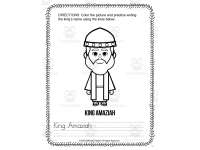
A coloring page for each of the five kings as well as the names of the kings that students can copy for writing practice.
With these in mind, I hope you have gotten a glimpse of what your children will enjoy in the product.
Click here to view my Kings of Judah Part 2 activity pack.
23 pages, Answer Key Included. pdf format
Recommended age groups kindergarten through 3rd grade.
Related resources
More resources teachers may find useful
24 related resources were found using this product's title, contributor, categories and tags.


In the classroom
Teaching tips & learning objectives

Learning objectives
- Locate facts about a biblical king in Scripture
- Organize findings about several kings in a summary table
- Judge whether each king was good or bad from the facts found

Skills covered
- Research — finding each king's reign, parents and key verses
- Map reading — labeling Judah and its neighboring areas
Good to know
Questions teachers ask about this resource
What do students need for the research?
A Bible is needed for the lookups; Bible dictionaries, encyclopedias or internet access are optional aids listed on the references page.

No reviews yet
Downloaded this resource? Tell other teachers how it went.
Curriculum
Standards, concepts & topics
Standards
 Standards
- CCSS.RF.4.1.a — Read grade-level text with purpose and understanding.
- CCSS.RF.4.1.c — Use context to confirm or self-correct word recognition and understanding, rereading as necessary
- CCSS.RF.4.2.a — Read grade-level text with purpose and understanding.
- CCSS.RF.4.2.c — Use context to confirm or self-correct word recognition and understanding, rereading as necessary
- CCSS.RF.4.3.c — Use context to confirm or self-correct word recognition and understanding, rereading as necessary
- CCSS.RF.4.3.a — Read grade-level text with purpose and understanding.
- CCSS.RI.2.10 — By the end of year, read and comprehend informational texts, including history/social studies, science, and technical texts, in the grades 2–3 text complexity band proficiently, with scaffolding as needed at the high end of the range.
- CCSS.RI.3.10 — By the end of the year, read and comprehend informational texts, including history/social studies, science, and technical texts, at the high end of the grades 2–3 text complexity band independently and proficiently
- CCSS.RL.K.7 — With prompting and support, describe the relationship between illustrations and the story in which they appear (e.g., what moment in a story an illustration depicts).
- CCSS.RL.K.9 — With prompting and support, compare and contrast the adventures and experiences of characters in familiar stories.
- CCSS.RL.1.7 — Use illustrations and details in a story to describe its characters, setting, or events.
- CCSS.RL.1.9 — Compare and contrast the adventures and experiences of characters in stories.
- CCSS.RL.2.7 — Use information gained from the illustrations and words in a print or digital text to demonstrate understanding of its characters, setting, or plot.
- CCSS.W.K.8 — With guidance and support from adults, recall information from experiences or gather information from provided sources to answer a question.
- CCSS.W.2.8 — Recall information from experiences or gather information from provided sources to answer a question.
- CCSS.W.3.7 — Conduct short research projects that build knowledge about a topic.
- CCSS.W.3.8 — Recall information from experiences or gather information from print and digital sources; take brief notes on sources and sort evidence into provided categories.
- CCSS.L.1.4 — Determine or clarify the meaning of unknown and multiple-meaning words and phrases based on grade 1 reading and content, choosing flexibly from an array of strategies. a. Use sentence-level context as a clue to the meaning of a word or phrase. b. Use frequently occurring affixes as a clue to the meaning of a word. c. Identify frequently occurring root words (e.g., look) and their inflectional forms (e.g., looks, looked, looking).
- CCSS.L.2.6 — Use words and phrases acquired through conversations, reading and being read to, and responding to texts, including using frequently occurring conjunctions to signal simple relationships (e.g., because).
- CCSS.L.3.4 — Determine or clarify the meaning of unknown and multiple-meaning word and phrases based on grade 3 reading and content, choosing flexibly from a range of strategies. a. Use sentence-level context as a clue to the meaning of a word or phrase. b. Determine the meaning of the new word formed when a known affix is added to a known word (e.g., agreeable/disagreeable, comfortable/uncomfortable, care/careless, heat/preheat). c. Use a known root word as a clue to the meaning of an unknown word with the same root (e.g., company, companion). d. Use glossaries or beginning dictionaries, both print and digital, to determine or clarify the precise meaning of key words and phrases.
- CCSS.L.3.5 — Demonstrate understanding of word relationships and nuances in word meanings. a. Distinguish the literal and nonliteral meanings of words and phrases in context (e.g., take steps). b. Identify real-life connections between words and their use (e.g., describe people who are friendly or helpful). c. Distinguish shades of meaning among related words that describe states of mind or degrees of certainty (e.g., knew, believed, suspected, heard, wondered).
- CCSS.L.3.6 — Acquire and use accurately grade-appropriate conversational, general academic, and domainspecific words and phrases, including those that signal spatial and temporal relationships (e.g., After dinner that night we went looking for them).
Core concepts
 Core concepts
- Kings of Judah
- Bible study
- Research skills
 Topics
Explore more
Categories this resource belongs to
Explore related searches
More to explore
You may also like