Brown v. Board of Education – 1954 Case Brief



- Grades
- Grades 8–11
- Pages
- 2
- File type
- Answer key
- Included


- Subject
- Social Studies, History: USA
- Topic
- Brown v Board, Supreme Court case
- Resource types
- Graphic Organizers, Worksheets
- Answer key
- Included
Product description
From the author
Brown v. Board of Education is a landmark United States Supreme Court case that was decided in 1954. The case involved the issue of racial segregation in public schools and had a profound impact on the civil rights movement. The case originated from several lawsuits filed by African American families challenging the segregation of public schools based on race. At the time, racial segregation was widespread in many areas of the United States, and public schools were often segregated, with African American students attending separate schools that were unequal in terms of resources and quality of education.
In Brown v. Board of Education, the Supreme Court unanimously ruled that segregation in public schools violated the Fourteenth Amendment's Equal Protection Clause, which guarantees equal treatment under the law. The Court concluded that separate educational facilities for white and African American students were inherently unequal and that racial segregation in public education had a detrimental impact on African American children, damaging their self-esteem and denying them equal educational opportunities. The decision in Brown v. Board of Education overturned the "separate but equal" doctrine established in the 1896 case Plessy v. Ferguson, which had allowed for racial segregation as long as the separate facilities were equal in quality.
The Brown decision declared that separate educational facilities were inherently unequal and ordered the desegregation of public schools. However, the implementation of the Brown decision faced significant resistance in many parts of the country. Some states and localities resisted desegregation efforts, leading to years of legal battles and social upheaval. It wasn't until years later, through further court rulings, federal legislation, and the efforts of civil rights activists, that significant progress was made in desegregating schools and advancing equal educational opportunities for all students. Overall, Brown v. Board of Education was a pivotal case in the civil rights movement, challenging the legal foundation of segregation and setting the stage for subsequent efforts to end racial discrimination in various aspects of American society.
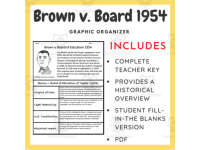
Teacher-prepared notes show students what is important and how ideas relate, and offer a model for how students should take notes themselves (Marzano et al., 2001). These teacher-created notes will help your students grasp the major impact of the Brown v. Board of Education 1954 case. These notes come with a student version and a completed teacher version. These notes work well as a supplement to class readings!
Product clipart credit: by Clip Art Emporium
Related resources
More resources teachers may find useful
24 related resources were found using this product's title, contributor, categories and tags.


In the classroom
Teaching tips & learning objectives

Learning objectives
Summarize the NAACP's legal strategy leading up to Brown v. Board of Education.
Explain how the case originated from Oliver Brown's protest of segregated schools in Topeka, Kansas.
Describe the historical significance of the Brown v. Board of Education ruling.

Teaching tips
Use the first, fully completed copy as a model or answer key when the second copy's later sections are assigned as independent student work.
Briefly review the role of the Supreme Court before assigning the case-specific notes.
Pair the organizer with a short excerpt of the Fourteenth Amendment's text so students can see the exact clause referenced in the legal reasoning section.

Skills covered
Legal case analysis — students summarize a case's origins, legal reasoning, and historical impact using a structured organizer.
Constitutional interpretation — students connect the Fourteenth Amendment's equal protection clause to a specific legal challenge.
Civics context-building — students relate a Supreme Court case to the broader structure of the judicial branch.
Good to know
Questions teachers ask about this resource
How can I use the organizer during a lesson?
Work through the origins, legal reasoning, and historical-impact sections in order. Ask students to explain how the constitutional question connects to the case rather than copying isolated details.

No reviews yet
Downloaded this resource? Tell other teachers how it went.
Resource details
Concepts & topics
Core concepts
 Core concepts
Brown v. Board of Education
Fourteenth Amendment
Civil rights history
Judicial branch
 Topics
More to explore
You may also like