



Contractions Anchor Chart – Grades 1-3 ELA
- Grades
- Grades 1–3
- Pages
- 2
- File type
- Answer key
- Included


- Subject
- ELA, Grammar
- Topic
- Contractions, Apostrophes
- Resource types
- Posters, Anchor Charts
- Answer key
- Included
- Standards
- CCSS.L.2.2
Product description
From the author
Contractions Anchor Chart
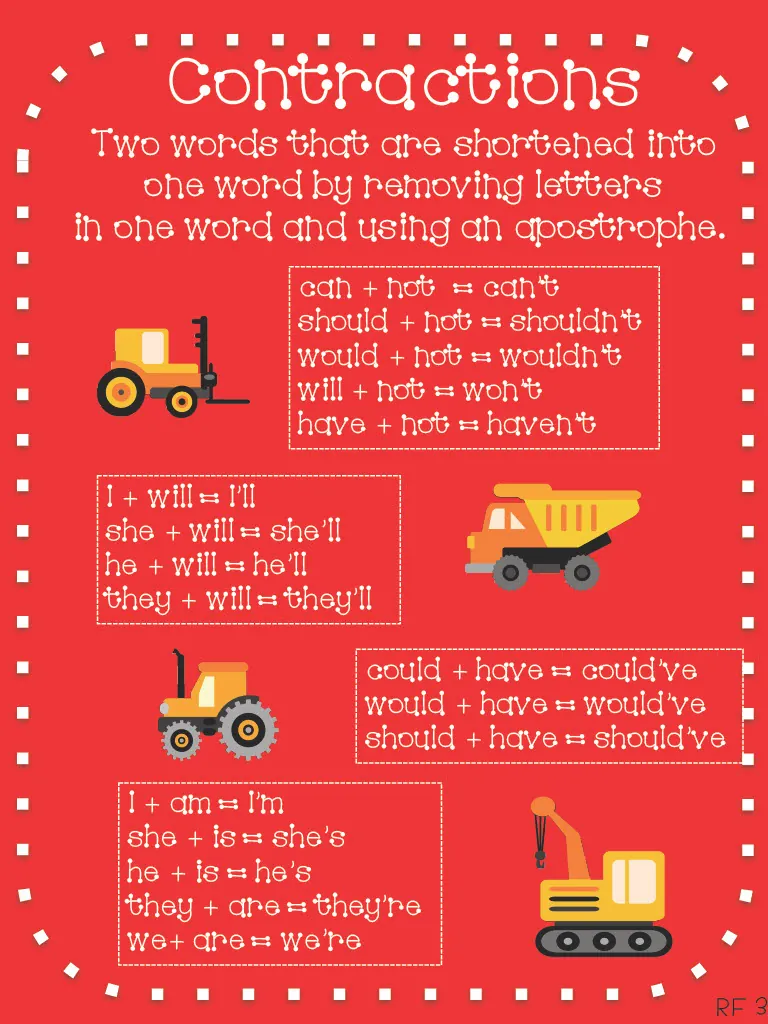
A user-friendly teaching resource designed for Grade 1, Grade 2, and Grade 3 educators who teach Language Arts. It targets the sub-subject of Spelling and presents an engaging approach to effectively illustrate contractions.
Included in Offering:
- The first chart: A comprehensive guide, displaying contraction forms in an easy-to-understand manner. Requires no additional input from the educator.
- The second chart: Promotes active learning through its fill-in-the-blank model. Students supply three words in the definition: two, one and apostrophe. The seventeen contraction examples remain completed.
Note: Both anchor charts can be utilized during whole-group lessons as visual aids, or during classroom discussions on contractions. They are also effective for small groups or one-on-one engagements serving as shared resources facilitating collaborative learning.
Homeschooling & Homework Assignments
Educators homeschooling students can find immense value in these charts too as they stand alone well while offering scope for extension activities when working individually at home. Teachers might consider setting them as homework assignments where pupils study from filled-in chart and complete their own versions using the second blank chart, thus reinforcing earlier learned concepts in school.
Bulletin Board Displays & Interactive Notebooks
This Contractions Anchor Chart also finds its place on bulletin board displays fostering ongoing review opportunities inside classrooms, as well it proves a perfect addition into students' interactive reading notebooks aiding consistent revision routine. Available instantly upon purchase in PDF format optimized for print (two pages), this anchor chart aims to make grammar instruction simpler without compromising robust learning experiences for your students.
Related resources
More resources teachers may find useful
24 related resources were found using this product's title, contributor, categories and tags.

In the classroom
Teaching tips & learning objectives

Learning objectives
Explain how the displayed word pairs form contractions by dropping letters and adding an apostrophe
Complete the definition of a contraction using the terms 'two,' 'one,' and 'apostrophe'
Use a completed contraction chart as an ongoing reference during reading and writing

Teaching tips
Display the completed chart first as a model, then hand out the fill-in version for students to complete independently or with a partner
Teach by base-word group in the order the chart already uses — not-contractions, then will, then have, then am/is/are
Post the completed version as a classroom anchor chart for ongoing reference during independent writing

Skills covered
Interpreting contraction examples — students see how two words combine by dropping letters and adding an apostrophe.
Academic vocabulary — students complete the fill-in chart's definition using the terms 'two,' 'one,' and 'apostrophe.'
Reference-chart use — students use the completed chart as an ongoing resource when reading or writing contractions.

No reviews yet
Downloaded this resource? Tell other teachers how it went.
Curriculum
Standards, concepts & topics
Standards
 Standards
- CCSS.L.2.2 — Demonstrate command of the conventions of standard English capitalization, punctuation, and spelling when writing. a. Capitalize holidays, product names, and geographic names. b. Use commas in greetings and closings of letters. c. Use an apostrophe to form contractions and frequently occurring possessives. d. Generalize learned spelling patterns when writing words (e.g., cage → badge; boy → boil). e. Consult reference materials, including beginning dictionaries, as needed to check and correct spellings.
Core concepts
 Core concepts
Contractions
Apostrophe use
Word combination
Topics
 Topics
Explore more
Categories this resource belongs to
Explore related searches
More to explore
You may also like


