Crash Course Sociology | 37 - Theories About Family and Marriage


- Grades
- Grades 10–12, High School
- File type
- Microsoft Word
- Editable
- Yes


- Subject
- Social Studies
- Topic
- Theories, Family
- Resource types
- Worksheets & Printables, Worksheets
- Editable
- Yes
About this resource
What's inside this resource
Related resources
More resources teachers may find useful
24 related resources were found using this product's title, contributor, categories and tags.


In the classroom
Teaching tips & learning objectives

Learning objectives
Define core kinship and family terms (kinship, fictive kin, nuclear family, family of orientation) after watching the video.
Explain residence and descent patterns (patrilocality, matrilocality, neolocality, patrilineal descent) with a specific example or statistic from the video.
Explain how three sociological theories — structural functionalism, social conflict/feminist theory, and symbolic interactionism — each interpret the role of family and marriage.

Teaching tips
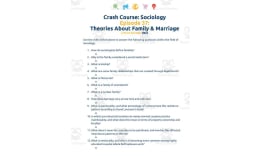
Play the linked 11-minute video once through, then a second time pausing near each new term so students can complete the matching worksheet question before moving on.
Save the three closing theory questions (13-15) for a follow-up discussion, since they ask students to compare structural functionalism, conflict theory, and symbolic interactionism rather than recall a single definition.
Use the separate answer key for a quick self- or peer-check pass before whole-class discussion, since each item includes a full explanation rather than a one-word answer.

Skills covered
Sociological vocabulary acquisition — students define terms such as kinship, fictive kin, and neolocality after encountering them in the video.
Theoretical comparison — students explain how structural functionalism, conflict theory, and symbolic interactionism each frame family and marriage differently (questions 13-15).
Video-based note-taking — students extract specific facts (e.g., a named percentage or comparison) from a spoken video source and record them in writing.
Good to know
Questions teachers ask about this resource
Do all 15 questions ask for a simple definition?
No — most ask for a definition or fact from the video, but the final three questions ask students to compare how three different sociological theories view family and marriage.

No reviews yet
Downloaded this resource? Tell other teachers how it went.
Resource details
Concepts & topics
Core concepts
 Core concepts
kinship and family structures
marriage and descent patterns
sociological theories of family
 Topics
Explore more
Categories this resource belongs to
Explore related searches
More to explore
You may also like