Crossword Puzzles about Middle School Chemistry
- Grades
- Grades 6–9, High School, Middle School
- File type
- Preparation
- Print ready


- Subject
- Science, Chemistry
- Topic
- Chemistry, crossword
- Resource types
- Crosswords Puzzles, Worksheets, Worksheets & Printables
- Preparation
- Print ready
About this resource
What's inside this resource
Product description
From the author
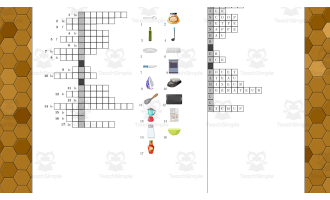
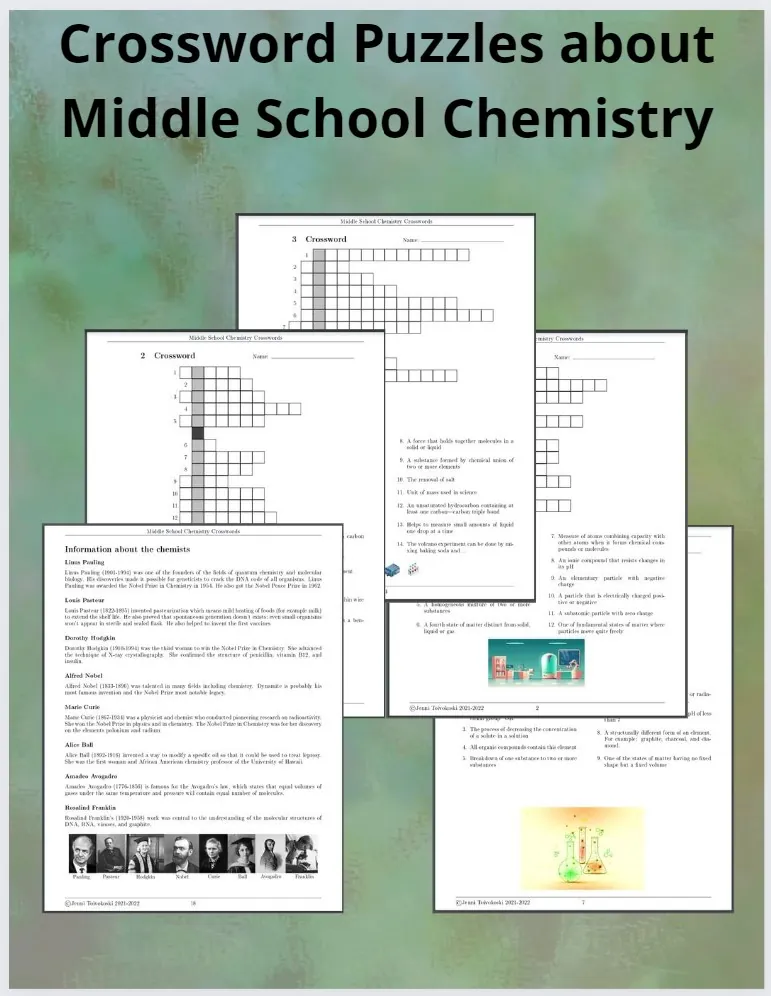
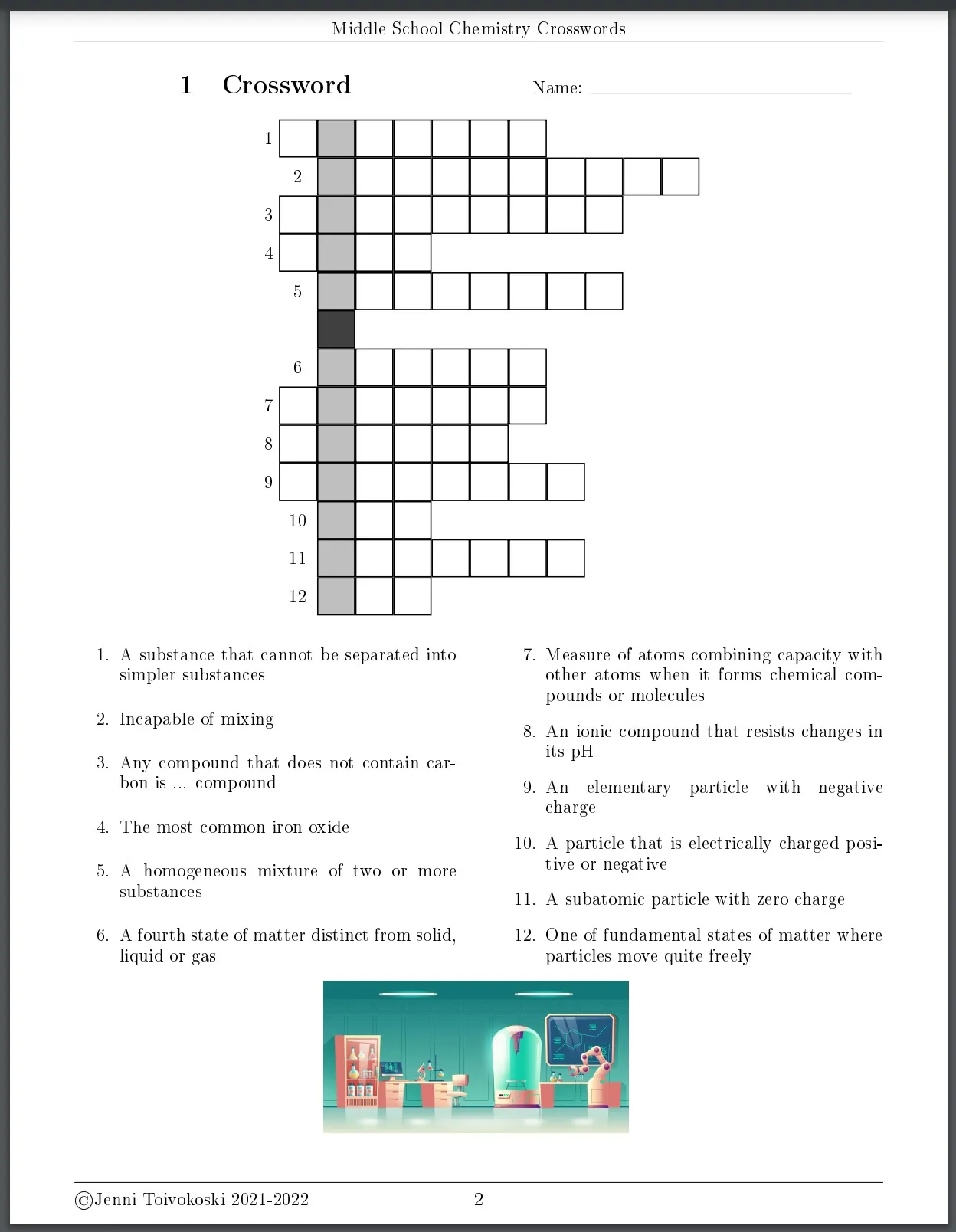
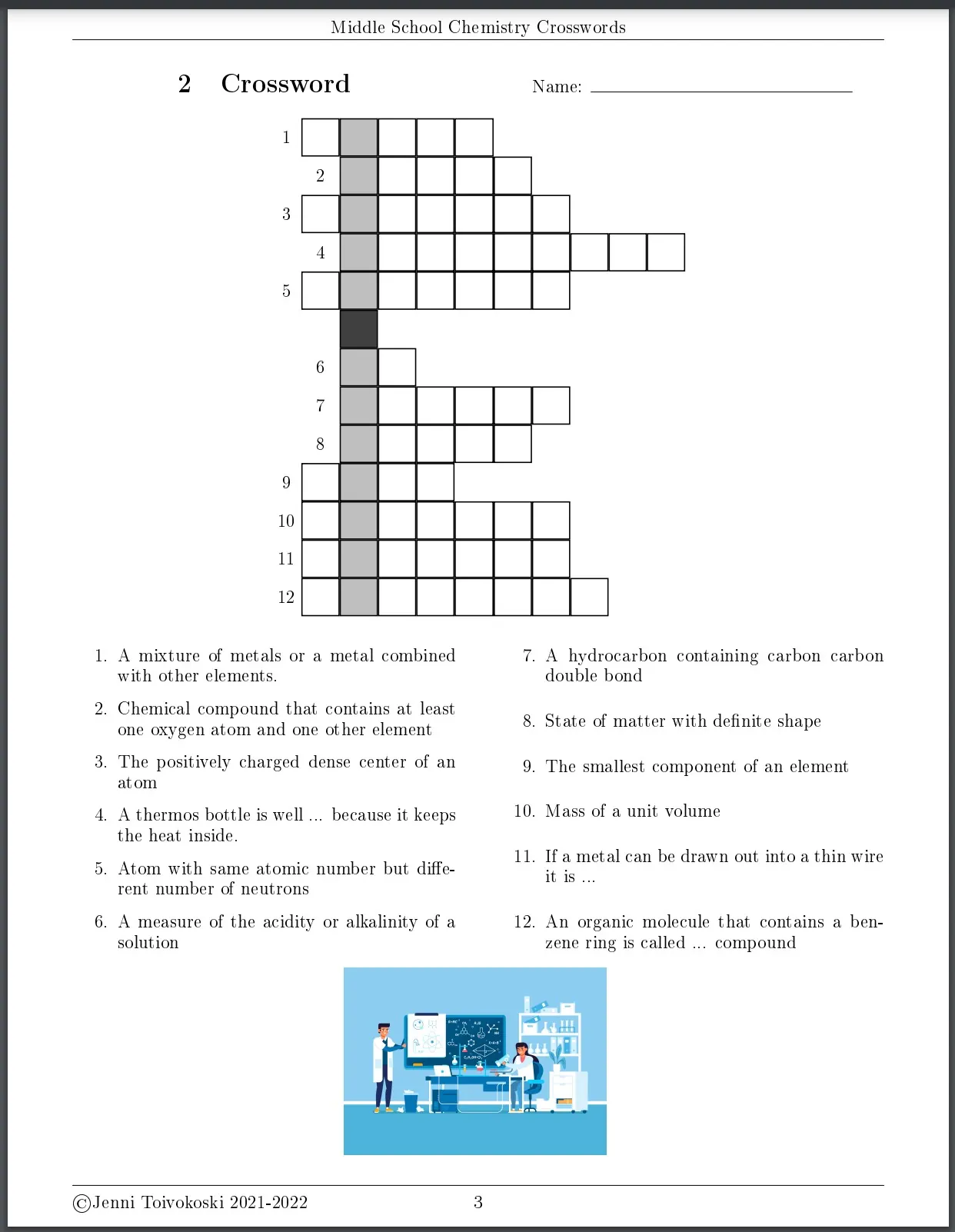
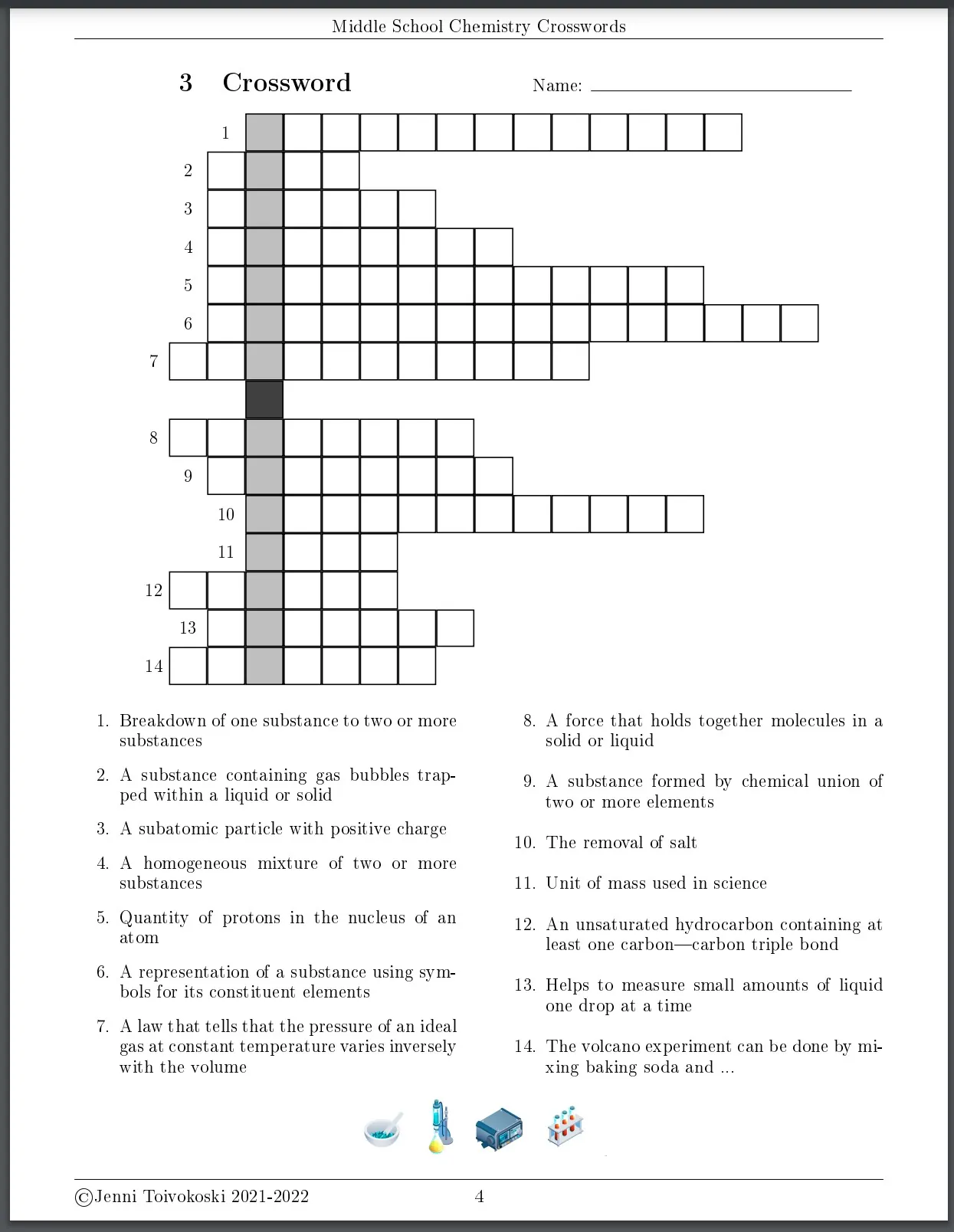
These crosswords help students to rehearse middle school chemistry concepts. When they fill a crossword, a hidden name of a famous chemist will appear. The accomplishments of the chemists are explained on the last page.
This material can be used for example as a review, exam preparation, time filler, material to a substitute teacher etc. This is ready to use, print-and-go material including all answers. Students may need some study book or other source to get all crosswords completed. However, you can use these without any books first to see how far the students will go! These crossword puzzles are best suitable for work in small groups, but can be also used for individual work.
The hints are verbal descriptions. Some examples of the hints:
A substance that cannot be separated into simpler substances
A mixture of metals or a metal combined with other elements
Helps to measure small amounts of liquid one drop at a time
Materials that ignite easily are called …
A law that tells that the pressure of an ideal gas at constant temperature varies inversely with the volume
Anode and cathode are both …
A glass container with a at bottom and a small spout for pouring
Organic compounds that contain the functional group OH
One of the states of matter having no fixed shape but a fixed volume
Purifying a liquid by boiling it and condensing its vapors
Examples of words in the crosswords:
Element, inorganic, oxide, nucleus, aromatic, chemical formula, alkyne, acid, double bond, dilution, absorption, allotrope, microscope, neutralization, ion, evaporation, radioactive, ionic bond, mass number
Some words occur in multiple crosswords, but never twice in the same crossword.
The hidden words in the middle rows are the following chemists:
Linus Pauling, Louis Pasteur, Dorothy Hodgkin, Alfred Nobel, Marie Curie, Alice Ball, Amadeo Avogadro, Rosalind Franklin.
Related resources
More resources teachers may find useful
24 related resources were found using this product's title, contributor, categories and tags.

In the classroom
Teaching tips & learning objectives

Learning objectives
Define core chemistry vocabulary terms -- element, compound, isotope, ion, valence, mixture -- by solving crossword clues.
Identify a historical chemist from the letters revealed in a crossword's vertical row.
Self-check crossword answers against the provided completed answer-key grids.

Teaching tips
Assign one crossword per class period across the eight puzzles, since each targets a different vocabulary cluster -- for example atomic particles and bonding in some puzzles, states of matter and mixtures in others.
Have students research the chemist named in each puzzle's vertical row using the included biography page once they finish solving it, connecting vocabulary practice to science history.
Preview the multi-word-answer convention before students begin -- one blank square marks a space between words -- since it is specific to this puzzle's format.

Skills covered
Chemistry vocabulary recall -- students match definitions such as "a substance that cannot be separated into simpler substances" to terms like element across 8 crosswords.
Self-checking -- students compare their completed grids against the provided answer-key pages.
Cross-curricular history connection -- solving each puzzle's vertical row reveals a chemist's name, linking to the included biography page for figures like Marie Curie and Rosalind Franklin.
Good to know
Questions teachers ask about this resource
What determines the hidden name revealed in each crossword's vertical row?
Solving all the clues correctly spells out one of eight chemists' names -- Linus Pauling, Louis Pasteur, Dorothy Hodgkin, Alfred Nobel, Marie Curie, Alice Ball, Amadeo Avogadro or Rosalind Franklin -- down that puzzle's vertical row.
How does the puzzle handle multi-word answers?
One grid square is left blank to represent the space between words, and the same convention applies to any other special character in an answer.

No reviews yet
Downloaded this resource? Tell other teachers how it went.
Resource details
Concepts & topics
Core concepts
 Core concepts
Chemistry vocabulary
Atomic structure
States of matter
History of chemistry
Topics
 Topics
Explore more
Categories this resource belongs to
Explore related searches
More to explore
You may also like