Decomposing Fractions – Grade 4 Worksheet Set
- Grades
- Grade 4
- Pages
- 62
- File type
- Answer key
- Included


- Subject
- Math, Fractions
- Topic
- Decomposing fractions, Unit fractions
- Resource types
- Worksheets
- Answer key
- Included
- Standards
- 4.NF.B.3
Product description
From the author
Decomposing fractions deals with the breaking down of a fraction or whole number into a sum of simpler parts. It provides a good foundation for addition and subtraction of fractions, converting improper fractions to mixed fractions and also makes word problems easier.
These worksheets aim to develop the skills and understanding of decomposing fractions by ensuring you can choose from a sufficient number of levels of worksheets with and without visual support, and where needed repeat a level with a different set of questions as many times as is needed.
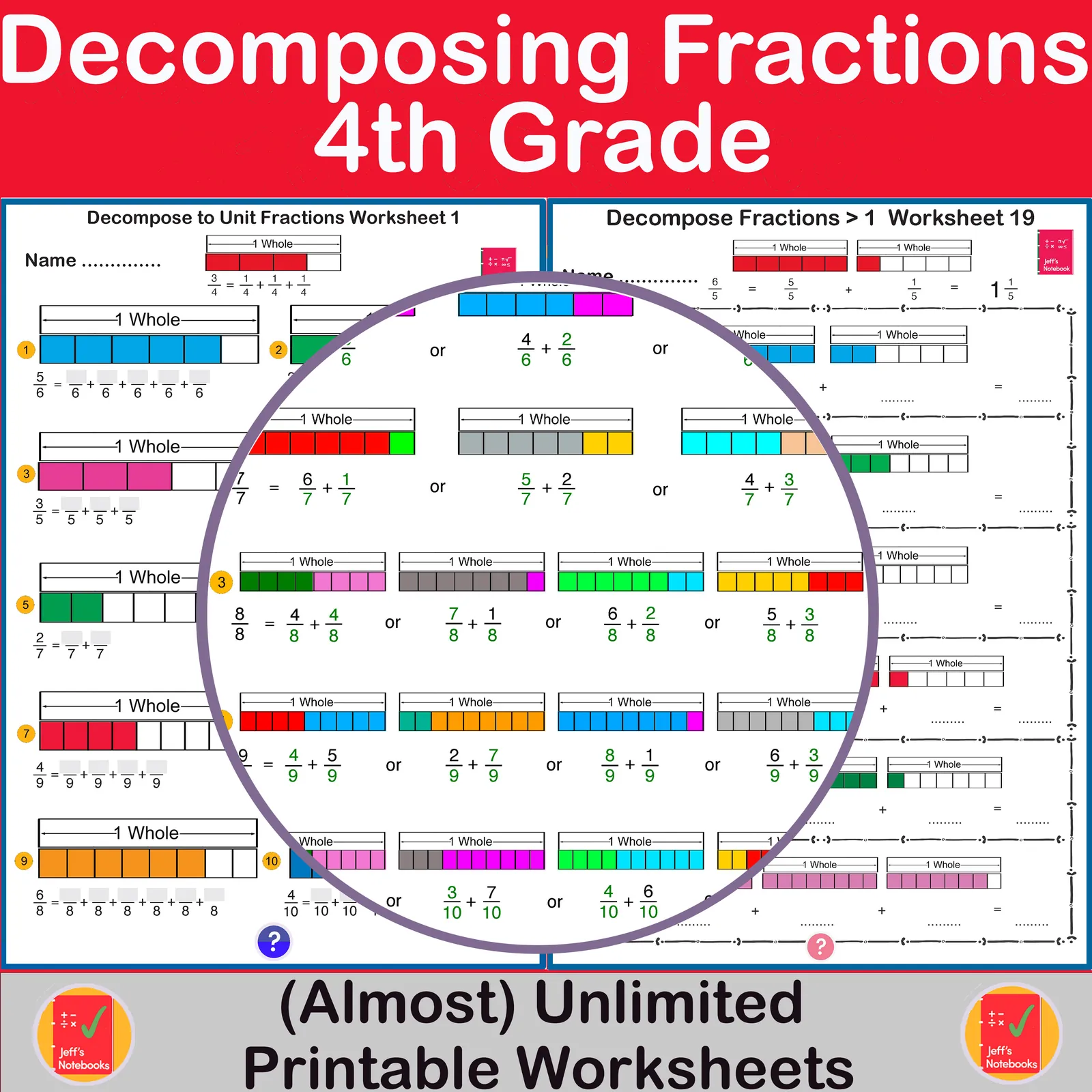
There are 5 levels of worksheets with visual support which form a natural progression:
Decompose fractions less than 1 to unit fractions
Decompose fractions less than 1 to 2 fractions
Decompose a fraction less than 1 to 3 fractions
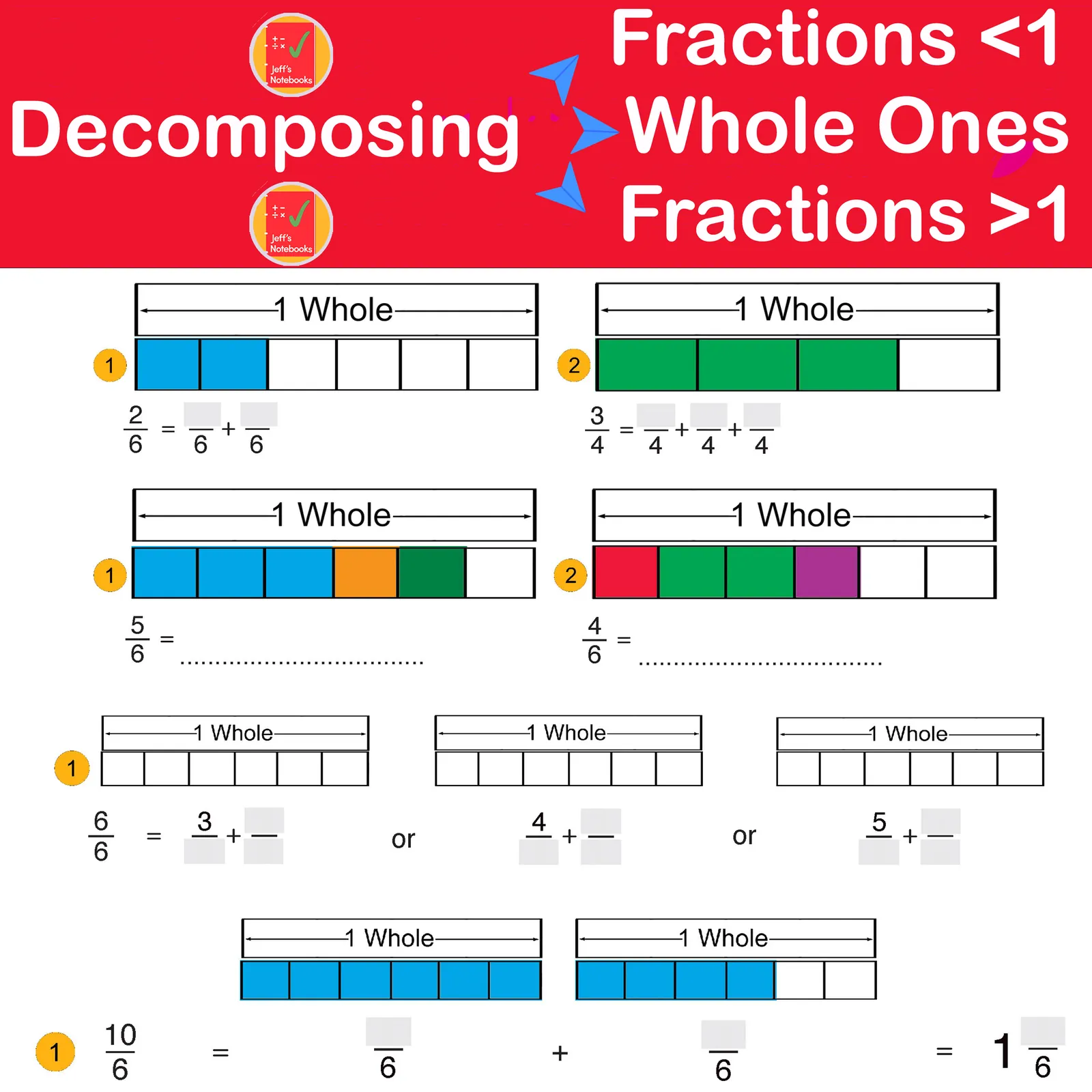
Decompose a Whole Number to 2 fractions
Decompose an improper number then write as a mixed number
Differentiation within each level
For each of the above there are a number of options available that will enable you to choose how much information your students need to complete a worksheet e.g. you may want them to:
-only to fill in the numerators for the decomposed fractions
-write out the fully the fraction before and after decomposition using colored fraction bar
-color in the fraction bar
-find the missing numerators or denominators using the shown numbers as clues
How many worksheets are there ?
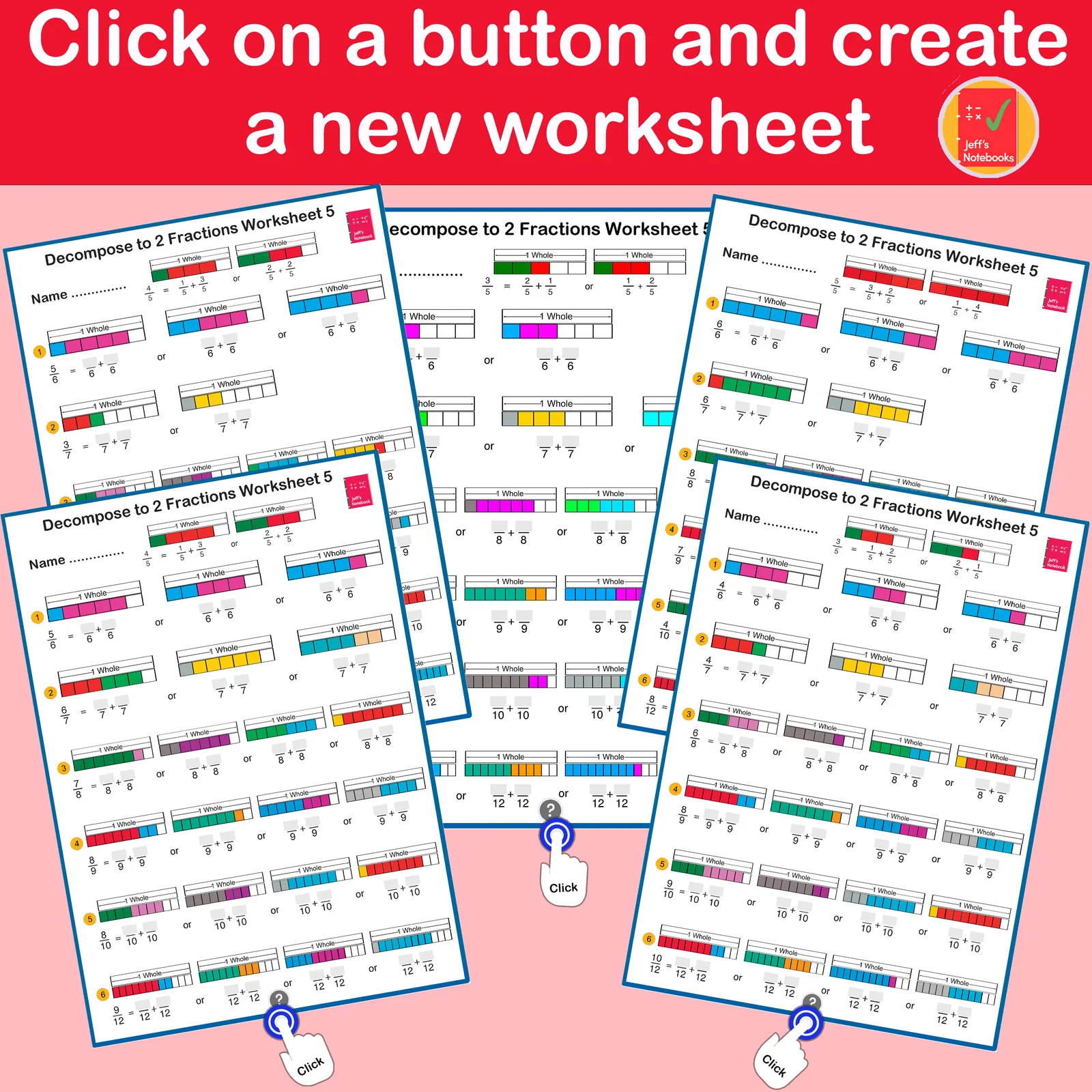
Lots and lots. There are 22 worksheet templates BUT at the click of a button numbers are randomised, so the questions change every time which allows you to create new worksheets at the same level for extra practice or revision throughout the year or even give groups of pupils in your class different sets of questions again all at the same level. The multiple levels of worksheets means that you can differentiate from the very start and have the freedom to set the pace of work that you think is best for each student.
With these worksheets there is a simple example at the top of the page as a memory jogger
Numerical Worksheets
There are 2 further sets of worksheets with numerical based questions.
The first covers decomposing fractions to unit fractions and 2 or more fractions.
The second set has questions on decomposing improper numbers then writing them as mixed numbers.
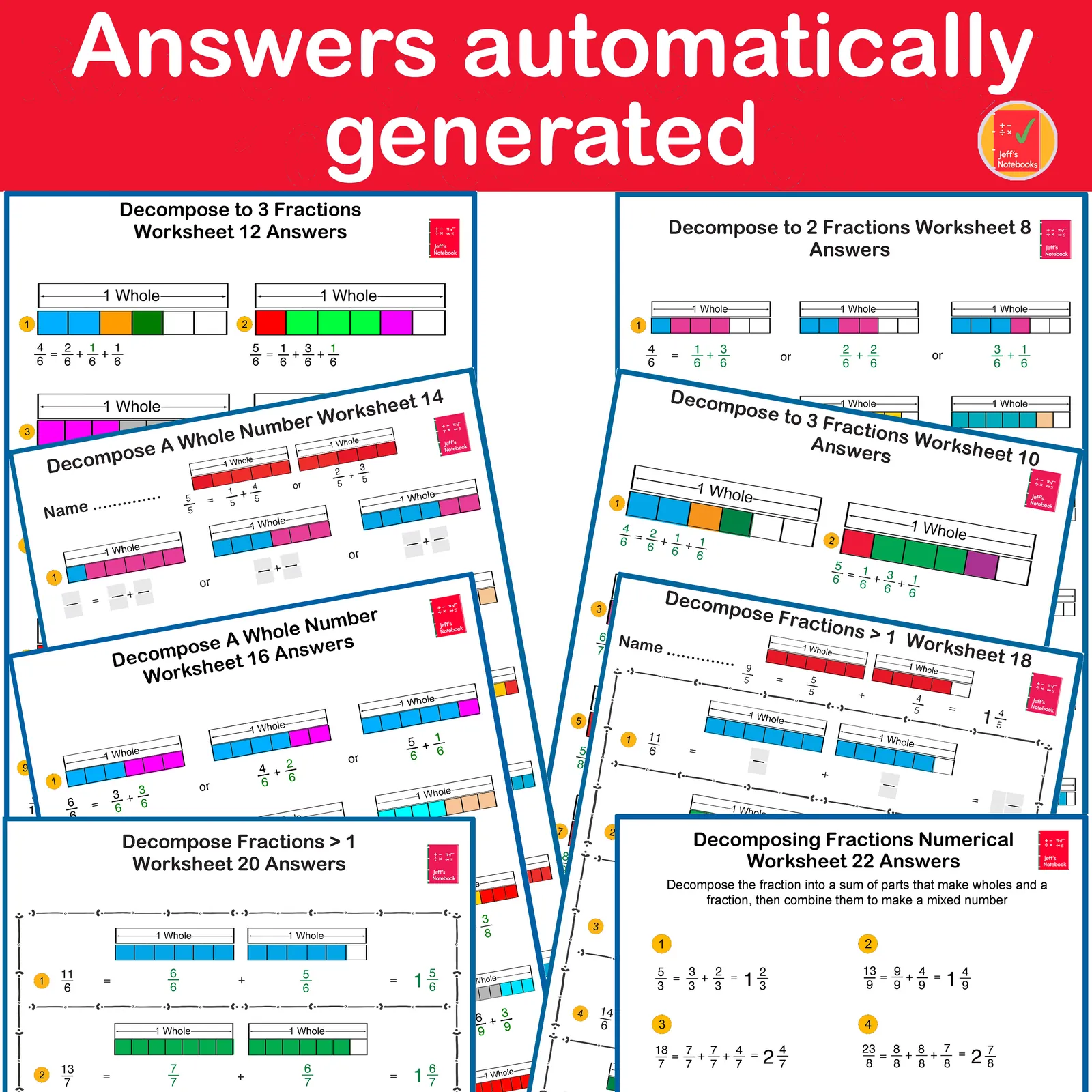
Answers can be found on the second page of every worksheet, are automatically generated when you create a new worksheet.
As these NO PREP worksheets need little explanation, they are ideal if you need to leave work for a replacement teacher.
Blank Templates
In addition there are blank templates of each of the 5 formats above that can be used for a more open-ended activity where students can create their own worksheets on decomposing fractions.
Note
These resources are PDF documents and work with the official Adobe Acrobat Reader on Windows or Mac computers with the randomising buttons also working via a touchscreen (PC or Mac)or on an Interactive Whiteboard.
Common Core
CCSS.MATH.CONTENT.4.NF.B.3
Understand a fraction a/b with a > 1 as a sum of fractions 1/b.
CCSS.math.content.4.nf.b.3.b
Decompose a fraction into a sum of fractions with the same denominator in more than one way, recording each decomposition by an equation. Justify decompositions, e.g., by using a visual fraction model.
Related resources
More resources teachers may find useful
24 related resources were found using this product's title, contributor, categories and tags.



In the classroom
Teaching tips & learning objectives

Learning objectives
Decompose a fraction less than 1 into a sum of unit fractions with the same denominator, recording the decomposition as an equation.
Decompose a fraction greater than 1 into whole-number parts and a remaining fraction, then write it as a mixed number.
Complete fraction-decomposition equations without a visual fraction-bar model, using the numerical-only worksheets.

Teaching tips
Select a visual level matching the type of fraction decomposition students are practising.
Choose among the four worksheet variants according to how much equation and fraction-bar information learners need.
Use worksheets 21 and 22 for numerical practice without fraction-bar models.

Skills covered
Fraction decomposition — students break a proper fraction into a sum of unit fractions with the same denominator (worksheets 1–4).
Multi-fraction decomposition — students find two or three addends with a common denominator, checking their work against a colored fraction bar (worksheets 5–12).
Improper-fraction-to-mixed-number conversion — students decompose a fraction greater than 1 into whole-number parts and a remaining fraction, then rewrite it as a mixed number (worksheets 17–20).
Good to know
Questions teachers ask about this resource
How is each of the five decomposition levels structured?
Each visual level has four variants. Depending on the level, students complete missing values, interpret a colored fraction bar, write full equations or color a bar themselves. The guide specifies the task for each worksheet.
Is there a version of the practice that skips the fraction-bar diagrams?
Yes — two numerical worksheets each provide 14 decomposition questions in equation form only, for students who no longer need the visual fraction-bar support.

No reviews yet
Downloaded this resource? Tell other teachers how it went.
Curriculum
Standards, concepts & topics
Standards
 Standards
- 4.NF.B.3 — Understand a fraction a/b with a > 1 as a sum of fractions 1/b. a. Understand addition and subtraction of fractions as joining and separating parts referring to the same whole. b. Decompose a fraction into a sum of fractions with the same denominator in more than one way, recording each decomposition by an equation. Justify decompositions, e.g., by using a visual fraction model. Examples: 3/8 = 1/8 + 1/8 + 1/8 ; 3/8 = 1/8 + 2/8 ; 2 1/8 = 1 + 1 + 1/8 = 8/8 + 8/8 + 1/8. c. Add and subtract mixed numbers with like denominators, e.g., by replacing each mixed number with an equivalent fraction, and/or by using properties of operations and the relationship between addition and subtraction. d. Solve word problems involving addition and subtraction of fractions referring to the same whole and having like denominators, e.g., by using visual fraction models and equations to represent the problem.
Core concepts
 Core concepts
Fraction decomposition
Unit fractions
Common denominators
Mixed numbers
Equation representation of fractions
 Topics
Explore more
Categories this resource belongs to
Explore related searches
More to explore
You may also like