Equivalent Fractions on the Number Line – 3rd Grade
- Grades
- Grade 3, Elementary
- File type
- Preparation
- Print ready


- Subject
- Math, Fractions
- Topic
- fractions, number line
- Resource types
- Worksheets & Printables, Worksheets
- Preparation
- Print ready
About this resource
What's inside this resource
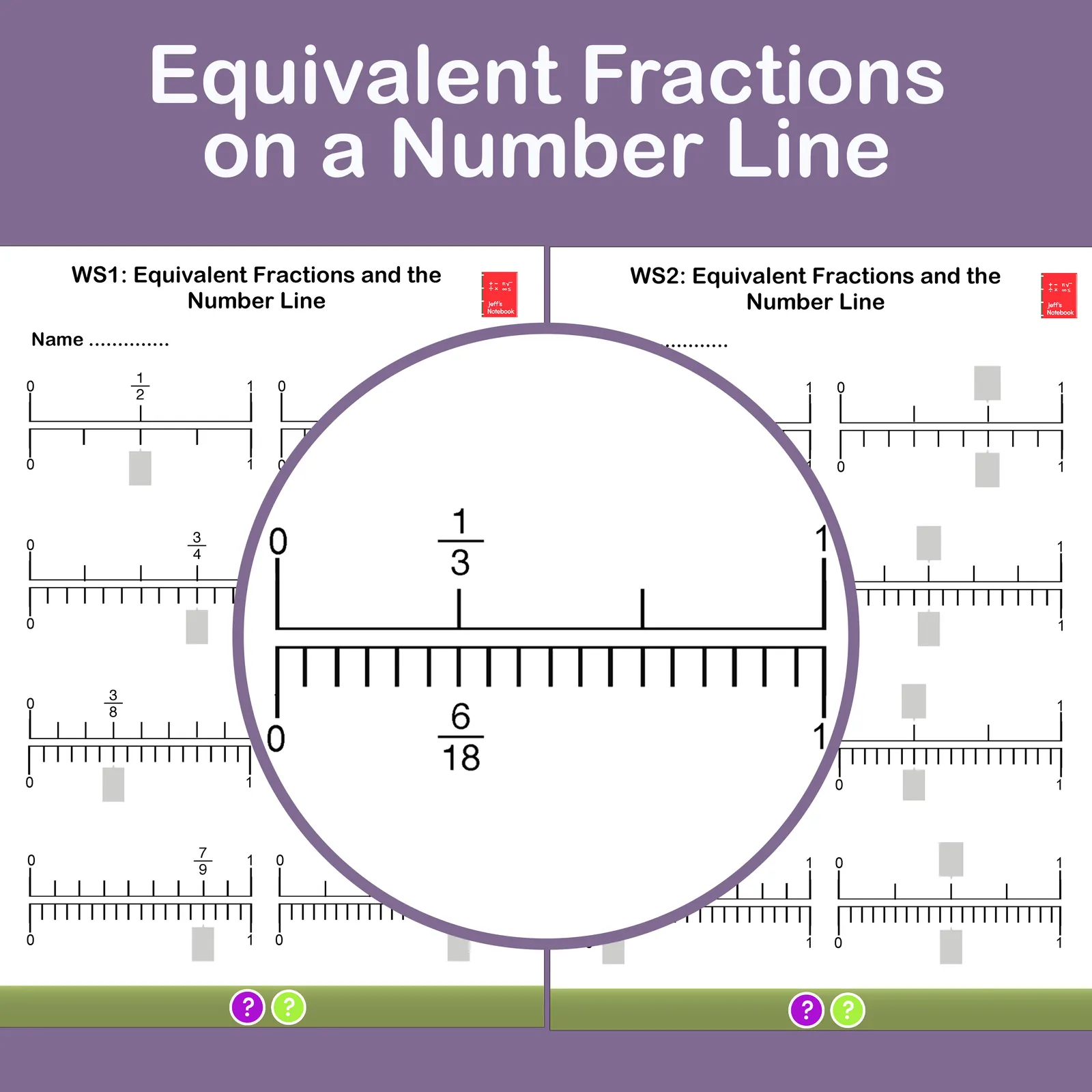
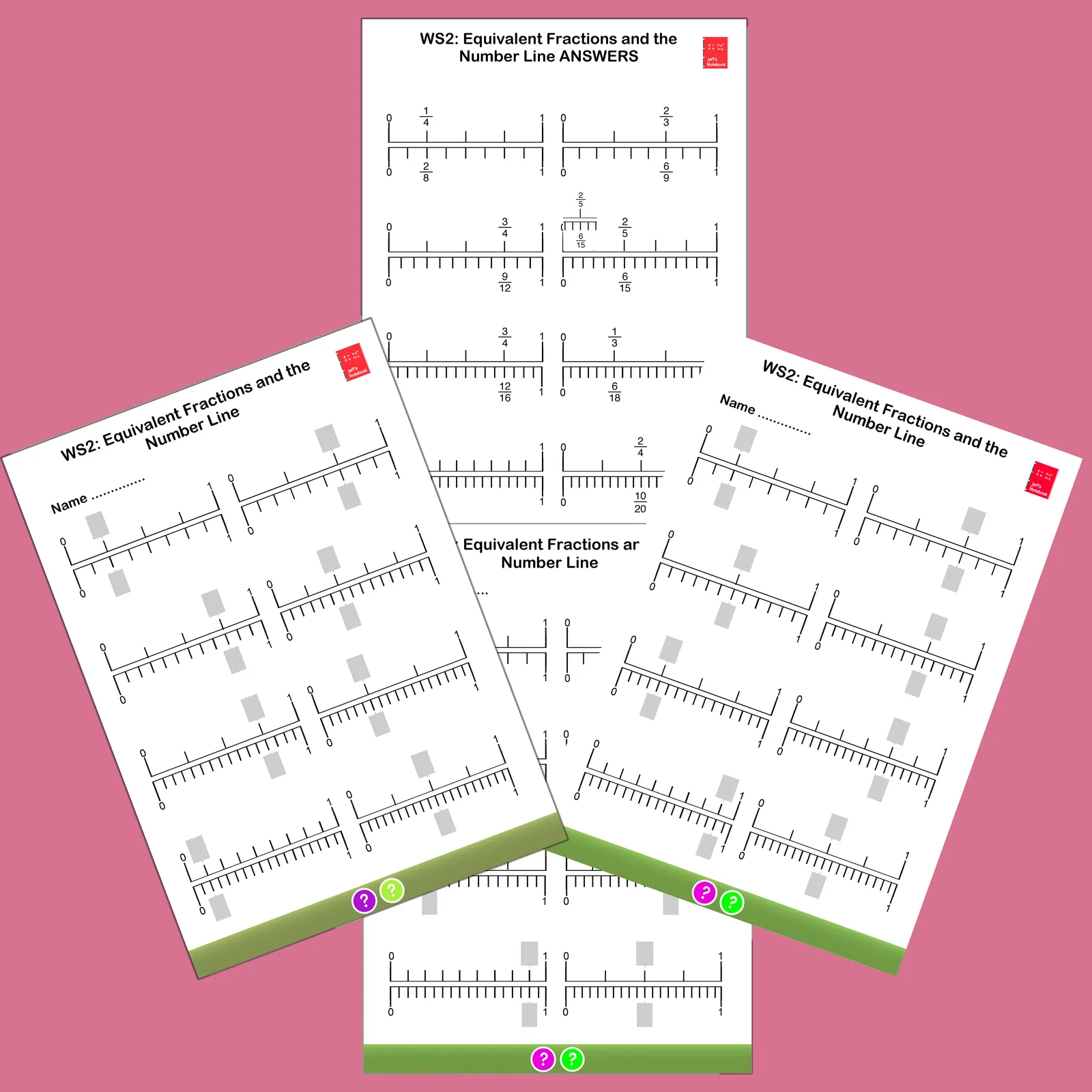
Fractions that have the same value, called Equivalent Fractions, can be found at the same point on the number line and is an ideal visual introduction into this topic.
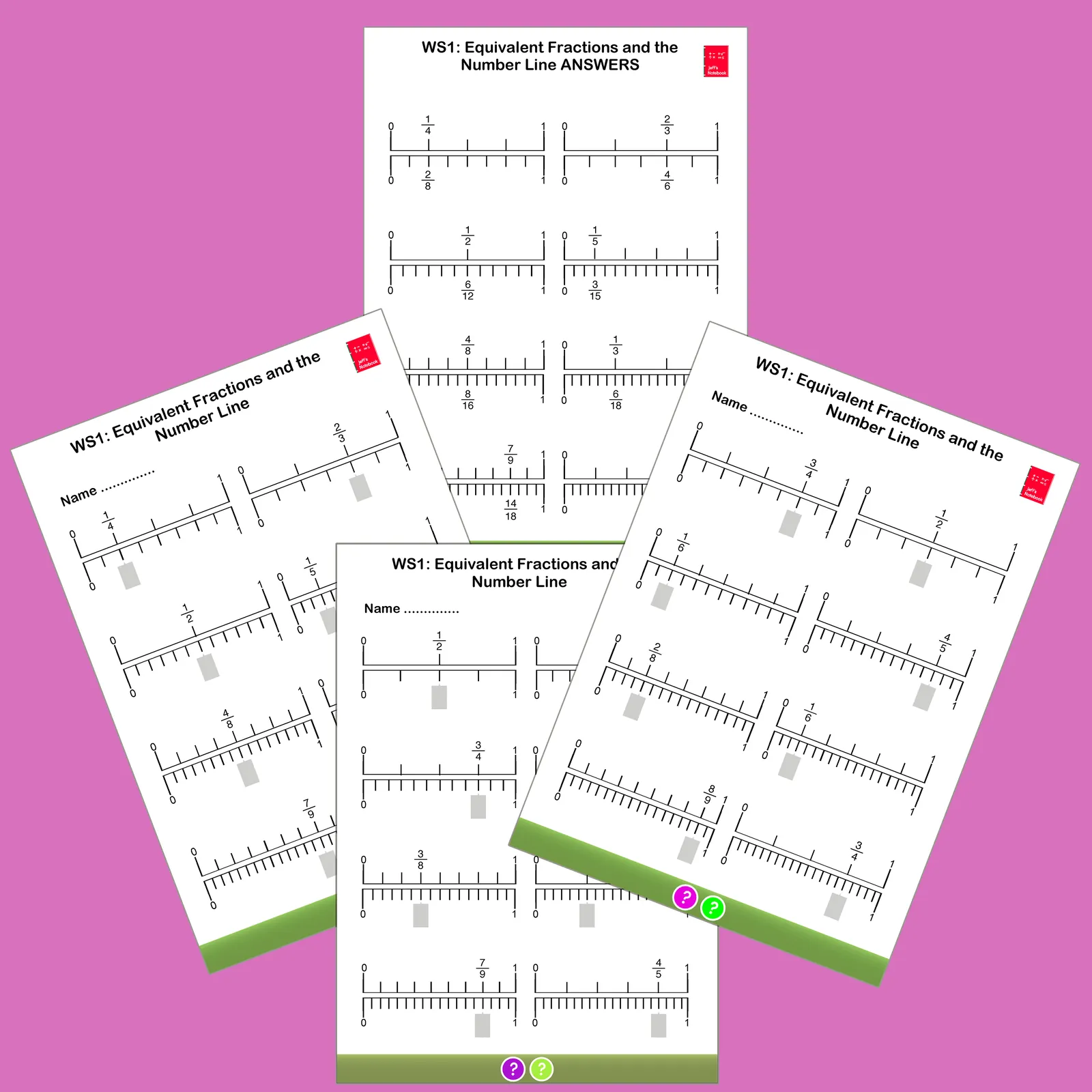
These printable Worksheets consist of questions containing 2 number lines between 0 and 1. Each number line is divided into a different number of equal parts which students then have to compare and determine the numerical value of the fraction or fractions.
Worksheet Set 1: One fraction is shown. Students write down the equivalent fraction to the one shown taking into account the number of equal parts on the line.
Worksheet Set 2: Two equivalent fractions are indicated on a number line. Students have to write down the numerical value of each fraction taking into account how each number line has been divided.
How many worksheets are there ?
Lots. At the click of a button all numbers are randomised, allowing you to create as many different worksheets as your students need for classwork, homework, revision, preparing for assessment, fillers etc., and the numbers will change every time.
Answers are on the second page of every worksheet, automatically generated when you create a new worksheet.
Note
These resources are PDF documents and work with the official Adobe Acrobat Reader on Windows or Mac computers with the randomising buttons also working via a touchscreen (PC or Mac)or on an Interactive Whiteboard.
Common Core Standards
CCSS3.NF.A.2
Understand a fraction as a number on the number line; represent fractions on a number line diagram.
CCSS3.NF.A.2a
Represent a fraction 1/𝘣 on a number line diagram by defining the interval from 0 to 1 as the whole and partitioning it into 𝘣 equal parts. Recognize that each part has size 1/𝘣 and that the endpoint of the part based at 0 locates the number 1/𝘣 on the number line.
CCSS3.NF.A.2b
Represent a fraction 𝘢/𝘣 on a number line diagram by marking off 𝘢 lengths 1/𝘣 from 0. Recognize that the resulting interval has size 𝘢/𝘣 and that its endpoint locates the number 𝘢/𝘣 on the number line.
CCSS3.NF.A.3a
Understand two fractions as equivalent (equal) if they are the same size, or the same point on a number line.
You may also like:
Equivalent Fractions using Rectangles - a visual approach - Worksheets +
Equivalent Fractions - Numerical method with multipliers and divisors
Related resources
More resources teachers may find useful
24 related resources were found using this product's title, contributor, categories and tags.


In the classroom
Teaching tips & learning objectives

Learning objectives
Mark the point on a number line that represents a fraction equivalent to one already shown, on a line divided into a different number of equal parts
Recognize that two fractions with different denominators can represent the same point on a number line
Write two equivalent fractions read from a pair of parallel number lines, each divided into a different number of equal parts

Teaching tips
Use the button feature described in the guide to generate a new randomized set of questions each time a fresh worksheet is needed
Print the included answers page alongside the worksheet to check completed work
Choose between the two worksheet formats described in the guide -- completing one line to match a given fraction, or reading two equivalent fractions from parallel lines -- to vary how equivalence is practiced. Check individual fraction positions with this fractions on a number line worksheet.

Skills covered
Equivalent-fraction identification -- pupils locate a fraction's matching point on a second number line split into a different number of equal parts.
Number-line partitioning -- pupils read a whole divided into differing denominators (for example thirds versus sixths) to place a fraction correctly.
Fraction-pair comparison -- in the second worksheet format, pupils read and record two equivalent fractions from parallel number lines.
Good to know
Questions teachers ask about this resource
How does the worksheet stay different each time it's printed?
An included guide explains that clicking the buttons at the bottom of the worksheet regenerates a new randomized set of equivalent-fraction questions.

No reviews yet
Downloaded this resource? Tell other teachers how it went.
Curriculum
Standards, concepts & topics
Standards
 Standards
- 3. NF.A.2 — Understand a fraction as a number on the number line; represent fractions on a number line diagram. a. Represent a fraction 1/b on a number line diagram by defining the interval from 0 to 1 as the whole and partitioning it into b equal parts. Recognize that each part has size 1/b and that the endpoint of the part based at 0 locates the number 1/b on the number line. b. Represent a fraction a/b on a number line diagram by marking off a lengths 1/b from 0. Recognize that the resulting interval has size a/b and that its endpoint locates the number a/b on the number line.
- 3. NF.A.3 — Explain equivalence of fractions in special cases, and compare fractions by reasoning about their size. a. Understand two fractions as equivalent (equal) if they are the same size, or the same point on a number line. b. Recognize and generate simple equivalent fractions, e.g., 1/2 = 2/4, 4/6 = 2/3). Explain why the fractions are equivalent, e.g., by using a visual fraction model. c. Express whole numbers as fractions, and recognize fractions that are equivalent to whole numbers. Examples: Express 3 in the form 3 = 3/1; recognize that 6/1 = 6; locate 4/4 and 1 at the same point of a number line diagram. d. Compare two fractions with the same numerator or the same denominator by reasoning about their size. Recognize that comparisons are valid only when the two fractions refer to the same whole. Record the results of comparisons with the symbols >, =, or <, and justify the conclusions, e.g., by using a visual fraction model.
Core concepts
 Core concepts
equivalent fractions
number lines
fraction denominators
Topics
 Topics
Explore more
Categories this resource belongs to
Explore related searches
More to explore
You may also like