Detective Worksheets For Kids


- Grades
- Grades 4–5, Elementary
- File type
- Preparation
- Print ready


- Subject
- Life Studies, Special Resources, Life Skills
- Topic
- detective, activities
- Resource types
- Workbooks, Worksheets & Printables, Activities
- Preparation
- Print ready
About this resource
What's inside this resource
Product description
From the author
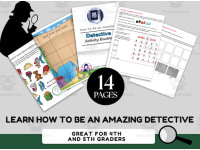
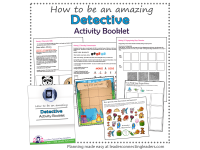
In this booklet learn about what a detective does every day as part of their job. These activities include practicing using observation, doing detective science, decoding communication, and learning more about fingerprints.
Are you a girl scout leader?
This activity booklet was designed to fulfill the requirements for the Junior Detective badge or can be used by frontier girl leaders to earn similar badges. Great for teachers and home schooled kids as well.
Related resources
More resources teachers may find useful
24 related resources were found using this product's title, contributor, categories and tags.



In the classroom
Teaching tips & learning objectives

Learning objectives
Practice observation and eyewitness-description skills through a partner sketch exercise and a timed memory challenge.
Encode a secret message using the Morse code alphabet as part of a bracelet-making craft.
Classify a set of fingerprints by pattern type (arch, loop, or whirl).

Teaching tips
Cut out the observation-activity images from each girl's packet before the meeting, as Activity 1's instructions specify, so partners can't see each other's picture in advance.
For Activity 4, have a leader who will stay the whole meeting secretly write the mystery note in advance, then gather writing samples from every adult present so girls have real candidates to compare against.
For the ink-chromatography step in Activity 4, use at least three different pens (including the one that wrote the mystery note) so the comparison is meaningful — cut coffee filter or paper towel strips about 1 inch wide and dip only the tip in water.

Skills covered
Observation and descriptive recall — a paired composite-sketch activity and a timed memory challenge build eyewitness-style observation skills.
Encoding and decoding — the Morse code bracelet craft has students translate a message into a physical code.
Pattern classification — students sort their own fingerprints into arch, loop, and whirl categories.
Good to know
Questions teachers ask about this resource
How does the fingerprinting activity have girls classify their own prints?
After inking and stamping each finger into provided boxes, girls determine whether each print is an arch, a loop, or a whirl and label it accordingly.
What method does Activity 4 use to figure out which pen wrote the mystery note?
An ink-chromatography experiment: strips of coffee filter or paper towel are dipped in water below dots from each candidate pen (including the note itself), and the resulting ink patterns are compared to identify a match.

No reviews yet
Downloaded this resource? Tell other teachers how it went.
Resource details
Concepts & topics
Core concepts
 Core concepts
Observation skills
Morse code
Fingerprint classification
Forensic science basics
Team problem-solving
 Topics
Explore more
Categories this resource belongs to
Explore related searches
More to explore
You may also like