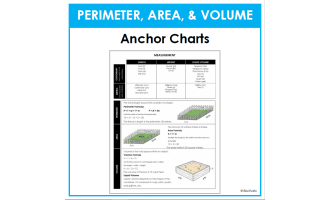
Finding Area & Perimeter of Rectangles Set


- Grades
- Grade 3, Elementary
- Pages
- 17
- File type
- Answer key
- Included


- Subject
- Math, Geometry, Measurements
- Topic
- math, area
- Resource types
- Worksheets & Printables, Worksheets
- Answer key
- Included
About this resource
What's inside this resource
This collection offers a diverse range of worksheets on area and perimeter of rectangles. The worksheets are organized into sets, each dedicated to a specific approach or level of difficulty.
The introductory set, "Area 1," requires the students count individual squares ... essentially the simplest way to find the area. As the work progresses, they'll encounter the use of formulas, both with and without the visual support of rectangles divided into squares.
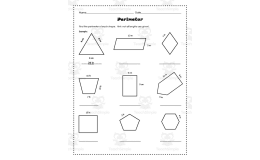
The "Perimeter" set starts with simple addition and gradually introduces the application of formulas, both with and without the visual support of the rectangles divided into squares.
The "Challenge Set" brings together the students knowledge requires students to synthesize their knowledge of area and perimeter, as well as the inverse relationship between multiplication and division, to solve multi-step problems.
Worksheet Sets
Area 1 - Beginning with just counting squares
Area 2 - Using the formula width x length with squares visible - a choice of unit length, in or cm
Area 3 - Extending Area 2 with larger rectangles - squares visible -
Area 4 - Using the formula of length x width with dimensions given - a choice of metric (mm, cm & m) or US customary units (in, ft or yd)
Area 5 - 2 rectangles simply connected with a common width apply the formula total area = width x length1 + width x length2 - squares visible
Area 6 - 2 rectangles simply connected with a common width - apply the formula total area = width (length1 + length2) - squares visible - unit length, in or cm
Area 7 - 2 rectangles simply connected with a common side - squares not visible - dimensions of the sides given.
Perimeter 1 - Find the perimeter by adding all the sides together - squares visible. a choice of unit lengths, inches or centimeters
Perimeter 2 - Use the formula 2 x width + 2 x length - squares visible - unit length, in or cm
Perimeter 3 - Use the formula 2(width + length) - Squares visible - unit length, in or cm
Perimeter 4 - Dimensions given, squares not visible - dimensions given - choose metric or United States customary units
2 Step problems - Either the perimeter or area is given plus the length of one side. Given these clues student must find the length of the unknown side then from this the unknown area or perimeter choose metric or US customary units
How many worksheets are in each set ?
Lots and lots. At the click of a button all numbers are randomised, so the questions change every time. This will allow you to create as many new worksheets you will need for practice throughout the year (classwork, homework, revision, fillers etc) or even give small groups of students in your class different sets of questions either at the same level or differentiated .
There will certainly be enough to ensure fluency in this topic.
You could also use any of the worksheets to explain or introduce the subject to your class as you will have almost unlimited examples to work with and they will be different from the actual worksheets you hand out to your students.
As these worksheets need little explanation and no preparation, they are ideal if you need to leave work for a substitute teacher.
Answers found on the second page of every worksheet are automatically generated when you create a new worksheet.
These printables require no preparation on your part. With answers automatically generated every time you can create a new worksheet it makes them ideal for substitute teachers on short notice.
Lastly, it's essential to note that these resources are compatible PDF documents. They operate seamlessly with the official Adobe Acrobat Reader on both Windows and Mac.
Related resources
More resources teachers may find useful
24 related resources were found using this product's title, contributor, categories and tags.



In the classroom
Teaching tips & learning objectives

Learning objectives
Find the area of a rectangle by counting the unit squares inside it and record the result in square units
Apply length x width to rectangles with and without a visible grid, in unit lengths, metric or US customary measures
Find the total area of two joined rectangles both as a x b + a x c and as a(b + c), and show the two give the same answer

Teaching tips
The guide's Area 2 notes suggest having students check a formula answer by counting squares as in Area 1, then comparing which method is quicker — a discussion the two sets are built to support
A button at the foot of each worksheet page re-randomises the questions, so one set covers classwork, homework and revision without any of the sheets matching
From Area 2 onward the pages carry three buttons — unit lengths, US customary or metric — which lets a class work in its own measurement system without a different file. Use this area on a grid worksheet when students need more practice counting square units.

Skills covered
Counting unit squares — the opening set prints twelve grid rectangles with a "....... Square Units" line under each, answered from 4 up to 42 square units.
Applying the area formula — Area 2 to Area 4 have students record Length, Width, Length x Width and Area line by line, for example Length = 5 cm, Width = 4 cm, 5 x 4 = 20, Area = 20 square cm.
Decomposing a compound shape and using the distributive property — Areas 5, 6 and 7 join two rectangles on a shared width and ask for the total first as two products added and then as one multiplication over a sum, so a x b + a x c and a(b + c) are shown to agree.
Good to know
Questions teachers ask about this resource
Can the same set be printed more than once with different numbers?
Yes. The guide directs you to click the button at the bottom of the page to randomize the questions, so that "no two worksheets will look exactly alike" — one set then covers classwork, homework and revision.
Which measurement systems can students work in?
From Area Set 2 onward the pages carry three buttons — unit lengths, United States customary units or metric. Area 4 and Perimeter 4 additionally come as two separate files, one mixing mm, cm and m and the other mixing inches, feet and yards.
How do the three two-rectangle sets differ from each other?
Area 5 asks for the total as width x length1 + width x length2; Area 6 asks for the same shape as width (length1 + length2); Area 7 removes the square grids so only the side lengths remain. The guide suggests working one shape both ways to show the two expressions agree.

No reviews yet
Downloaded this resource? Tell other teachers how it went.
Curriculum
Standards, concepts & topics
Standards
 Standards
- 3. MD.C.5 — Recognize area as an attribute of plane figures and understand concepts of area measurement. a. A square with side length 1 unit, called “a unit square,” is said to have “one square unit” of area, and can be used to measure area. b. A plane figure which can be covered without gaps or overlaps by n unit squares is said to have an area of n square units.
- 3. MD.C.6 — Measure areas by counting unit squares (square cm, square m, square in, square ft, and improvised units).
- 3. MD.C.7 — Relate area to the operations of multiplication and addition. a. Find the area of a rectangle with whole-number side lengths by tiling it, and show that the area is the same as would be found by multiplying the side lengths. b. Multiply side lengths to find areas of rectangles with whole-number side lengths in the context of solving real world and mathematical problems, and represent whole-number products as rectangular areas in mathematical reasoning. c. Use tiling to show in a concrete case that the area of a rectangle with wholenumber side lengths a and b + c is the sum of a × b and a × c. Use area models to represent the distributive property in mathematical reasoning. d. Recognize area as additive. Find areas of rectilinear figures by decomposing them into non-overlapping rectangles and adding the areas of the nonoverlapping parts, applying this technique to solve real world problems.
Core concepts
 Core concepts
Area
Perimeter
Area formula
Distributive property
Units of measurement
 Topics
Explore more
Categories this resource belongs to
Explore related searches
More to explore
You may also like