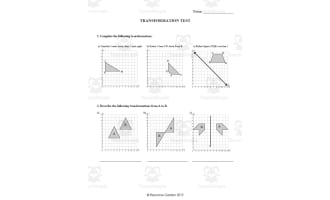
Transformation Geometry Project with Answer Key

- Grades
- Grades 7–8, Middle School
- Pages
- 8
- File type
- Answer key
- Included


- Subject
- Math, Geometry, Graphing
- Topic
- geometry project, graphing
- Resource types
- Activities, Projects
- Answer key
- Included
About this resource
What's inside this resource
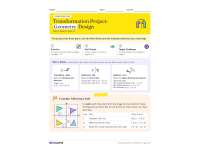
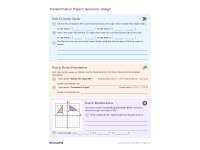
Give grade 8 students a transformation geometry project that moves from practice to problem solving. A Move Rules card on the first page shows each move with a diagram and its coordinate rule: translations by distance and direction, reflections across the x- or y-axis, and rotations of 90° or 180° about the origin. A worked example tracks one vertex of a flag through a three-step path.
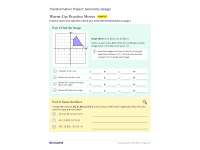
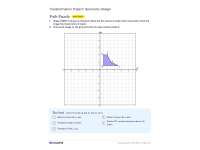
Two warm-up pages build fluency. Students find the image of a shape after four different moves, name a move from its coordinates, test whether the order of two moves matters, repair incomplete descriptions and explain the error in Kai's rotation. In the Path Puzzle, they carry shape PQRST through five moves on a −10 to 10 coordinate plane, record every vertex, find a single move that matches two steps, and list the moves that undo the path. The Target Challenge asks for two different paths that land the shape exactly on a dashed target.
- Six student pages: 22 numbered items, five path images to plot and a four-point Quick Self-Check
- Answer key and teacher notes: two pages with every answer, key grids, a teacher checklist and a list of likely mistakes
- Color and grayscale files: print the sheets in whichever style suits your printer
Related resources
More resources teachers may find useful
24 related resources were found using this product's title, contributor, categories and tags.


In the classroom
Teaching tips & learning objectives

Learning objectives
Apply coordinate rules for translations, reflections across an axis and rotations about the origin
Describe a transformation precisely by naming the distance and direction, the mirror line, or the angle, direction and center
Show that changing the order of two moves can change where a point lands

Teaching tips
Point students back to the Move Rules card and worked example on page 1 when they get stuck, as the directions suggest
Check the warm-up answers with the key before the Path Puzzle so a rule mistake does not carry through all five steps
Offer tracing paper for checking rotations, following the teacher tip on the key

Skills covered
Applying coordinate rules: students find the image vertices of shape JKLM after a translation, a reflection and two rotations.
Precise description: students name moves from coordinates and repair vague descriptions such as "Rotate the shape 90°."
Error analysis: students explain how Kai turned his triangle the wrong way and give the correct vertices.
Good to know
Questions teachers ask about this resource
Where do students make their own choices in this project?
In the Target Challenge, students choose their own moves to carry shape PQRST onto a dashed target and must find two different paths. The shape and the five-move Path Puzzle are supplied, so every image can be checked against the key grid.
Which rotations and reflections are used?
Rotations of 90° clockwise, 90° counterclockwise and 180° about the origin, plus reflections across the x-axis and the y-axis. Translations move left or right and up or down by whole units.
Why does the warm-up ask students to switch the order of two moves?
Combo Check sends point P(4, 2) through a rotation and a translation, then reverses the order. P lands in two different places, which shows students why a path must be followed in the order given.

No reviews yet
Downloaded this resource? Tell other teachers how it went.
Curriculum
Standards, concepts & topics
Standards
 Standards
- 8.G.A.3 — Describe the effect of dilations, translations, rotations, and reflections on twodimensional figures using coordinates.
- 8.G.A.2 — Understand that a two-dimensional figure is congruent to another if the second can be obtained from the first by a sequence of rotations, reflections, and translations; given two congruent figures, describe a sequence that exhibits the congruence between them.
Core concepts
 Core concepts
transformations
translation
reflection
rotation
coordinate plane
sequences of transformations
 Topics
Explore more
Categories this resource belongs to
Explore related searches
More to explore
You may also like